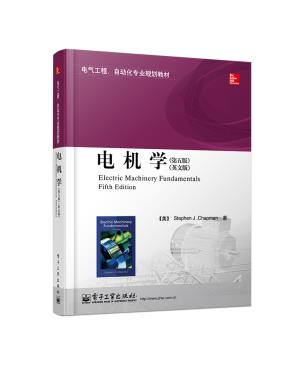
电机学(第五版)(英文版)"
本书是关于电机学的经典教材。全书内容涉及电机原理、变压器、交流电机、同步发电机、同步电动机、感应电动机、直流电机、直流电动机和发电机、单相及特种电动机等,附录内容包括三相电路、线圈节距及分布绕组、同步电机的凸极理论、常数及转换系数表。全书叙述清晰,图文并茂,例题、习题丰富,并结合MATLAB进行了大量的仿真分析。
ABOUT THE AUTHOR Stephen J. Chapman received a B.S. in Electrical Engineering from Louisiana State University (1975) and an M.S.E. in Electrical Engineering from the University of Central Florida (1979), and pursued further graduate studies at Rice University. From 1975 to 1980, he served as an officer in the U.S. Navy, assigned to teach electrical engineering at the U.S. Naval Nuclear Power School in Orlando, Florida. From 1980 to 1982, he was affiliated with the University of Houston, where he ran the power systems program in the College of Technology. From 1982 to 1988 and from 1991 to 1995, he served as a member of the technical staff of the Massachusetts Institute of Technology’s Lincoln Laboratory, both at the main facility in Lexington, Massachusetts, and at the field site on Kwajalein Atoll in the Republic of the Marshall Islands. While there, he did research in radar signal processing systems. He ultimately became the leader of four large operational range instrumentation radars at the Kwajalein field site (TRADEX, ALTAIR, ALCOR, and MMW). From 1988 to 1991, Mr. Chapman was a research engineer for Shell Development Company in Houston, Texas, where he did seismic signal processing research. He was also affiliated with the University of Houston, where he continued to teach on a part-time basis. Mr. Chapman is currently manager of systems modeling and operational analysis for BAE Systems Australia, in Melbourne. Mr. Chapman is a senior member of the Institute of Electrical and Electronic Engineers (and several of its component societies). He is also a member of Engineers Australia. 前 言 自从本书第一版出版以来的这些年间,更大功率和更加完善的电机固态驱动装置的研发有了迅猛的进展。本书的第一版中曾经论述到,直流电动机在需要调速的应用场合是首选方法。这一表述现今已不再准确。当今,速度控制应用场合最常选用的是带有电动机固态驱动器的感应电动机系统。直流电动机已主要限定在已有可用直流电源的特殊应用场合,例如汽车电气系统等。 本书的第三版已对内容做了大幅度的重新组织,以便反映出这些变化。有关交流电动机和发电机的内容现在涵盖在第3章到第6章,先于有关直流电机的内容出现。此外,与早前版本相比,缩减了有关直流电机的篇幅。本版仍延续了这一相同的基本架构。 另外,第五版中删除了以前的第3章中关于固态电子学的内容。来自于本书使用者的反馈意见表明,这些内容对意欲快速了解者来说太过详细,但对固态电子学课程来说又不够详尽。由于很少有教师采用这些材料,所以已将其从这一版中删除了,但作为补充材料添加到了本书的网站上。继续使用该章中材料的教师或学生,可以免费下载。 在每章的开头增加了学习目标,以促进学生学习。 第1章是关于电机基本概念的介绍,并将这些概念应用到一个直线直流电机,这可能是最简单的电机的例子。第2章涵盖了变压器的内容,其不是旋转电机,但享有很多类似的分析方法。 从第2章以后,教师可以选择先讲授直流电机,或者先讲授交流电机。第3章到第6章涵盖了交流电机的内容,第7章和第8章涵盖了直流电机的内容。各章编排完全独立,以便教师可以按照最适合其需要的次序讲授。例如,重点在于交流电机的一学期课程,可以选择第1章至第6章,剩余时间用在直流电机上。重点在于直流电机的一学期课程,可以选择第1章、第2章、第7章和第8章,其他剩余时间用在交流电机上。第9章为单相和特种电动机,包括通用电动机、步进电动机、无刷直流电动机和罩极电动机。 修订并修正了习题和各章的结尾部分,在上一版的基础上,有超过70%的习题为新的或者修改过的。 最近几年,在教授电气工程和电气技术学生所采用的方法上有了很大的变化。像MATLAB这类卓越的分析工具已广泛应用于大学工程类课程的教学。这些工具使非常繁杂的计算变得简单易行,也使得学生可以交互式地探索问题的特征。 本教材不教授MATLAB ,认为学生通过以前的学习已经熟悉了其使用方法。同时,本书也不依赖于学生是否有MATLAB软件。如果有MATLAB可以使用,则可以充实学习经历。但如果没有MATLAB可用,则只需要跳过涉及MATLAB的例题,本教材其余部分的安排仍然是合理的。 在过去的25年,如果没有许多人的帮助,要完成这本书简直是不可能的。我非常欣喜地看到,过去了这么些年,这本书仍然颇受欢迎,很大程度上是由于审阅者提供的极好反馈意见。就本版来说,我要特别感谢: Ashoka K.S. Bhat,University of Victoria William Butuk,Lakehead University Shaahin Filizadeh,University of Manitoba Jesús Fraile-Ardanuy,Universidad Politécnica de Madrid Riadh Habash,University of Ottawa Floyd Henderson,Michigan Technological University Rajesh Kavasseri,North Dakota State University Ali Keyhani,The Ohio State University Andrew Knight,University of Alberta Xiaomin Kou,University of Wisconsin–Platteville Ahmad Nafisi,California Polytechnic State University, San Luis Obispo Subhasis Nandi,University of Victoria M. Hashem Nehrir,Montana State University–Bozeman Ali Shaban,California Polytechnic State University, San Luis Obispo Kuang Sheng,Rutgers University Barna Szabados,McMaster University Tristan J. Tayag,Texas Christian University Rajiv K. Varma,The University of Western Ontario Stephen J. Chapman,Melbourne, Victoria, Australia I n the years since the first edition of Electric Machinery Fundamentals was published, there has been rapid advance in the development of larger and more sophisticated solid-state motor drive packages. The first edition of this book stated that dc motors were the method of choice for demanding variable-speed applications. That statement is no longer true today. Now, the system of choice for speed control applications is most often an ac induction motor with a solid-state motor drive. DC motors have been largely relegated to special-purpose applications where a dc power source is readily available, such as in automotive electrical systems. The third edition of the book was extensively restructured to reflect these changes. The material on ac motors and generators is now covered in Chapters 3 through 6, before the material on dc machines. In addition, the dc machinery coverage was reduced compared to earlier editions. This edition continues with this same basic structure. In addition, the former Chapter 3 on solid-state electronics has been deleted from the fifth edition. Feedback from users has indicated that that material was too detailed for a quick overview, and not detailed enough for a solid-state electronics course. Since very few instructors were using this material, it has been removed from this edition and added as a supplement on the book’s website. Any instructor or student wishing to continue using the material in this chapter can freely download it. Learning objectives have been added to the beginning of each chapter toenhance student learning. Chapter 1 provides an introduction to basic machinery concepts, and concludes by applying those concepts to a linear dc machine, which is the simplest possible example of a machine. Chapter 2 covers transformers, which are not rotating machines, but which share many similar analysis techniques. After Chapter 2, an instructor may choose to teach either dc or ac machinery first. Chapters 3 through 6 cover ac machinery, and Chapters 7 and 8 cover dc machinery. These chapter sequences have been made completely independent of each other, so that an instructor can cover the material in the order which best suits his or her needs. For example, a one-semester course with a primary concentration in ac machinery might consist of parts of Chapters 1, 2, 3, 4, 5, and 6, with any remaining time devoted to dc machinery. A one-semester course with a primary concentration in dc machinery might consist of parts of Chapters 1, 2, 7, and 8, with any remaining time devoted to ac machinery. Chapter 9 is devoted to single-phase and special-purpose motors, such as universal motors, stepper motors, brushless dc motors, and shaded-pole motors. The homework problems and the ends of chapters have been revised and corrected, and more than 70% of the problems are either new or modified since the last edition. In recent years, there have been major changes in the methods used to teach machinery to electrical engineering and electrical technology students. Excellent analytical tools such as MATLAB® have become widely available in university engineering curricula. These tools make very complex calculations simple to perform, and they allow students to explore the behavior of problems interactively. This edition of Electric Machinery Fundamentals makes selected use of MATLAB to enhance a student’s learning experience where appropriate. For example, students use MATLAB in Chapter 6 to calculate the torque–speed characteristics of induction motors, and to explore the properties of double-cage induction motors. This text does not teach MATLAB; it assumes that the student is familiar with it through previous work. Also, the book does not depend on a student having MATLAB. MATLAB provides an enhancement to the learning experience if it is available, but if it is not, the examples involving MATLAB can simply be skipped, and the remainder of the text still makes sense. This book would never have been possible without the help of dozens of people over the past 25 years. It is gratifying for me to see the book still popular after all that time, and much of that is due to the excellent feedback provided by reviewers. For this edition, I would especially like to thank: Ashoka K.S. Bhat University of Victoria William Butuk Lakehead University Shaahin Filizadeh University of Manitoba Jesús Fraile-Ardanuy Universidad Politécnica de Madrid Riadh Habash University of Ottawa Floyd Henderson Michigan Technological University Rajesh Kavasseri North Dakota State University Ali Keyhani The Ohio State University Andrew Knight University of Alberta Xiaomin Kou University of Wisconsin–Platteville Ahmad Nafisi California Polytechnic State University, San Luis Obispo Subhasis Nandi University of Victoria M. Hashem Nehrir Montana State University–Bozeman Ali Shaban California Polytechnic State University, San Luis Obispo Kuang Sheng Rutgers University Barna Szabados McMaster University Tristan J. Tayag Texas Christian University Rajiv K. Varma The University of Western Ontario Stephen J. Chapman Melbourne, Victoria, Australia


TABLE OF CONTENTS Chapter 1 Introduction to Machinery Principles 1 1.1 Electrical Machines, Transformers, and Daily Life 1 1.2 A Note on Units and Notation 2 1.3 Rotational Motion, Newton’s Law, and Power Relationships 3 1.4 The Magnetic Field 7 1.5 Faraday’s Law—Induced Voltage from a Time-Changing Magnetic Field 22 1.6 Production of Induced Force on a Wire 25 1.7 Induced Voltage on a Conductor Moving in a Magnetic Field 26 1.8 The Linear DC Machine—A Simple Example 27 1.9 Real, Reactive, and Apparent Power in Single-phase AC Circuits 36 1.10 Summary 41 Questions 42 Problems 42 References 49 Chapter 2 Transformers 50 2.1 Why Transformers are Important to Modern Life 51 2.2 Types and Construction of Transformers 52 2.3 The Ideal Transformer 53 2.4 Theory of Operation of Real Single-Phase Transformers 59 2.5 The Equivalent Circuit of a Transformer 67 2.6 The Per-Unit System of Measurements 74 2.7 Transformer Voltage Regulation and Efficiency 79 2.8 Transformer Taps and Voltage Regulation 86 2.9 The Autotransformer 87 2.10 Three-Phase Transformers 92 2.11 Three-Phase Transformation Using Two Transformers 100 2.12 Transformer Ratings and Related Problems 107 2.13 Instrument Transformers 113 2.14 Summary 114 Questions 115 Problems 116 References 122 Chapter 3 Ac Machinery Fundamentals 123 3.1 A Simple Loop in a Uniform Magnetic Field 124 3.2 The Rotating Magnetic Field 129 3.3 Magnetomotive Force and Flux Distribution on AC Machines 136 3.4 Induced Voltage in AC Machines 138 3.5 Induced Torque in an AC Machine 143 3.6 Winding Insulation in an AC Machine 145 3.7 AC Machine Power Flows and Losses 146 3.8 Voltage Regulation and Speed Regulation 148 3.9 Summary 149 Questions 150 Problems 150 References 151 Chapter 4 Synchronous Generators 152 4.1 Synchronous Generator Construction 153 4.2 The Speed of Rotation of a Synchronous Generator 157 4.3 The Internal Generated Voltage of a Synchronous Generator 157 4.4 The Equivalent Circuit of a Synchronous Generator 158 4.5 The Phasor Diagram of a Synchronous Generator 162 4.6 Power and Torque in Synchronous Generators 163 4.7 Measuring Synchronous Generator Model Parameters 166 4.8 The Synchronous Generator Operating Alone 170 4.9 Parallel Operation of AC Generators 179 4.10 Synchronous Generator Transients 193 4.11 Synchronous Generator Ratings 199 4.12 Summary 207 Questions 207 Problems 208 References 215 Chapter 5 Synchronous Motors 216 5.1 Basic Principles of Motor Operation 216 5.2 Steady-State Synchronous Motor Operation 220 5.3 Starting Synchronous Motors 231 5.4 Synchronous Generators and Synchronous Motors 237 5.5 Synchronous Motor Ratings 238 5.6 Summary 238 Questions 239 Problems 240 References 245 Chapter 6 Induction Motors 246 6.1 Induction Motor Construction 247 6.2 Basic Induction Motor Concepts 249 6.3 The Equivalent Circuit of an Induction Motor 253 6.4 Power and Torque in Induction MotorS 258 6.5 Induction Motor Torque–Speed Characteristics 264 6.6 Variations in Induction Motor Torque–speed Characteristics 278 6.7 Trends in Induction Motor Design 285 6.8 Starting Induction Motors 288 6.9 Speed Control of Induction Motors 293 6.10 Solid-State Induction Motor Drives 300 6.11 Determining Circuit Model Parameters 306 6.12 The Induction Generator 313 6.13 induction motor ratings 318 6.14 Summary 319 Questions 320 Problems 321 References 326 Chapter 7 Dc Machinery Fundamentals 328 7.1 A Simple Rotating Loop between Curved Pole Faces 328 7.2 Commutation in a Simple Four-Loop DC Machine 338 7.3 Commutation and Armature Construction in Real DC Machines 342 7.4 Problems with Commutation in Real Machines 351 7.5 The Internal Generated Voltage and Induced Torque Equations of Real DC Machines 361 7.6 The Construction of DC Machines 364 7.7 Power Flow and Losses in DC Machines 369 7.8 Summary 371 Questions 372 Problems 372 References 376 Chapter 8 Dc Motors And Generators 377 8.1 Introduction to DC Motors 378 8.2 The Equivalent Circuit of a DC Motor 379 8.3 The Magnetization Curve of a DC Machine 380 8.4 Separately Excited and Shunt DC Motors 381 8.5 The Permanent-Magnet DC Motor 399 8.6 The Series DC Motor 401 8.7 The Compounded DC Motor 406 8.8 DC Motor Starters 410 8.9 The Ward-Leonard System and Solid-State Speed Controllers 418 8.10 DC Motor Efficiency Calculations 425 8.11 Introduction to DC Generators 427 8.12 The Separately Excited Generator 428 8.13 The Shunt DC Generator 434 8.14 The Series DC Generator 438 8.15 The Cumulatively Compounded DC Generator 439 8.16 The Differentially Compounded DC Generator 444 8.17 Summary 446 Questions 447 Problems 447 References 457 Chapter 9 Single-Phase and Special-Purpose Motors 458 9.1 The Universal Motor 459 9.2 Introduction to Single-Phase Induction Motors 461 9.3 Starting Single-Phase Induction Motors 468 9.4 Speed Control of Single-Phase Induction Motors 475 9.5 The Circuit Model of a Single-Phase Induction Motor 476 9.6 Other Types of Motors 482 9.7 Summary 492 Questions 493 Problems 494 References 495 Chapter A Three-Phase Circuits 496 A.1 Generation of Three-Phase Voltages and Currents 496 A.2 Voltages and Currents in a Three-Phase Circuit 499 A.3 Power Relationships in Three-Phase Circuits 502 A.4 Analysis of Balanced Three-Phase Systems 505 A.5 One-Line Diagrams 511 A.6 Using the Power Triangle 511 Questions 514 Problems 514 Reference 516 Chapter B Coil Pitch and Distributed Windings 517 B.1 The Effect of Coil Pitch on AC Machines 517 B.2 Distributed Windings in AC Machines 525 B.3 Summary 532 Questions 533 Problems 533 References 534 Chapter C Salient-Pole Theory of Synchronous Machines 535 C.1 Development of the Equivalent Circuit of a Salient-Pole Synchronous Generator 536 C.2 Torque and Power Equations of a Salient-Pole Machines 540 Problems 542 Chapter D Tables of Constants and Conversion Factors 543