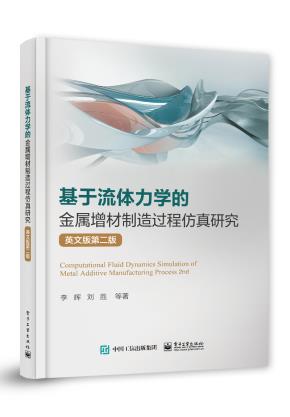
基于流体力学的金属增材制造过程仿真研究(英文版第二版) "
本书针对金属增材制造加工过程进行了系统研究,基于计算流体动力学方法研究金属增材制造工艺过程中的流体问题。第一章为绪论。第二章至第四章研究金属增材制造打印机腔体内部流场及颗粒分布特性,并设计了新颖的流体罩和负压管对打印机腔体内部流场优化以及溅射颗粒清除。第五章至第九章主要研究金属增材制造加工过程中熔池特性,其中第五章研究了金属熔池动力学特性,第六章研究了外加磁场对金属增材制造过程中熔池以及凝固过程的影响,第七章和第八章研究了金属增材制造过程中工件内部单气孔缺陷和多气孔缺陷的演化过程。第九章研究金属增材制造工件激光清洗工艺,以控制工件表面粗糙度。 本次主要修订了技术内容的专业描述,更新了部分结果。
Preface Additive Manufacturing (AM) is a widely used technology for the design and production of high-performance components. The layers designed by the computer are gradually added to construct 3D parts in AM process. This unique process can be used to manufacture complex or customized parts. The fluid problem in the metal additive manufacturing process is investigated based on the Computational Fluid Dynamics (CFD) method. Chapter 1 provides the introduction. Chapters 2 to 4 present the internal flow field and tracks of spatter particles inside the printer and an innovative fluid cover and a negative pressure tube designed to optimize the internal flow field and remove spatter particles, respectively. In chapter 5, the dynamic characteristics of the molten pool is investigated. In chapter 6, the effect of the external magnetic field on the molten pool and the solidification process is studied. In chapter 7 and chapter 8, the evolution processes of single pore defects and multi-pores defects inside the workpiece are discussed respectively. In chapter 9, the laser polishing method is proposed for metal additive manufactured workpieces to control the surface roughness. Professors Hui Li and Sheng Liu contribute to the numerical simulation and experimental method. Professor Sheng Liu revises the script.


Chapter 1 Introduction 1 1.1 Background 2 1.2 Motivation 3 1.3 Outline 4 Chapter 2 Investigation of the flow field in Laser-based Powder Bed Fusion manufacturing 5 2.1 Introduction 7 2.2 Simulation model of the L-PBF printer 10 2.2.1 Problem description 10 2.2.2 Geometric model of the L-PBF printer 11 2.2.3 Numerical model of the L-PBF printer 12 2.3 Simulation results 16 2.3.1 Distribution of the flow field 16 2.3.2 Distribution of the temperature field 21 2.3.3 Distribution of spatter particles 23 2.4 Conclusions 28 References 30 Chapter 3 Investigation of optimizing the flow field with fluid cover in Laser-based Powder Bed Fusion manufacturing process 33 3.1 Introduction 35 3.2 Simulation model of L-PBF printer 37 3.2.1 Geometry of L-PBF printer with a fluid stabilizing cover 37 3.2.2 Numerical model of printer with a fluid stabilizing cover 37 3.2.3 Mesh of L-PBF printer with a fluid stabilizing cover 39 3.2.4 Model of the fluid stabilizing cover and particles 40 3.3 Simulation results and discussion 43 3.3.1 Influence of the fluid stabilizing cover on the flow field 43 3.3.2 Influence of fluid stabilizing cover on particle distribution and removing rate 47 3.4 Summary and conclusions 51 References 53 Chapter 4 Numerical investigation of controlling spatters with negative pressure pipe in Laser-based Powder Bed Fusion process 54 4.1 Introduction 56 4.2 Simulation model of L-PBF printer 59 4.2.1 Geometric model of L-PBF printer 59 4.2.2 Numerical model of L-PBF printer 61 4.3 Simulation results and discussions 64 4.3.1 Effect of pipe diameter 68 4.3.2 Effect of outlet flow rate 70 4.3.3 Effect of initial particle velocity 74 4.4 Summary and conclusions 76 References 78 Chapter 5 Evolution of molten pool during Laser-based Powder Bed Fusion of Ti-6Al-4V 80 5.1 Introduction 82 5.2 Modeling approach and numerical simulation 85 5.2.1 Model establishing and assumptions 85 5.2.2 Governing equations 87 5.2.3 Heat source model 87 5.2.4 Phase change 88 5.2.5 Boundary conditions setup 89 5.2.6 Mesh generation 90 5.3 Experimental procedures 91 5.4 Results and discussions 92 5.4.1 Surface temperature distribution and morphology 92 5.4.2 Formation and solidification of the molten pool 94 5.4.3 Development of the evaporation region 98 5.5 Conclusions 101 References 103 Chapter 6 Simulation of surface deformation control during Laser-based Powder Bed Fusion Al-Si-10Mg powder using an external magnetic field 107 6.1 Introduction 109 6.2 Modeling and simulation 112 6.2.1 Modeling of L-PBF 112 6.2.2 Mesh model and basic assumptions 113 6.2.3 Heat transfer conditions 114 6.2.4 Marangoni convection 115 6.2.5 Phase-change material 115 6.2.6 Lorentz force 116 6.3 Results 118 6.3.1 Velocity field in the molten pool 118 6.3.2 Lorentz force in the MP 121 6.3.3 Surface deformation of the sample 123 6.4 Conclusions 127 References 128 Chapter 7 Influence of laser post- processing on pore evolution of Ti-6Al-4V alloy by Laser-based Powder Bed Fusion 131 7.1 Introduction 133 7.2 Experimental procedures 136 7.2.1 Sample fabrication 136 7.2.2 Determination of porosity by micro-CT 137 7.3 Modeling and simulation 140 7.3.1 Numerical model 140 7.3.2 Moving Gaussian heat source 143 7.3.3 Thermal boundary conditions 143 7.3.4 Marangoni effect, surface tension and recoil pressure 144 7.4 Numerical results and discussion 145 7.5 Conclusions 152 References 153 Chapter 8 Evolution of multi pores in Ti-6Al-4V/Al-Si-10Mg alloy during laser post-processing 157 8.1 Introduction 159 8.2 Experimental procedures 162 8.2.1 Sample preparation 162 8.2.2 Detection of porosity by mirco-CT 162 8.3 Model and simulation 165 8.3.1 Simulation model 165 8.3.2 Gaussian heat source 167 8.3.3 Latent heat of phase change 168 8.3.4 Level-set method 169 8.3.5 Boundary conditions 169 8.4 Numerical results and discussion 171 8.5 Conclusions 177 References 179 Chapter 9 Investigation of laser polishing of four Laser-based Powder Bed Fusion alloy samples 182 9.1 Introduction 184 9.2 Model and theoretical calculation 188 9.2.1 Physical model and assumptions 188 9.2.2 Governing equations and boundary conditions 190 9.2.3 Simulation results 192 9.3 Experimental methods 195 9.3.1 Sample fabrication 195 9.3.2 Morphology observation by 3D optical profiler 198 9.3.3 Experimental results 199 9.4 Conclusions 206 References 208