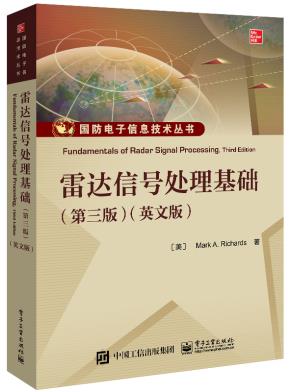
雷达信号处理基础(第三版)(英文版) "
本书作者为国际著名雷达信号处理专家。该书从信号处理的角度出发,系统地介绍了脉冲多普勒体制和调频连续波体制的雷达系统及其信号处理的基本理论和方法,内容包括雷达系统与信号处理概述、信号模型、雷达数据采集、雷达波形、多普勒处理、检测基础原理、测量与目标跟踪技术、合成孔径雷达成像技术、阵列信号处理技术等。本书在第三版更新时补充了大量关于雷达信号处理近期研究成果和当前研究热点的内容,修订了关于基础理论和方法的详尽介绍与严谨论述,提供了大量有助于读者深入探究的示例和MATLAB演示案例。
典范著作:本书是雷达技术领域的一本非常优秀的著作,深入浅出地讲解了雷达信号处理技术的基本概念、基本原理、物理模型与数学表述、工程实现过程、处理性能影响因素和性能评价指标,包含了雷达信号处理涉及的全部核心要素。本书已出版到第三版,基本概念论述简洁清晰,理论推导科学严谨,参考图表仿真准确,作为雷达技术领域的著作堪称典范。 新增内容:鉴于新能源汽车和汽车自动驾驶技术的蓬勃发展,针对近10年来汽车工业对近距连续波雷达技术的亟需,第三版在前版基础上对毫米波雷达内容进行了丰富和扩充。新增内容符合当下车载毫米波雷达信号处理技术发展的趋势,涵盖了当下车载毫米波雷达采用的调频连续波雷达体制、复杂背景条件下的目标恒虚警检测技术、调频连续波雷达波形、宽带雷达波束形成、合成孔径雷达成像的处理技术(距离徙动算法),并且扩充了其他雷达信号处理方法。新增内容主要针对当下车载毫米波雷达发展的大趋势,弥补了第二版主要侧重脉冲体制雷达的信号处理而缺失连续波体制雷达的信号处理的不足,围绕调频连续波雷达信号处理技术这一主题,每一章中都成体系地对其进行了扩充。新增内容特别适合毫米波雷达开发人员和从业人员阅读参考。 读者对象:适合阅读本书的读者的范围较为广泛。一方面,本书特别适合初入雷达技术行业的初学者,在对雷达信号处理技术进行系统深入的阐述、研究和分析之余,还提供了大量有助于读者深入理解的示例和指标分析;另一方面,作者提供了大量的模型仿真和性能指标仿真,并以图表的形式直观地表述,特别适合行业翘楚作为参考书和工具书使用。 Preface This third edition of Fundamentals of Radar Signal Processing (FRSP) shares with the first two editions the goal of providing an in-depth tutorial in the fundamental techniques of radar signal processing. The full spectrum of foundational methods on which virtually all modern radar systems rely is covered, including topics such as target and interference models, matched filtering, waveform design, Doppler processing, threshold detection, and measurement accuracy. Chapters or sections on tracking, adaptive array processing, and synthetic aperture imaging introduce those more advanced techniques and provide a bridge to dedicated texts. The book is written from a digital signal processor’s viewpoint. The techniques and interpretations of linear systems, filtering, sampling, Fourier analysis, and random processes are used throughout to provide a consistent and unified tutorial approach. Students should have a firm foundation in these areas to obtain the most benefit. The mathematical level is appropriate for college seniors and first-year graduate students and is leavened by extensive interpretation. Because this text concentrates on the signal processing, it does not address many other aspects of radar technology such as transmitter and receiver hardware technology or electromagnetic wave propagation. Familiarity with basic radar systems, perhaps from studying one of the books mentioned below, will help prepare the reader to get the most out of this text. This book first came about in 2005 because I could not identify an appropriate textbook for Georgia Tech’s ECE 6272, Fundamentals of Radar Signal Processing, a semester-length first-year graduate course I taught. There existed at that time a number of books on radar systems in general (e.g., Skolnik, Edde) that provided good qualitative and descriptive introductions to radar systems as a whole and could be enthusiastically recommended as first texts for anyone interested in the topic. Indeed, having worked on speech enhancement in graduate school, I read the first edition of Skolnik’s classic Introduction to Radar Systems when I first accepted a job in radar, hoping to avoid appearing completely ignorant on my first day at the new job. (It didn’t work, through no fault of Skolnik.) Some of these texts provided greater quantitative depth on basic radar systems and some signal processing topics. At the same time, a number of good texts were available on advanced topics in radar signal processing, principally synthetic aperture imaging and space-time adaptive processing. The problem, in my view, was the existence of a substantial gap between the systems books and the advanced signal processing books. Specifically, I believed the radar community lacked a current text providing a unified, modern treatment of the basic radar signal processing techniques mentioned above. The closest was probably Levanon’s Radar Principles, which I used for early offerings of ECE 6272, but it was not comprehensive enough. It was my hope that this book would fill that gap, and I believe it has largely been successful in doing so. However, it has now been over 16 years since the first edition was published. While new books continue to appear, particularly the excellent Principles of Modern Radar series, to my surprise none has emerged that covers basic radar signal processing techniques with similar depth and breadth. In the meantime, radar technology and applications have continued to evolve, and rather rapidly. For instance, the last 10 years have seen a tremendous increase in the number of short-range continuous wave (CW) radars fielded, especially in the automotive industry. At the same time, complex new methods such as multi-input, multi-output (MIMO) processing, compressed sensing, artificial intelligence, and “deep learning” have crossed over from other application realms into advanced radar. To continue meeting its goals, this text must also evolve. The second edition (2014) made one major addition, adding the chapter on measurement accuracy and the introduction to tracking, in addition to many more minor updates. This edition likewise has one major change. The first two editions assumed pulsed radar throughout, even though a number of the topics are also applicable to CW systems. In this edition, CW radars are now included explicitly, with an emphasis on “fast-chirp” linear frequency-modulated CW (FMCW) radars, the most common variety in current usage. Although data acquisition for pulsed and FMCW radars is very different, much of the basic processing that follows is essentially the same, a commonality that I have tried to emphasize in this edition. Each chapter has one or two other significant updates and many small ones. Chapter 1 now includes a discussion of virtual antenna elements to set the stage for virtual arrays in Chap. 9. The discussion of Doppler shift in Chap. 2 has been simplified from that in previous editions. Also in Chap. 2, the K distribution has been added to the discussion of PDFs for describing target and clutter fluctuations. The first portion of Chap. 3 has been significantly restructured and expanded to introduce FMCW radar, describing how range profiles are acquired and some of the range ambiguity and blind zone considerations in comparison to the pulsed case. The coherent processing interval is emphasized as a common data structure for both pulsed and FMCW, and so a common starting point for understanding subsequent processing steps. The impact of incorporating FMCW continues in Chap. 4 with a brief discussion of CW waveforms in general before homing in on the fast-chirp linear FMCW variant of most interest. This chapter also now includes more information on mismatched filters for phase-coded waveforms and closes with a new comparison of frequency-modulated and phase-modulated waveforms. Chapter 5 adds an introduction to the keystone transform for combatting range migration and introduces along-track interferometry (ATI) as a complement to DPCA for detecting ground movers in clutter. Chapter 6 has a new example of the effect of spiky interference on detection performance. Also new is the use of binary integration gain as an alternative way to quantify the impact of M-of-N processing. Chapter 7 adds a brief section on the optimum combination of two noisy measurements to improve the motivation and understanding of the prediction-correction structure of most track filters. In Chap. 8, the sequence of SAR image formation algorithms has been extended to include the range migration algorithm, a workhorse in current practice, and a very basic introduction to the important emerging class of backprojection algorithms. Chapter 9 now introduces the idea of virtual arrays (VAs), essential to the understanding of MIMO array systems. While MIMO processing itself is beyond the scope of this text, the discussion of VAs provides a base for its study in more specialized references. Also, both phase and time delay steering of arrays are now discussed and compared explicitly. The two appendices are largely unchanged except for the addition of the K distribution to the PDFs, discussed in App. A. Finally, some additional homework problems have been added to most chapters to improve the book’s usefulness as an academic text. Throughout the text, I once more attempt to do a better job of identifying and bringing out common themes that arise again and again in radar signal processing, if sometimes in disguise. These include phase history, coherent integration, matched filtering, integration and processing gain, and maximum likelihood estimation. A one-semester course in radar signal processing can cover Chaps. 1 through 7, perhaps skipping some of the later sections of Chaps. 2 and 3 for time savings. Such a course provides a solid foundation for more advanced work in detection theory, adaptive array processing, synthetic aperture imaging, and more advanced radar concepts such as passive and bistatic systems. A quarter-length course could cover Chaps. 1 through 5 and the non-CFAR portion of Chap. 6 reasonably thoroughly. In either case, a firm background in basic continuous and discrete signal processing and an introductory exposure to random variables and processes are advisable. (登录华信教育资源网(www.hxedu.com.cn)可注册并免费下载本书附录A、附录B及其他补充资料。采用本书授课的教师,可联系te_service@phei.com.cn获取教学相关资料。——编者注) I have tried in this edition to eliminate all known errors in the second edition, but because there is significant new material, there are likely new errors. I invite readers to help me keep the errata sheet up to date by sending any and all errors they find to me at mrichards@ieee.org. Mark A. Richards, Ph.D. January 2022

CHAPTER 1 Introduction to Radar Systems and Signal Processing 雷达系统与信号处理概述 1.1 History and Applications of Radar 雷达的历史和应用 1.2 Basic Radar Functions 雷达的基本功能 1.3 Elements of a Radar 雷达的基本组成 1.3.1 Radar Frequencies 雷达频率 1.3.2 Radar Waveforms and Transmitters 雷达波形和发射机 1.3.3 Antennas 天线 1.3.4 Virtual Elements and Virtual Arrays 等效阵元和等效阵列 1.3.5 Receivers 接收机 1.4 Common Threads in Radar Signal Processing 雷达信号处理的共同主线 1.4.1 Signal-to-Interference Ratio 信干比 1.4.2 Resolution and Region of Support 分辨率与支撑域 1.4.3 Integration and Phase History Modeling 积累与相位历程建模 1.5 A Preview of Basic Radar Signal Processing 基本雷达信号处理概述 1.5.1 Radar Time Scales 雷达的时间尺度 1.5.2 Phenomenology 现象学 1.5.3 Signal Conditioning and Interference Suppression 信号调节和干扰抑制 1.5.4 Detection 检测 1.5.5 Measurements and Track Filtering 测量与跟踪滤波 1.5.6 Imaging 成像 1.6 Radar Literature 雷达文献 1.6.1 Introductions to Radar Systems and Applications 雷达系统和应用简介 1.6.2 Basic Radar Signal Processing 基本雷达信号处理 1.6.3 Advanced Radar Signal Processing 高级雷达信号处理 1.6.4 Radar Applications 雷达的应用 1.6.5 Current Radar Research 当前的雷达研究 References 参考文献 Problems 习题 CHAPTER 2 Signal Models 信号模型 2.1 Components of a Radar Signal 雷达信号的组成 2.2 Modeling Amplitude 幅度模型 2.2.1 Simple Point Target Radar Range Equation 点目标的雷达距离方程 2.2.2 Distributed Target Forms of the Range Equation 分布式目标的雷达距离方程 2.2.3 Radar Cross Section 雷达截面积 2.2.4 Radar Cross Section for Meteorological Targets 气象目标的雷达截面积 2.2.5 Statistical Description of Radar Cross Section 雷达截面积的统计描述 2.2.6 Target Fluctuation Models 目标起伏模型 2.2.7 Swerling Models Swerling模型 2.2.8 Effect of Target Fluctuations on Doppler Spectrum 目标起伏对多普勒谱的影响 2.3 Modeling Clutter 杂波模型 2.3.1 Behavior of σ0 σ0的性质 2.3.2 Signal-to-Clutter Ratio 信杂比 2.3.3 Temporal and Spatial Correlation of Clutter 杂波的时间和空间相关性 2.3.4 Compound Models of Radar Cross Section 雷达截面积的混合模型 2.4 Noise Model and Signal-to-Noise Ratio 噪声模型和信噪比 2.5 Jamming 干扰 2.6 Electromagnetic Interference 电磁干扰 2.7 Frequency Models: The Doppler Shift 频率模型:多普勒频移 2.7.1 Doppler Shift 多普勒频移 2.7.2 The Stop-and-Hop Approximation and Phase History 停–跳近似和相位历程 2.7.3 Measuring Doppler Shift: Spatial Doppler 多普勒频移的测量:空间多普勒 2.8 Spatial Models 空间模型 2.8.1 Coherent Scattering 相干散射 2.8.2 Variation with Angle 随角度的变化 2.8.3 Variation with Range 随距离的变化 2.8.4 Noncoherent Scattering 非相干积累 2.8.5 Projections 投影 2.8.6 Multipath 多径 2.9 Spectral Model 谱模型 2.10 Summary 总结 References 参考文献 Problems 习题 CHAPTER 3 Radar Data Acquisition and Organization 雷达数据采集与存储结构 3.1 A Signal Processor’s Radar Architecture Model 信号处理器的雷达架构模型 3.2 Measuring a Range Profile 距离像测量 3.2.1 Pulsed Radar Range Profile: One Pulse in Fast Time 脉冲雷达距离像:快时间中的脉冲信号 3.2.2 FMCW Radar Range Profile: One Sweep in Fast Time FMCW雷达距离像:快时间中的扫频信号 3.3 Multiple Range Profiles: Slow Time and the CPI 多距离像:慢时间和相参处理时间 3.4 Multiple Channels: The Datacube 多通道:数据立方 3.5 Dwells 驻留时间 3.6 Sampling the Doppler Spectrum 多普勒频谱采样 3.6.1 The Nyquist Rate in Doppler 多普勒频谱内的奈奎斯特速率 3.6.2 Straddle Loss 跨越损失 3.7 Sampling in the Spatial and Angle Dimensions 空间和角度维采样 3.7.1 Spatial Array Sampling 空间阵列采样 3.7.2 Sampling in Angle 角度采样 3.8 I/Q Imbalance and Digital I/Q I/Q通道不均衡与数字I/Q 3.8.1 I/Q Imbalance and Offset I/Q通道不均衡及其补偿 3.8.2 Correcting I/Q Errors I/Q通道误差校正 3.8.3 Digital I/Q 数字I/Q 3.9 Summary 总结 References 参考文献 Problems 习题 CHAPTER 4 Radar Waveforms 雷达波形 4.1 Introduction 简介 4.2 The Waveform Matched Filter 波形匹配滤波器 4.2.1 The Matched Filter 匹配滤波器 4.2.2 Matched Filter for the Simple Pulse 简单脉冲匹配滤波器 4.2.3 All-Range Coherent Matched Filtering 全距离相参匹配滤波器 4.2.4 Straddle Loss 跨越损失 4.2.5 Range Resolution of the Matched Filter 匹配滤波器的距离分辨率 4.3 Matched Filtering of Moving Targets 动目标的匹配滤波 4.4 The Ambiguity Function 模糊函数 4.4.1 Definition and Properties of the Ambiguity Function 模糊函数的定义和性质 4.4.2 Ambiguity Function of the Simple Pulse 简单脉冲的模糊函数 4.5 The Pulse Burst Waveform 脉冲串波形 4.5.1 Matched Filter for the Pulse Burst Waveform 脉冲串波形的匹配滤波器 4.5.2 Pulse-by-Pulse Processing 逐个脉冲处理 4.5.3 Range Ambiguity 距离模糊 4.5.4 Doppler Response of the Pulse Burst Waveform 脉冲串波形的多普勒响应 4.5.5 Ambiguity Function for the Pulse Burst Waveform 脉冲串波形的模糊函数 4.5.6 The Slow-Time Spectrum and the Periodic Ambiguity Function 慢时间频谱和周期模糊函数 4.6 Frequency-Modulated Pulse Compression Waveforms 调频脉冲压缩波形 4.6.1 Linear Frequency Modulation 线性调频脉冲压缩波形 4.6.2 The Principle of Stationary Phase 驻相原理 4.6.3 Ambiguity Function of the LFM Waveform LFM波形的模糊函数 4.6.4 Range-Doppler Coupling 距离-多普勒耦合 4.6.5 Stretch Processing 展宽处理 4.7 Range Sidelobe Control for FM Waveforms FM波形的距离旁瓣控制 4.7.1 Matched Filter Frequency Response Shaping 匹配滤波器频率响应整形 4.7.2 Matched Filter Impulse Response Shaping 匹配滤波器冲激响应整形 4.7.3 Waveform Spectrum Shaping 波形频谱整形 4.8 Frequency-Coded Waveforms 频率编码波形 4.8.1 The Stepped Frequency Waveform 步进频率波形 4.8.2 The Stepped Chirp Waveform 步进线性调频波形 4.8.3 Costas Frequency Codes Costas频率编码波形 4.9 Phase-Modulated Pulse Compression Waveforms 相位调制脉冲压缩波形 4.9.1 Biphase Codes 二相编码 4.9.2 Polyphase Codes 多相编码 4.9.3 Mismatched Phase Code Filters 失配相位编码滤波器 4.10 Continuous Wave Radar 连续波雷达 4.10.1 Single-Frequency CW 点频连续波 4.10.2 Periodically Modulated CW 周期调制连续波 4.10.3 Linear Frequency-Modulated CW 线性调频连续波 4.10.4 “Fast Chirp” Linear Frequency-Modulated CW 快速线性调频序列连续波 4.10.5 Sidelobe Control in Linear FMCW 线性调频连续波中的旁瓣控制 4.10.6 Other CW Waveforms 其他连续波波形 4.11 Frequency-Modulated versus Phase-Modulated Waveforms 频率调制与相位调制波形 4.12 Summary 总结 References 参考文献 Problems 习题 CHAPTER 5 Doppler Processing 多普勒处理 5.1 Introduction 简介 5.2 Moving Platform Effects on the Doppler Spectrum 运动平台对多普勒谱的影响 5.3 Moving Target Indication 动目标指示 5.3.1 Pulse Cancellers 脉冲对消器 5.3.2 Vector Formulation of the Matched Filter 匹配滤波器的矢量表示 5.3.3 Matched Filters for Clutter Suppression 杂波抑制的匹配滤波器 5.3.4 Blind Speeds and Staggered PRFs 盲速和参差脉冲重复频率 5.3.5 MTI Figures of Merit MTI质量图 5.3.6 Limitations to MTI Performance MTI性能限制 5.4 Pulse Doppler Processing 脉冲多普勒处理 5.4.1 The Discrete-Time Fourier Transform of a Moving Target 动目标的DTFT 5.4.2 Sampling the DTFT: The Discrete Fourier Transform DTFT采样:DFT 5.4.3 The DFT of Noise 噪声的DFT 5.4.4 Pulse Doppler Processing Gain 脉冲多普勒处理增益 5.4.5 Matched Filter and Filterbank Interpretations of Pulse Doppler Processing with the DFT 基于DFT的脉冲多普勒处理的匹配滤波器和滤波器组解释 5.4.6 Fine Doppler Estimation 精细多普勒估计 5.4.7 Modern Spectral Estimation in Pulse Doppler Processing 脉冲多普勒处理的现代谱估计 5.4.8 CPI-to-CPI Stagger and Blind Zone Maps CPI间参差和盲区图 5.5 Pulse Pair Processing 脉冲对处理 5.6 Additional Doppler Processing Issues 其他多普勒处理问题 5.6.1 Range Migration and the Keystone Transform 距离徙动与Keystone变换 5.6.2 Combined MTI and Pulse Doppler Processing MTI和脉冲多普勒级联处理 5.6.3 Transient Effects 暂态影响 5.6.4 PRF Regimes 脉冲重复频率体制 5.6.5 PRF Selection 脉冲重复频率选择 5.6.6 Ambiguity Resolution 模糊解决 5.7 Clutter Mapping 杂波图 5.8 The Moving Target Detector 动目标检测器 5.9 MTI for Moving Platforms: Ground Moving Target Indication 运动平台的MTI:地面动目标检测 5.9.1 Simplified GMTI Clutter and Target Models 地面动目标检测杂波和目标简化模型 5.9.2 DPCA and ATI 相位中心偏移天线和ATI 5.9.3 Clutter Suppression Interferometry 杂波抑制干涉图 5.9.4 Analysis of Adaptive DPCA 自适应DPCA分析 5.10 Summary 总结 References 参考文献 Problems 习题 CHAPTER 6 Detection Fundamentals 检测基础原理 6.1 Introduction 简介 6.2 Radar Detection as Hypothesis Testing 雷达假设检验检测 6.2.1 The Neyman-Pearson Detection Rule 奈曼–皮尔逊检测准则 6.2.2 The Likelihood Ratio Test 似然比检验 6.3 Threshold Detection in Coherent Systems 相干系统中的阈值检测 6.3.1 The Gaussian Case for Coherent Receivers 相干接收机的高斯情况 6.3.2 Unknown Parameters and Threshold Detection 未知参数和阈值检测 6.3.3 Linear and Square Law Detectors 线性检测器和平方律检测器 6.3.4 Other Unknown Parameters 其他未知参数 6.4 Threshold Detection of Radar Signals 雷达信号的阈值检测 6.4.1 Coherent, Noncoherent, and Binary Integration 相干、非相干和二元积累 6.4.2 Nonfluctuating Targets 非起伏目标 6.4.3 Albersheim’s Equation Albersheim方程 6.4.4 Fluctuating Targets 起伏目标 6.4.5 Simplified Equations for PD for Some Swerling Cases 不同Swerling情形下的检测概率简化方程 6.4.6 Shnidman’s Equation Shnidman方程 6.4.7 Detection in Clutter 杂波中检测 6.4.8 Binary Integration 二元积累 6.4.9 Integration Summary 积累总结 6.5 Constant False Alarm Rate Detection 恒虚警率检测 6.5.1 The Effect of Unknown Interference Power on False Alarm Probability 未知干扰对虚警率的影响 6.5.2 Cell-Averaging CFAR 单元平均CFAR 6.5.3 Analysis of Cell-Averaging CFAR 单元平均CFAR分析 6.5.4 CA CFAR Limitations 单元平均CFAR的局限 6.5.5 Extensions to Cell-Averaging CFAR 单元平均CFAR的改进方法 6.5.6 Order Statistic CFAR 有序统计CFAR 6.5.7 Adaptive CFAR 自适应CFAR 6.5.8 CFAR for Two-Parameter PDFs 双参数概率密度函数CFAR 6.5.9 Temporal CFAR 时域CFAR 6.5.10 Distribution-Free CFAR 概率分布无关CFAR 6.6 System-Level Control of False Alarms 虚警率的系统级控制 6.7 Summary 总结 References 参考文献 Problems 习题 CHAPTER 7 Measurements and Introduction to Tracking 测量与跟踪 7.1 Estimators 估计量 7.1.1 Estimator Properties 估计量的性质 7.1.2 The Cramèr-Rao Lower Bound 克拉美罗下界 7.1.3 The CRLB and Signal-to-Noise Ratio CRLB和信噪比 7.1.4 Maximum Likelihood Estimators 最大似然估计量 7.2 Range, Doppler, and Angle Estimators 距离、多普勒与角度估计量 7.2.1 Range Estimators 距离估计量 7.2.2 Doppler Signal Estimators 多普勒信号估计 7.2.3 Angle Estimators 角度估计量 7.3 Introduction to Tracking 跟踪导论 7.3.1 Optimal Combination of?Two Noisy Measurements 两个含噪测量的最优组合 7.3.2 Sequential Least Squares Estimation 序贯最小二乘估计 7.3.3 The α-β Filter α-β滤波器 7.3.4 The Kalman Filter 卡尔曼滤波器 7.3.5 The Tracking Cycle 跟踪周期 7.4 Summary 总结 References 参考文献 Problems 习题 CHAPTER 8 Introduction to Synthetic Aperture Imaging 合成孔径成像技术 8.1 Fundamental SAR Concepts and Relations 合成孔径雷达概念与关系基础 8.1.1 Cross-Range Resolution in Radar 雷达横向分辨率 8.1.2 The Synthetic Aperture Viewpoint 合成孔径的视角 8.1.3 Doppler Viewpoint 多普勒的视角 8.1.4 SAR Coverage and Sampling SAR的场景覆盖和采样 8.2 Stripmap SAR Data Characteristics 条带式SAR的数据特性 8.2.1 Stripmap SAR Geometry 条带式SAR的成像几何 8.2.2 Stripmap SAR Data Set 条带式SAR的回波数据特性 8.3 Stripmap SAR Image Formation Algorithms 条带式SAR的成像算法 8.3.1 Doppler Beam Sharpening 多普勒波束锐化 8.3.2 Quadratic Phase Error Effects 二次相位误差的影响 8.3.3 Range-Doppler Algorithms 距离–多普勒算法 8.3.4 Depth of Focus 聚焦深度 8.3.5 Range Migration Algorithm 距离徙动算法 8.4 Spotlight SAR Data Characteristics 聚束式SAR的数据特性 8.5 The Polar Format Image Formation Algorithm for Spotlight SAR 聚束式SAR的极坐标格式成像算法 8.6 Backprojection 后向投影成像算法 8.7 Interferometric SAR 干涉SAR技术 8.7.1 The Effect of Height on a SAR Image 地面高程在SAR图像中的表现 8.7.2 IFSAR Processing Steps IFSAR处理步骤 8.8 Other Considerations 其他考虑 8.8.1 Motion Compensation SAR运动补偿 8.8.2 Autofocus 自聚焦 8.8.3 Speckle Reduction 相干斑抑制 8.8.4 Moving Targets 动目标 8.9 Summary 总结 References 参考文献 Problems 习题 CHAPTER 9 Introduction to Array Processing 阵列信号处理 9.1 Virtual Arrays 等效阵列 9.2 Beamforming and Beam Steering 波束形成和波束扫描 9.2.1 Time Delay Steering 时延波束扫描 9.2.2 Phase Steering 相控波束扫描 9.2.3 Narrowband Phase Beamforming 窄带相控波束形成 9.2.4 Adaptive Beamforming 自适应波束形成 9.2.5 Adaptive Beamforming with Preprocessing 预处理后的自适应波束形成 9.3 Space-Time Signal Environment 空–时信号环境 9.4 Space-Time Signal Modeling 空–时信号建模 9.5 Processing the Space-Time Signal 空–时信号处理 9.5.1 Optimum Matched Filtering 最优匹配滤波 9.5.2 STAP Metrics STAP性能测度 9.5.3 Relation to Displaced Phase Center Antenna Processing STAP与相位中心偏移天线处理之间的关系 9.5.4 Adaptive Matched Filtering 自适应匹配滤波 9.6 Reduced-Dimension STAP 降维STAP 9.7 Advanced STAP Algorithms and Analysis 高级STAP算法和分析 9.8 Limitations to STAP STAP限制 9.9 Summary 总结 References 参考文献 Problems 习题 APPENDIX A Selected Topics in Probability and Random Processes APPENDIX B Selected Topics in Digital Signal Processing
http://www.hxedu.com.cn/hxedu/fg/book/bookinfo.html?code=G0451570