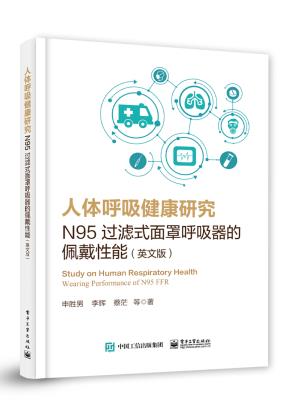
人体呼吸健康研究:N95过滤式面罩呼吸器的佩戴性能"
本书针对人类呼吸安全问题,运用商业软件及自主开发程序,从提高呼吸的舒适性和佩戴的舒适性两个角度全面而详细的研究了纤维对空气颗粒物的过滤性能、口罩内流场分布和口罩与人脸的接触特性,并提出了新型风扇口罩的设计和面部密封设计的新技术。本书全部内容具有原创性和前瞻性,部分研究成果发表在公共环境卫生行业的顶级期刊。本书的所有研究内容、方法和结果的科学性及可信度均得到同行专家认可,本书的研究将为控制和降低雾霾对中国民众呼吸健康造成的威胁提供可靠、有效的理论依据和指导。
With the growth of industrialization, air pollution has become an increasingly serious concern in China. Air pollution has deleterious effects on public health. In China, particulate matter with an aerodynamic diameter of less than 2.5 μm (PM2.5), which is small enough to gain entry into the thoracic region of the respiratory system resulting in respiratory and cardiovascular diseases, has become the fourth most common health concern. It is reported that 350,000 to 500,000 people die prematurely each year as a result of outdoor air pollution in China. A common solution to prevent inhalation of air pollutants, especially PM2.5, is to wear a respirator in daily life. This book first studies the mechanism of particles adsorption and rebound by respirator fibers, then it studies the flow-field of N95 filtering facepiece respirator (FFR), and proposes a method to improve the flow-field distribution and improve respiratory comfort. Finally, it investigates the contact characteristics between a respirator and a headform, and proposes a novel technology to improve the wearing comfort and fit of FFR wearers. Chapter 1 of this book is the Introduction. Chapter 2 and Chapter 3 study the filtration performance of multi-fiber filters, the mechanism of particles adsorption by respirator fibers, and particle rebound by the cross-scale analysis. Chapter 2 investigates the pressure drops and filtration efficiency with different fiber arrangements, fiber diameters, face velocities and particle sizes. The layered structures with the same fiber diameters and total solid volume fraction (SVF) are compared. Then, methods to optimize the dense-sparse structure so as to achieve a better filtration performance by using less tiny fibers in the front-row and removing some fibers in the back-row are discussed. In Chapter 3, the interaction between the particle and fiber surface is studied using a self-developed Fortran code and an adherence criterion to determine whether a particle will rebound from or adhere to a solid surface is proposed. The effects of particle rebound characteristics on the morphology of particle depositions are also analyzed. Chapters 4 to 7 study the flow-field in the upper respiratory system when the N95 FFR is worn. In Chapter 4, a transient numerical simulation of air flow containing carbon dioxide, thermal dynamics, pressure and wall shear stress distribution in the respiratory system is conducted for an individual wearing an FFR. In Chapter 5, the distribution characteristics of water vapor condensation on the inner surface of a FFR are studied under different breathing conditions, including different environmental temperatures and breathing patterns. In Chapter 6, micro-climate features in the deadspace of an N95 FFR considering water vapor condensation are studied. It simulates the temperature and water vapor distribution in the deadspace of N95 FFR using the computational fluid dynamics method. Then, it experimentally measures the temperature, relative humidity and bacteria distribution inside N95 FFR. Chapter 7 quantitatively investigates the flow characteristics and respiratory deposition of particles. A computational fluid dynamic method is used to assess the velocity, concentration and inhalation levels of indoor particles using a mankind realistic upper respiratory tract. An experiment is also performed to measure the PM2.5 concentrations. Chapter 8 and Chapter 9 examine optimization of the respiratory design to improve the flow-field and increase the comfort of wearers. In Chapter 8, an improved FFR designed to increase the comfort of wearers during low-moderate work is presented. The newly developed respirator helps lower the deadspace temperature and CO2 level by an active ventilation fan. Chapter 9 focuses on the development of an FFR with an intelligent control fan which has better comfort and permeability. A fan with intelligent control can reduce the temperature and humidity and CO2 concentration. Chapter 10 and Chapter 11 investigate the contact characteristics between a respirator and a headform. Chapter 10 presents a computational study on contact pressure and the resultant deformation between an N95 FFR and a newly developed digital headform. In Chapter 11, the effects of four typical facial expressions (calmness, happiness, sadness, and surprise) on the contact characteristics between an N95 FFR and a headform are investigated. Chapter 12 proposes a novel technology to produce customized face seal design for improving the wearing comfort and fit of FFR wearers. Experimental results showed that the newly designed FFR face seal provided the subjects with an improved contact pressure. Mr. Wei Li for Chapters 2 to 3, Mr. Xiaotie Zhang for Chapter 4 and Chapter 8, Miss Yu Rao for Chapter 5, Mr. Quan Yang for Chapters 6 to 7, Mr. Song Zhou for Chapter 9, Mr. Mang Cai for Chapters 10 to 12, Mr. Fuhao Cui and Mr. Dongqi Zhang are responsible for the organization and verification of the book. Professor Hui Li contributes to the finite element simulation and CFD simulation. This book is supported by Hubei Provincial Natural Science Foundation of China (Grant No. 2015CFB307), the Science and Technology Planning Program of Shenzhen (Grant No. JCYJ20170816171733384), the Fundamental Research Funds for the Central Universities of China (Grant No. 2042014kf0034), and the scholarship from China Scholarship Council (CSC) under the Grant CSC No. 201606275005. Authors gratefully acknowledge all the support.


Chapter 1 Introduction 001 1.1 Background 002 1.2 Motivation 004 1.3 Outline 007 Chapter 2 Study of the filtration performance of multi-fiber filters 009 2.1 Introduction 011 2.2 Model of multi-fiber filters 014 2.2.1 Geometric model and simulation method of multi-fiber filters 014 2.2.2 Model validation 016 2.3 Filtration efficiency and its optimization 020 2.3.1 Comparison of filtration performance between parallel and staggered designs 020 2.3.2 Filtration efficiency at different face velocities and particle diameters 022 2.3.3 Filtration performance of layered filters with the same total SVF 024 2.3.4 Optimization of pressure drop and filtration efficiency 025 2.4 Conclusion 028 References 030 Chapter 3 Study of particle rebound and deposition on fiber surface 034 3.1 Introduction 036 3.2 Models of flow field and particle movement 041 3.2.1 Flow field and particle movement 041 3.2.2 Particle rebound model 044 ? 3.3 Particle transport and deposition 048 3.3.1 Effect of particle rebounds on particle deposition 048 3.3.2 Effects of face velocity on particle deposition 050 3.3.3 Effects of particle diameter on particle deposition 052 3.3.4 Filtration efficiency of a single fiber 054 3.4 Conclusion 057 References 059 Chapter 4 Investigation of the flow-field in the upper respiratory system when wearing N95 FFR 064 4.1 Introduction 066 4.2 Modeling of full breathing cycles 068 4.2.1 Flow field reverse modeling 068 4.2.2 CFD simulation of a full breathing cycle 071 4.3 Flow field of a full breathing cycle 074 4.3.1 Flow characteristics of a full breathing cycle 074 4.3.2 CO2 volume fraction 075 4.3.3 Temperature distribution inside FFR cavity 077 4.3.4 Pressure and wall shear stress inside upper respiratory airway 079 4.4 Discussion 082 4.5 Conclusion 085 References 086 Chapter 5 Investigation of water vapor condensation on the inner surface of N95 FFR 089 5.1 Introduction 091 5.2 CFD modeling of water vapor condensation 093 5.2.1 Model of water vapor condensation 093 5.2.2 CFD-setup and boundary conditions of water vapor condensation 093 5.3 Water vapor condensation on the inner surface of N95 FFR 097 5.3.1 Effects of different environmental temperatures 099 5.3.2 Effects of different breathing velocities 102 5.3.3 Effects of different breathing frequencies 104 5.4 Discussion 108 5.5 Conclusion 110 References 111 Chapter 6 Effect of vapor condensation on micro-climate in the deadspace of N95 FFR 113 6.1 Introduction 115 6.2 CFD modeling of vapor condensation 117 6.2.1 Model of vapor condensation 117 6.2.2 CFD-setup and boundary conditions of vapor condensation 118 6.2.3 FFR performance and vapor condensation distribution 120 6.3 Experiment of micro-climate inside N95 FFR 126 6.3.1 Experiment of temperature and relative humidity measuring inside FFR 127 6.3.2 Experiment of bacteria accounting on the inner surface of FFR 129 6.4 Conclusion 133 References 134 Chapter 7 Investigation of movement characteristics and respiratory deposition of indoor cigarette particles 136 7.1 Introduction 138 7.2 Model of particle movement and respiratory deposition 141 7.2.1 Description of room, human and particles system 141 7.2.2 CFD model of cigarette particles deposition 143 7.2.3 PM2.5 measurement 146 7.3 Flow field and cigarette particles deposition 147 7.4 Conclusion 155 References 156 Chapter 8 An improved FFR design with a ventilation fan: CFD simulation and validation 159 8.1 Introduction 161 8.2 Improved FFR design and CFD simulation 163 8.2.1 Improved FFR design 163 8.2.2 Simulation method of flow field in FFR 164 8.3 Performance of the ventilation fan and its effects 169 8.3.1 Flow characteristics of the ventilation fan 169 8.3.2 Effects of fan orientation 170 8.3.3 Experiment on temperature of headform and FFR 172 8.4 Conclusion 177 References 178 Chapter 9 Design of the FFR with an intelligent control fan 181 9.1 Introduction 183 9.2 Improved FFR design 184 9.3 Design of intelligent control system 186 9.4 Test results of FFR performance 189 9.5 Discussion 193 9.6 Conclusion 194 References 195 Chapter 10 Study of contact characteristics between a respirator and a headform 196 10.1 Introduction 198 10.2 Models and methods of contact characteristics between a respirator and a headform 202 10.2.1 Geometric models of headform and respirator 202 10.2.2 Simulation methods of contact characteristics 205 10.3 Contact characteristics between a respirator and a headform 208 10.4 Conclusion 214 References 216 Chapter 11 The effects of facial expressions on respirators fit 218 11.1 Introduction 220 11.2 Models and methods of facial expressions 223 11.2.1 FE models of the headfrom and respirator 223 11.2.2 Simulation methods of facial expressions 225 11.3 Effects of facial expressions on respirators fit 227 11.4 Conclusion 234 References 236 Chapter 12 Customized design and 3D printing of face seal for an N95 FFR 238 12.1 Introduction 240 12.2 Design, manufacture and test of customized face seals 242 12.2.1 3D laser scanning of human headform 243 12.2.2 Customized design of FFR face seal 243 12.2.3 3D printing of the FFR face seal 245 12.2.4 Experiment setup and procedures 245 12.3 Contact characteristics between the FFR and headform 249 12.4 Discussion 253 12.5 Conclusion 255 References 256