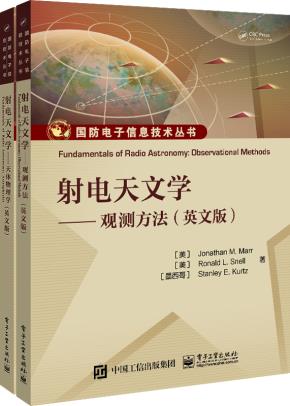
射电天文学(英文版)(全2册) "
天文学让执着探索宇宙的人类着迷,而射电天文学是天文学的第一个不在可见光波段的分支,因此也是探索最广泛的学科之一。这套英文教材由两册书组成,其中一册书侧重观测方法,讨论射电天文学的仪器设备和技术。射电观测人员始终要牢记:成功观测的关键是射电望远镜的功能和对望远镜的使用。书中首先回顾了天文学基础知识和相关内容,然后讨论辐射物理,使用射电望远镜收集和探测射电信号,射电望远镜组件的各种功能,以及成功进行射电观测所涉及的过程。书中也提供了对综合孔径基本原理的概念性介绍,以及真实干涉测量观测等高级主题的讨论。另一册书侧重天体物理学,讨论了引起射电辐射的最常见的物理过程,并给出了射电辐射的机制,以及对应天体的例子,阐述了如何从射电观测中获得相关的物理参数。
射电天文学——观测方法 分册前言和致谢 Preface Astronomy amuses and intrigues many curious minds and is, arguably, the most popular science. Many astronomy enthusiasts, however, have an incomplete appreciation of all that astronomy offers. A concept held by many is that astronomical discoveries are made with observations of light visible to the human eye. In reality, much of astronomy and astrophysics involves observations in other wavelength regimes. Radio astronomy was the first nonvisible-wavelength branch of astronomy developed, and hence is one of the most extensively explored. The contributions of radio astronomy in its 80-year history have contributed greatly to our understanding of the universe. Five Nobel Prizes in physics, for example, have been awarded for the results of research conducted at radio wavelengths. One can make a strong case, therefore, for course offerings for undergraduate astronomy and astrophysics students to include radio astronomy. The graduate curriculum for astronomy and astrophysics often includes a course in radio astronomy, and textbooks exist for this level. Unfortunately, there is no suitable radio astronomy textbook for undergraduates. All three authors of this book have taught radio astronomy courses for undergraduates, and we have found the need to develop our own teaching material at a level more suitable for students of radio astronomy than what is offered by existing texts. Our primary goal in converting our teaching material into a textbook is to serve undergraduate courses. However, we also hope that these pages will serve as a reference for graduate students getting involved in radio astronomy. As such, the amount of material presented is more than what would reasonably fit into a one-semester course. Instructors are advised to use their own discretion in selecting the chapters and sections to suit their course. We have divided the material into two volumes. The first volume, Fundamentals of Radio Astronomy: Observational Methods, discusses radio astronomy instruments and the techniques that a radio observer should know in order to make successful observations. The emphasis is on the use and functioning of radio telescopes. It is not a guide to building amateur radio telescopes. In the second volume, Fundamentals of Radio Astronomy: Astrophysics, we discuss the more common physical processes that give rise to radio emissions and present examples of astronomical objects that emit radiation by these mechanisms, along with illustrations of how the relevant physical parameters are obtained from radio observations. A common approach in teaching radio astronomy courses is to teach about the instrumentation first and then discuss the astrophysics learned from radio astronomical studies. This reflects the philosophy that understanding one’s instruments is crucial to the proper analysis of the observations and success in the research. However, we consider it equally feasible, especially at the undergraduate level, to teach the astrophysics first and to finish the course with coverage of the instrumentation. Moreover, a radio astronomy course might cover only instrumentation and observing methods or only radio astrophysics, according to other courses offered by the department. To accommodate a wealth of needs, we have structured the two volumes so that they can be presented in either order and are largely independent from one another. To accompany this text, we have developed a set of laboratory exercises. These labs make use of the small radio telescope (SRT) and the very small radio telescope (VSRT) that were developed by Massachusetts Institute of Technology’s Haystack Observatory for educational use. The SRT is a 2-m-class, single-dish telescope, operating at 21 cm, while the VSRT is a table-top interferometer operating at 2.5 cm. Instructions for the VSRT labs are given in Appendix G. The data analysis software in our zip files are Java packages that can be installed on any operating system (at no cost). This Java package demonstrates the principles of Fourier transforms. These transforms are needed for the analysis of interferometric data; this software application will provide invaluable insights when covering Chapters 5 and 6 of the first volume. We assume that the reader has completed an introductory physics sequence. More specifically, we assume the reader has experience with electricity and magnetism and an exposure to wave theory. We include some material that will enhance the understanding for readers with more extensive physics and mathematics backgrounds; these sections are indicated with an asterisk (*). A thorough discussion of interferometry and aperture synthesis, in particular, is quite involved and is beyond the scope of a one-semester undergraduate course. With the goal of conveying a conceptual understanding of the fundamental principles, we first discuss a simplified situation in Chapter 5, which avoids many of the inherent complexities. Readers who make actual interferometer observations will need to know more practical details; therefore, we provide in Chapter 6 a more advanced and thorough discussion of real-world interferometry observations, while maintaining the undergraduate level of discussion. Furthermore, the VSRT labs provide a hands-on experience for students to gain an intuitive sense of how aperture synthesis works. These labs are complementary to the presentation in Chapter 5 and can be done without going through the mathematics of Chapter 6. For classes that do not have access to a VSRT, the data analysis package VSRTI_Plotter.jar can be used, which simulate the labs. We expect that this textbook will also be of interest to physics majors with no prior background in astronomy. Thus, the early chapters include explanations of relevant topics in astronomy, with particular emphasis on the physics and measurements of radiation. There are some mathematical concepts that we do not assume all readers of this book will know, but which can enhance the understanding of the material. We review the relevant aspects of these mathematical topics in the appendices, so they do not distract from the presentation of the radio astronomy but are readily available to both students and instructors. It is our experience that students greatly desire, and benefit from, examples that demonstrate how the material is used to solve problems. Hence, we have included numerous examples dispersed throughout the chapters. Each chapter also concludes with a list of questions and problems. Historically, astronomers have predominantly used cgs units. In more recent years, SI units have become commonplace. For this reason, and because we hope these volumes will be of interest to physics majors as well, we have written all equations and examples using SI units. To facilitate comparison with other texts, we also provide the cgs formulations of the fundamental equations and constants. In the second volume, there is a need for astronomy-specific units, such as parsecs, solar luminosities, and solar masses. These units are explained in the beginning chapters of the second volume. The first page of the appendices in both volumes lists all constants and unit conversions. Although the initial development of radio astronomy occurred in the first half of the twentieth century, with subsequent technological advancements, many technical aspects of radio astronomy continue to change. Some parts of this book, therefore, will become obsolete in time. We encourage the instructor to use updated, supplemental material where appropriate. We have created all the material here purely as part of our efforts in teaching radio astronomy, which we have enjoyed immensely through the years. We hope that our efforts in making this material available to others enhances both the teaching and the learning of radio astronomy and that you will find the experience as rewarding as we have. Acknowledgments We have received generous and wonderful help from a number of people whose selfless contribution of time deserves to be acknowledged. We are very grateful for the advice, feedback, and other assistance provided by Esteban Araya, Walter Brisken, Barry Clark, Mark Claussen, Chris DePree, Vivek Dhawan, Neal Erickson, Paul Goldsmith, Greg Hallenbeck, James Lowenthal, Carl Heiles, Peter Hofner, Jim Moran, Amy Lovell, Robert Marr, Rick Perley, Thomas Perry, Preethi Pratap, Luis Rodriquez, Alan Rogers, Ken Schick, Greg Taylor, Clara Thomann, Leise van Zee, Francis Wilkin, Min Yun, and all the students who used our lecture notes as their reading material through the years. 射电天文学——天体物理学 分册前言和致谢 Preface This is the second volume of a two-volume textbook on radio astronomy. The authors have all taught courses in radio astronomy at the undergraduate level, and although there are a number of reference books on radio astronomy available, none were found ideal for use as an undergraduate textbook. Thus we found the need to develop our own teaching material and this textbook is based on these notes and our teaching experiences. Unlike many reference books on radio astronomy, our goal is to develop an understanding in the students of the underlying principles. Toward this end we have provided the background and derivations for most of the equations used in the textbook. Although we wrote this textbook with the undergraduate student in mind, we feel these volumes will also serve graduate students who are just getting started in radio astronomy. The first volume, Fundamentals of Radio Astronomy: Observational Methods, discusses radio astronomy instrumentation and the techniques that a radio observer should know in order to make successful observations. In this, the second volume, Fundamentals of Radio Astronomy: Astrophysics, we discuss the physical processes that give rise to radio emission, present examples of astronomical objects that emit by these mechanisms, and illustrate how the relevant physical parameters of astronomical sources can be obtained from the radio observations. We recognize that these two volumes cover more material than can be reasonably covered in a one semester course on radio astronomy. We provide the material in two volumes to serve courses that either emphasize radio wavelength instrumentation and observational techniques or that emphasize the astrophysics of radio sources. The two volumes are largely independent of each other, so instructors can pick and choose topics from the two volumes that best fit their courses. Despite devoting an entire volume to the astrophysics at radio wavelengths, we still could not cover all possible topics. We have, for instance, excluded planetary radio astronomy. Radio emission from planets, asteroids and comets is a rich and exciting area of study, but one that requires a volume in itself to be properly presented. Furthermore, discussion of the topics that we do present is necessarily limited in scope in order to provide a textbook of reasonable length and to avoid immersing the undergraduate student in overly complex details. In this volume we assume students have completed at least a beginning sequence in physics that includes a good background in electricity and magnetism and some knowledge of modern physics. We also assume that students have had both differential and integral calculus. Some of the more complex and lengthy derivations have been placed in appendices, so as not to distract from the presentation of the astrophysics, while still being available for readers who want to work through them.We also include in the appendices several important mathematical concepts. Additionally, in our experiences we have found that students benefit from examples; hence we have included an ample number of examples dispersed throughout the chapters. Each chapter also concludes with a list of questions and problems. In the presentation of the material, we devote the first four chapters to covering the relevant physics, with an extensive discussion of radiation processes. The physics concepts and equations can then be applied as needed in the presentation of the astrophysics. We believe that this approach yields a deeper understanding and teaches the student how to use the tools of the trade more generally. Additionally, we have written the astrophysics chapters (Chapters 5-10) to be independent of each other. Instructors should not feel the need to cover Chapter 5 in order to discuss Chapter 6, for example, nor do these chapters need to be presented in sequential order. When we wrote the first volume, we chose primarily to use SI units, as this system is used in most physics textbooks and historically was used by early radio astronomers. We often provided the conversions needed to change to cgs units. However, results presented in the astronomical literature have generally used cgs units. As such, when we considered introducing quantities in this volume such as column density, we felt that the cgs unit of cm?2, and not the SI unit of m?2, was more appropriate for teaching students about the field of astrophysics. For this reason all equations and examples in this volume are in cgs units. The first appendix lists constants in both cgs and SI units, and Section 1.1.1 provides a discussion of the unique challenge of converting the equations of electricity and magnetism between cgs and SI units. We hope this approach for units in the two volumes is not too confusing for students. If nothing else it might help prepare them for a professional life that almost certainly includes mutiple systems of units. Over its 80 year history, radio astronomy has contributed greatly to our understanding of the Universe, including four Nobel Prize winning discoveries, and we believe courses covering this subject are important in the undergraduate curriculum. We hope that our efforts in making this material available to others will enhance both the teaching and the learning of radio astronomy, and that you will find the study of this topic equally as rewarding as we have. Acknowledgments We have received generous and insightful help from a number of people whose selfless contributions of time deserve to be acknowledged. We are very grateful for the advice, feedback, and other assistance provided by Esteban Araya, Chris Carilli, Ed Churchwell, Mark Claussen, Paul Goldsmith, David Hough, Jay Lockman, Amy Lovell, Jeff Mangum, Chris O’Dea, Bruce Partridge, Luis Rodriguez, Leise van Zee, Joel Weisberg, Francis Wilkin, Grant Wilson, and Min Yun. We also wish to thank the following who have allowed us to use their previously published material or have provided new materials for this volume: Esteban Araya, Dan Clemens, Scott Croom, Tom Dame, John Dickey, Rob Gutermuth, Mark Heyer, Adam Leroy, Jay Lockman, Michael McCrackan, Maura McLaughlin, Rick Perley, Peter Schloerb, Gregory Taylor, Joe Taylor, Steven Tremblay, Fabian Walter, Grant Wilson, and Min Yun. We acknowledge the use of the Legacy Archive for Microwave Background Data Analysis (LAMBDA), a service of the NASA Goddard Space Flight Center, the ESA/Planck Collaboration and the NRAO/AUI image gallery websites. We also made use of the NASA/IPAC Extragalactic Database (NED), which is operated by the Jet Propulsion Laboratory, California Institute of Technology, under contract with the National Aeronautics and Space Administration. Finally we wish to acknowledge the feedback we have received from all of the students who used our lecture notes as their reading material through the years.


射电天文学. 观测方法 分册目录 CHAPTER 1 Introductory Material 射电天文学基础 1.1 BRIEF HISTORY OF RADIO ASTRONOMY 射电天文学简史 1.2 SOME FUNDAMENTALS OF RADIO WAVES 射电波的一些基本原理 1.2.1 Electromagnetic Radiation 电磁辐射 1.2.2 Spectroscopy 频谱学 1.3 FINDING OUR WAY IN THE SKY 在天空中定位 1.3.1 Sky Coordinate System: Right Ascension and Declination 天球坐标系:赤经和赤纬 1.3.2 Observer-Centered Definitions 以观测者为中心的定义 1.3.3 Apparent Sizes 表观尺寸 1.4 BASIC STRUCTURE OF A TRADITIONAL RADIO TELESCOPE 传统射电望远镜的基本结构 1.4.1 Parabolic Reflector 抛物面式反射面 1.4.2 Mount 座架 1.4.3 Feeds, Receivers, and Computer 馈源、接收机和计算机 1.5 RADIO MAPS 射电成图 QUESTIONS AND PROBLEMS 习题 CHAPTER 2 Introduction to Radiation Physics 辐射物理学简介 2.1 MEASURES OF THE AMOUNT OF RADIATION 辐射量的测量 2.1.1 Total Energy Emitted 辐射的总能量 2.1.2 Luminosity 光度 2.1.3 Flux 流量 2.1.4 Flux Density 流量密度 2.1.5 Intensity 强度 2.1.6 Relation between Intensity and the Electric Field and Magnetic Field Waves 强度与电磁场波之间的关系 2.2 BLACKBODY RADIATION 黑体辐射 2.3 RAYLEIGH–JEANS APPROXIMATION 瑞利–金斯近似 2.4 BRIGHTNESS TEMPERATURE 亮温度 2.5 COHERENT RADIATION 相干辐射 2.6 INTERFERENCE OF LIGHT 光的干涉 2.7 POLARIZATION OF RADIATION 辐射的偏振 2.7.1 Stokes Parameters 斯托克斯参数 QUESTIONS AND PROBLEMS 习题 CHAPTER 3 Radio Telescopes 射电望远镜 3.1 RADIO TELESCOPE REFLECTORS, ANTENNAS, AND FEEDS 射电望远镜的反射面、天线和馈源 3.1.1 Primary Reflectors 主反射面 3.1.2 Beam Pattern 波束图 3.1.3 Feeds and Primary Reflector Illumination 馈源和主反射面照明 3.1.4 Surface Errors 表面误差 3.1.5 Beam Pattern Revisited* 再谈波束图 3.2 HETERODYNE RECEIVERS 外差式接收机 3.2.1 Transmission Lines 传输线 3.2.2 Front-End Receiver Components 接收机前端组件 3.2.3 Back-End Receiver Components 接收机后端组件 3.2.4 High-Frequency Heterodyne Receivers 高频外差式接收机 3.3 NOISE, NOISE TEMPERATURE, AND ANTENNA TEMPERATURE 噪声、噪声温度和天线温度 3.4 BOLOMETER DETECTORS 辐射热探测计 3.5 SPECTROMETERS 频谱仪 3.5.1 Filter Bank Spectrometer 滤波器组式频谱仪 3.5.2 Digital Spectrometers* 数字式频谱仪 3.6 VERY LOW-FREQUENCY RADIO ASTRONOMY 甚低频射电天文学 3.6.1 Low-Frequency Window 低频窗口 3.6.2 Antennas 天线 3.6.3 Receivers 接收机 3.6.4 Radio Frequency Interference 射频干扰 QUESTIONS AND PROBLEMS 习题 CHAPTER 4 Single-Dish Radio Telescope Observations 单口径射电望远镜观测 4.1 BASIC MEASUREMENTS WITH A SINGLE-DISH TELESCOPE 单口径望远镜的基本测量 4.1.1 Switched Observations 开关式观测 4.1.2 Determination of System Temperature 系统温度的确定 4.1.3 Measurement of Antenna Temperature 天线温度的测量 4.1.4 Uncertainty in the Measured Antenna Temperature 测量天线温度的不确定性 4.2 ANTENNA BEAM 天线波束 4.2.1 Beam Power Pattern and Antenna Solid Angle 波束功率方向图和天线立体角 4.2.2 Main Beam and Angular Resolution 主波束和角分辨率 4.2.3 Main Beam Efficiency 主波束效率 4.2.4 Detected Power from Extended Sources 从扩展源中探测功率 4.3 OBSERVING RESOLVED VERSUS UNRESOLVED SOURCES 观测可解析源与不可解析源 4.3.1 Unresolved Sources 不可解析源 4.3.2 Resolved Sources 可解析源 4.3.3 Uniform Source That Fills the Sky 充满天空的均匀源 4.3.4 Brightness Temperature versus Antenna Temperature, Beam Dilution, and Beam Filling Factor 亮温度与天线温度、波束稀释和波束填充系数的关系 4.4 SPECTRAL-LINE OBSERVATIONS 谱线观测 4.4.1 Spectral Parameters 频谱参数 4.4.2 Frequency Switching 频率切换 4.5 OBTAINING RADIO IMAGES 获取射电图像 4.5.1 Convolution with Beam Pattern 与波束图的卷积 4.5.2 Deconvolution 去卷积 4.6 CALIBRATION OF A RADIO TELESCOPE 射电望远镜的校准 4.6.1 Pointing Corrections 指向校正 4.6.2 Calibration of the Gain, Effective Area, and Gain Curve 增益、有效面积和增益曲线的校准 4.6.3 Measuring the Beam Pattern and Main Beam Efficiency 测量波束图和主波束效率 4.6.4 Calculating Antenna Solid Angle and Main Beam Efficiency 计算天线立体角和主波束效率 4.7 TELESCOPE SENSITIVITY CONSIDERATIONS IN PLANNING AN OBSERVATION 规划观测时关于望远镜灵敏度的考虑 4.8 POLARIZATION CALIBRATION* 偏振校准 QUESTIONS AND PROBLEMS 习题 CHAPTER 5 Aperture Synthesis Basics: Two-Element Interferometers 综合孔径基础:两单元干涉仪 5.1 WHY APERTURE SYNTHESIS 为什么要综合孔径 5.2 TWO-ELEMENT INTERFEROMETER 两单元干涉仪 5.3 OBSERVATIONS OF A SINGLE-POINT SOURCE 单点源的观测 5.3.1 Response of the Additive Interferometer 相加干涉仪的响应 5.3.2 Response of the Multiplicative Interferometer 相关干涉仪的响应 5.3.3 Effect of Noise 噪声的影响 5.4 FRINGE FUNCTION 条纹函数 5.5 VISIBILITY FUNCTION 可见度函数 5.5.1 Analysis of Visibilities for a Single-Point Source 点源的可见度函数分析 5.6 OBSERVATIONS OF A PAIR OF UNRESOLVED SOURCES 一对不可解析源的观测 5.7 OBSERVATIONS OF A SINGLE EXTENDED SOURCE 单个扩展源的观测 5.8 COHERENCE AND THE EFFECTS OF FINITE BANDWIDTH AND INTEGRATION TIME 有限带宽与积分时间的相干性及其影响 5.8.1 Bandwidth Smearing 带宽导致的模糊 5.8.2 Time Smearing 时间导致的模糊 5.9 BASIC PRINCIPLES OF INTERFEROMETRY 干涉测量的基本原理 QUESTIONS AND PROBLEMS 习题 CHAPTER 6 Aperture Synthesis: Advanced Discussion 综合孔径:高级讨论 6.1 CROSS-CORRELATION OF RECEIVED SIGNALS 接收信号的互相关 6.2 COMPLEX-VALUED CROSS-CORRELATION 复值互相关 6.3 COMPLEX CORRELATION OF A POINT SOURCE AT A SINGLE FREQUENCY 单频上点源的复相关 6.4 EXTENDED SOURCES AND THE FOURIER TRANSFORM 扩展源和傅里叶变换 6.5 FOURIER TRANSFORMS FOR SOME COMMON SOURCE SHAPES 常见形状源的傅里叶变换 6.5.1 Visibility Function of a Point Source 点源的可见度函数 6.5.2 Visibility Function of Two Point Sources 双点源的可见度函数 6.5.3 Visibility Function of a Gaussian Profile 高斯轮廓源的可见度函数 6.6 THREE DIMENSIONS, THE EARTH’S ROTATION, AND THE COMPLEX FRINGE FUNCTION 三维空间、地球自转和复条纹函数 6.7 NONZERO BANDWIDTH AND FINITE INTEGRATION TIME 非零带宽和有限积分时间 6.8 SOURCE STRUCTURE AND THE VISIBILITY FUNCTION 源结构和可见度函数 6.8.1 Sky Coordinates and the Visibility Function 天球坐标和可见度函数 6.8.2 uv-Plane uv平面 6.8.3 Visibility Functions of Simple Structures 简单结构的可见度函数 6.9 THE EARTH’S ROTATION AND UV TRACKS 地球自转和 uv 轨迹 6.10 INTERFEROMETERS AS SPATIAL FILTERS 干涉仪作为空间滤波器 6.11 SENSITIVITY AND DETECTION LIMITS 灵敏度和探测极限 6.11.1 Noise in a Visibility 可见度中的噪声 6.11.2 Image Sensitivity 图像灵敏度 6.11.3 Brightness Sensitivity 亮度灵敏度 6.12 CALIBRATION 校准 6.13 IMAGE FORMATION 图像形成 6.13.1 Image Dimensions and Gridding Parameters 图像尺寸和网格参数 6.13.2 Dirty Map and Dirty Beam 脏图和脏波束 6.13.3 uv Weighting Schemes uv加权方案 6.13.4 CLEANing the Map: Deconvolving the Dirty Beam 洁化图像:对脏波束去卷积 6.13.5 Self-Calibration and Closure Phase and Amplitude 自校准、闭合相位和振幅 6.14 VERY LONG BASELINE INTERFEROMETRY* 甚长基线干涉测量(VLBI) 6.14.1 VLBI Resolution and Sensitivity VLBI的分辨率和灵敏度 6.14.2 Hardware Considerations for VLBI VLBI的硬件考虑 6.14.3 Fringe Searching or Fringe Fitting 条纹搜索或条纹拟合 QUESTIONS AND PROBLEMS 习题 Appendix A Constants and Conversions 常量及其单位换算 Appendix B Derivation of Beam Pattern 波束图的推导 Appendix C Cross-Correlations 互相关 Appendix D Complex-Exponential Form of Wave Functions 波函数的复指数形式 Appendix E Primer on Fourier Transforms, with Focus on Use in Aperture Synthesis 综合孔径应用中的傅里叶变换 Appendix F Wiener-Khinchin Theorem 维纳-欣钦定理 Appendix G Interferometer Simulation Activities 干涉仪的仿真 Index 索引 射电天文学. 天体物理学 分册目录 CHAPTER 1 Introductory Material 射电天文学基础 1.1 UNITS AND NOMENCLATURE 单位和命名法 1.1.1 Issues with Units of Electricity and Magnetism 电和磁单位的问题 1.1.2 Astronomy Units 天文学单位 1.1.3 Nomenclature for Atomic Ionization States 原子电离态的命名法 1.2 RADIATION MEASURES 辐射测量 1.2.1 Luminosity 光度 1.2.2 Flux 流量 1.2.3 Flux Density 流量密度 1.2.4 Intensity 强度 1.2.5 Polarization 偏振 1.3 SKY COORDINATES 天球坐标系 1.3.1 Equatorial Coordinate System 赤道坐标系 1.3.2 Galactic Coordinate System 银河坐标系 1.4 DOPPLER EFFECT 多普勒效应 1.4.1 Classical Doppler Effect 经典多普勒效应 1.4.2 Relativistic Doppler Effect 相对论多普勒效应 1.5 COSMOLOGICAL REDSHIFT AND THE EXPANDING UNIVERSE 宇宙学红移和膨胀的宇宙 1.6 DISTANCE AND AGE CALCULATIONS 距离和年龄的计算 QUESTIONS AND PROBLEMS 习题 CHAPTER 2 Propagation of Radiation 辐射的传播 2.1 RADIATIVE TRANSFER 辐射转移 2.1.1 Absorption of Radiation 辐射的吸收 2.1.2 Emission of Radiation 辐射的发射 2.1.3 General Radiative Transfer Equation 一般辐射转移方程 2.2 PROPAGATION IN AN IONIZED MEDIUM 在电离介质中的传播 2.2.1 Plasma Frequency 等离子体频率 2.2.2 Dispersion Measure 色散测量 2.2.3 Faraday Rotation 法拉第旋转 QUESTIONS AND PROBLEMS 习题 CHAPTER 3 Continuum Emission Processes 连续辐射过程 3.1 RADIATION FROM ACCELERATED CHARGES 加速电荷的辐射 3.2 THERMAL RADIATION 热辐射 3.2.1 Blackbody Radiation 黑体辐射 3.2.2 Rayleigh-Jeans Approximation 瑞利–金斯近似 3.2.3 Brightness Temperature 亮温度 3.2.4 Thermal Bremsstrahlung Radiation (or Free-Free Emission) 热轫致辐射(或自由–自由辐射) 3.3 NON-THERMAL RADIATION 非热辐射 3.3.1 Cyclotron Radiation 回旋辐射 3.3.2 Synchrotron Radiation by a Single Relativistic Electron 单个相对论电子的同步辐射 3.3.3 Radiation by an Ensemble of Relativistic Electrons 相对论电子集合体的辐射 3.3.4 Polarization of Synchrotron Radiation 同步辐射的偏振 3.3.5 Optical Depth Effects: Synchrotron Self-Absorption 光学深度效应:同步辐射的自吸收 QUESTIONS AND PROBLEMS 习题 CHAPTER 4 Spectral Lines 谱线 4.1 EMISSION AND ABSORPTION LINES 发射和吸收线 4.1.1 Einstein Coefficients 爱因斯坦系数 4.1.1.1 Spontaneous Emission 自发辐射 4.1.1.2 Absorption 吸收 4.1.1.3 Stimulated Emission 受激辐射 4.1.1.4 Absorption Coefficient 吸收系数 4.1.1.5 Relations between the Einstein A and B Coefficients 爱因斯坦A系数和B系数之间的关系 4.1.2 Line Broadening 谱线展宽 4.1.3 Spectral Line Radiative Transfer 谱线辐射转移 4.1.4 Kirchhoff’s Rules for Spectroscopy 基尔霍夫光谱学法则 4.1.5 Collisional Transition Rates and Excitation Temperature 碰撞转换率和激发温度 4.2 RADIO SPECTRAL LINES 射电谱线 4.2.1 21-cm Spectral Line of Atomic Hydrogen 氢原子的21 cm谱线 4.2.2 Radio Recombination Spectral Lines 射电复合谱线 4.2.3 Molecular Rotational Spectral Lines 分子旋转谱线 QUESTIONS AND PROBLEMS 习题 CHAPTER 5 The Cold Interstellar Medium of the Milky Way 银河系中的冷星际介质 5.1 21-CM SPECTRAL LINE OF ATOMIC HYDROGEN 氢原子的21 cm谱线 5.1.1 Observations of the 21-cm Line 21 cm谱线的观测 5.1.2 Rotation Curve of the Galaxy 银河系的旋转曲线 5.1.3 Distribution of HI in the Milky Way 银河系中的中性氢分布 5.1.4 Absorption Lines - Warm and Cold Gas 温热气体的吸收线 5.1.5 Magnetic Field 磁场 5.2 OBSERVATIONS OF THE ROTATIONAL LINES OF MOLECULES 分子旋转谱线的观测 5.2.1 Molecular Clouds 分子云 5.2.2 Distribution of Molecular Clouds in the Galaxy 银河系中的分子云分布 5.2.3 Molecular Cloud Cores 分子云核 5.2.4 Astrochemistry 天体化学 5.3 OBSERVATIONS OF THE THERMAL EMISSION FROM DUST 尘埃热辐射的观测 5.3.1 Dust Extinction 尘埃消光 5.3.2 Dust Emission 尘埃辐射 5.3.3 Global Distribution of Dust 尘埃的全局分布 QUESTIONS AND PROBLEMS 习题 CHAPTER 6 HⅡ Regions and Planetary Nebulae at Radio Wavelengths 射电波段的HⅡ区和行星状星云 6.1 HⅡ REGIONS HⅡ区 6.1.1 Ionization Structure of HⅡ Regions HⅡ区的电离结构 6.1.2 The Temperature of HⅡ Regions HⅡ区的温度 6.1.3 Time Scales of HⅡ Regions HⅡ区的时标 6.2 RADIO EMISSION FROM HⅡ REGIONS HⅡ区的射电辐射 6.2.1 Bremsstrahlung Emission from HⅡ Regions HⅡ区的韧致辐射 6.2.2 Radio Recombination Line Emission from HⅡ Regions HⅡ区的射电复合线辐射 6.2.3 Gas Density and Temperature from RRLs: Non-Equilibrium Effects 非平衡效应下来自射电复合线的气体密度和温度 6.3 THE CLASSIFICATION AND EVOLUTION OF HⅡ REGIONS HⅡ区的分类与演化 6.3.1 Classification of HⅡ Regions HⅡ区的分类 6.3.2 Evolution of HⅡ Regions HⅡ区的演化 6.4 PLANETARY NEBULAE 行星状星云 QUESTIONS AND PROBLEMS 习题 CHAPTER 7 Radio Emission from Stellar Objects 恒星天体的射电辐射 7.1 SOLAR RADIO EMISSION 太阳射电辐射 7.1.1 The Quiet Sun 宁静太阳 7.1.2 Slowly Varying Component of the Sun 太阳的缓慢变化成分 7.1.3 Radio Bursts 射电暴 7.2 RADIO EMISSION FROM STARS 恒星的射电辐射 7.2.1 Thermal Radio Emission 射电热辐射 7.2.1.1 Main Sequence Stars 主序星 7.2.1.2 Giant and Supergiant Stars 巨型和超巨型恒星 7.2.2 Winds from Asymptotic Giant Branch Stars 来自渐近巨支星的星风 7.2.3 Flare Stars 耀星 7.3 YOUNG STARS 年轻恒星 7.3.1 Proto-stellar Disks 原恒星盘 7.3.2 Thermal Radio Jets 射电热喷流 7.3.3 Molecular Outflows 分子外向流 7.4 RADIO PULSARS 射电脉冲星 7.4.1 Pulsar Mechanics 脉冲星机制 7.4.2 Pulsar Emission Mechanisms 脉冲星的辐射机理 7.4.3 Pulsar Searches 脉冲星搜索 7.4.4 Binary Pulsars 脉冲双星 7.4.5 Radio Pulsars as Probes of the Interstellar Medium 作为星际介质探针的射电脉冲星 7.4.6 Supernova Remnants 超新星遗迹 QUESTIONS AND PROBLEMS 习题 CHAPTER 8 Galaxies at Radio Wavelengths 射电波段的星系 8.1 21-CM HI OBSERVATIONS 21 cm中性氢的观测 8.1.1 HI Mass of Galaxies 星系中的中性氢质量 8.1.2 Imaging HI in Galaxies 星系中的中性氢成像 8.2 MOLECULAR GAS IN GALAXIES 星系中的分子气体 8.2.1 Molecular Gas Mass 分子气体质量 8.2.2 Imaging CO in Galaxies 星系中的一氧化碳成像 8.2.3 Other Molecules in Galaxies 星系中的其他分子 8.3 RADIO CONTINUUM EMISSION FROM GALAXIES 星系的射电连续辐射 8.3.1 Dust Emission 尘埃辐射 8.3.2 Long Wavelength Radio Continuum Emission 长波射电连续辐射 8.4 DISTANT GALAXIES 遥远的星系 QUESTIONS AND PROBLEMS 习题 CHAPTER 9 Radio Galaxies and Quasars 射电星系和类星体 9.1 BRIEF OVERVIEW OF ACTIVE GALACTIC NUCLEI 活动星系核(AGN)的简述 9.2 AGN MODEL AGN的模型 9.3 MORPHOLOGIES, SIZES, AND SPECTRA OF RADIO GALAXIES AND QUASARS 射电星系和类星体的形态、尺寸及频谱 9.3.1 Synchrotron Spectrum from an Inhomogeneous Source 来自非均匀源的同步辐射谱 9.3.2 Free-free Absorption of Synchrotron Radiation 同步辐射的自由–自由吸收 9.3.3 Inverse Compton Scattering and the Compton Limit 逆康普顿散射和康普顿极限 9.4 INFERRING PHYSICAL CONDITIONS IN AGN 推断AGN中的物理条件 9.4.1 Spectral Index Maps 谱指数图 9.4.2 Kinematic Studies 运动学研究 9.4.3 Magnetic Field Estimates 磁场估计 9.4.4 Electron Cooling Timescales and the Nature of Hot Spots in Jets 电子冷却时标和喷流中热点的性质 9.5 THE CENTER OF THE MILKY WAY 银心 QUESTIONS AND PROBLEMS 习题 CHAPTER 10 Cosmic Microwave Background 宇宙微波背景(CMB) 10.1 COSMOLOGICAL MODELS 宇宙学模型 10.2 BLACKBODY NATURE OF THE CMB CMB的黑体性质 10.3 ANISOTROPIES IN THE CMB CMB中的各向异性 10.4 COSMOLOGICAL PARAMETERS 宇宙学参数 10.5 CMB POLARIZATION CMB偏振 QUESTIONS AND PROBLEMS 习题 APPENDIX A Constants and Conversions 常量及其单位换算 APPENDIX B Mathematica Code for Calculating Age of Universe and Distances for Given Redshift 根据确定的红移计算宇宙年龄和距离的Mathematica代码 APPENDIX C Complex-Valued Wave Functions 复值波函数 APPENDIX D Derivations of the Effects of Propagation of Radiation in Ionized Media 电离介质中辐射传播效应的推导 APPENDIX E Fourier Transform 傅里叶变换 Index 索引
http://www.hxedu.com.cn/hxedu/fg/book/bookinfo.html?code=G0458370