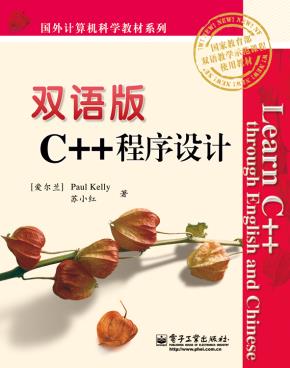
双语版C++程序设计(LearnC++throughEnglishandChinese)"
本书由在计算机程序设计方面有着丰富教学和实践经验的中外作者合作编写。共分14章内容,由浅入深全面介绍C++程序设计方法。本书通俗易懂,例子贴近生活,尤其强调读者的亲自参与意识。所有实例经过精心挑选。每章都为初学者提供了常见错误分析,每章结尾有很多有趣的习题,可以提高读者上机编程的兴趣。 本书是国内首次出版的中英文对照混排式双语版C++程序设计教材,既方便初学者熟悉相关概念和内容,也便于英文非母语的读者熟悉英文专业词汇。 本书可作为高等学校计算机相关专业或软件学院的C++程序设计双语教材,也可供程序员和编程爱好者参考使用。
Preface This textbook teaches the fundamentals of programming using C++, a programming language which supports the development of software using the object-oriented paradigm. Although the book is primarily intended as a textbook for a programming module in a computer science course, it is equally suited to an individual familiar with another programming language and who now wants to learn how to program in C++. This book focuses on core concepts and features of C++ while keeping the explanations as simple as possible. Drawing on their professional experience, the authors teach C++ programming largely by way of examples that are organised for easy step-by-step learning. Like so many other programming languages, C++ contains numerous English technical terms that are difficult for all students, including the native English speaking student. Learn C++ though English and Chinese explains C++ concepts and terminology in English with additional explanatory annotations in Chinese. This bi-lingual approach will be appreciated by Chinese students and will help them focus on the C++ language without being over-burdened by English technical terminology. Despite C++ being available on a wide variety of platforms, this book is not specific to any particular machine, compiler, or operating system. All programs are designed to be portable with little or no modification to a wide variety of platforms. Learn C++ through English and Chinese ●Is a comprehensive introduction to programming in C++. ●Uses practical examples to explain difficult theoretical examples. ●Uses a step-by-step approach with detailed explanation of programming examples. ●Uses explanatory annotations written in Chinese. ●Provides end-of-chapter 詐rogramming pitfalls?commonly experienced by learners. ●Provides a 詑uick syntax reference?at the end of each chapter that summarises the C++ syntax covered in the chapter. This is a useful resource for experienced programmers as well as for learners. ●Provides end-of-chapter exercises, allowing the learner to test and re-enforce their understanding of C++. ●Is suitable for students new to programming and those familiar with some other language, such as C or Basic, and who now wish to learn C++. ●Is accompanied by a web site containing the example programs, solutions to selected exercises, frequently asked questions and links to other useful resources. Typographic Conventions The line numbers to the left of the program examples are for reference purposes only and are not part of the C++ language. When a new term is introduced it is in italic type. C++ statements, keywords, program variables and values are in this font. This font is used in examples to show values that should be typed at the keyboard by the user. Paul Kelly Dublin Institute of Technology 前 言 针对国内大学逐渐与国际接轨的发展趋势,英语教学和双语教学逐渐被人们重视起来。一方面,在国家教育部的大力支持下,许多课程建设成了国家教育部双语教学示范课程,但是这些课程大多采用英文原版教材,而面向双语教学的双语版教材在国内实属罕见。另一方面,以“国际化、工业化”为办学理念,注重国际化、工业化人才培养的软件示范学院的部分课程还邀请了一些外籍教师进行全英语授课,但是由于目前国内学生的英语水平参差不齐,导致全英语授课的教学效果不是非常理想。本书正是在此背景和需求下应运而生的。 本书的第一作者是爱尔兰都柏林工业大学(DIT)的高级讲师Paul Kelly。Kelly老师长期从事程序设计类课程的教学工作,在程序设计类课程教学方面教学实践经验丰富,在国外已先后出版多本程序设计语言类书籍。自哈尔滨工业大学软件示范学院成立以来,一直作为外聘教师在哈尔滨工业大学软件示范学院从事程序设计方面的教学工作,对中国学生比较了解,针对其在教学中发现的问题,即初学者面临着既不熟悉专业术语和基本概念、又不熟悉英文专用词汇的双重困难,提出了出版英汉对照混排式双语版教材的思路,帮助学生在克服语言障碍的同时,能够更快更好地熟悉和掌握计算机程序设计方面的基础知识,为国内的双语教学提供了一种最佳的解决方案。 本书内容共分14章,由浅入深、全面介绍C++程序设计方法,既适合于以C++作为入门语言的读者,也适合于学习过其他程序设计语言后想再学习C++的读者。本书的特点如下: 1.使用非常实用和贴近生活的例子以及图示来通俗易懂地讲解 难于理解的概念,介绍面向对象程序设计方法的同时,尤其 强调读者的亲自参与意识。 2.采用案例驱动和循序渐进方式,从一个应用实例出发,先利 用现有知识编写出一个较为简单的程序,然后在此基础上, 不断扩充,在扩充的过程中引入一个新的概念和知识点,逐 渐编写出一个较大的程序,每个例程都有详细的讲解。有的 章以一个例子为中心贯穿始终讲解,后面章节的例子还会重 用已有的部分程序代码,前、后章节之间既有内容上的联 系,也有例程上的联系。 3.重点内容和段落给出了中文注解。 4.每章后面都有一节介绍初学者编程时易犯的错误,以帮助初 学者在程序设计中避免这些错误。 5.每章后面都有快速语法参考,总结本章内容,便于读者快速 查询相关内容。 6.每章后面都有精心设计的、有趣的习题,便于读者测试和强 化对相关内容的理解。 7.有相关的教学网站(华信教育资源网,网址 http://www.hxedu.com.cn),方便读者下载示例的源代码、 部分习题解答及教学课件等资料。 本书由在计算机程序设计方面有着丰富教学和实践经验的中外作者合作编写。本书是在国内首次出版中英文对照混排式双语版教材,适合低年级的学生对照阅读,既方便初学者熟悉相关概念和内容,也便于母语不是英语的读者熟悉英文的专业词汇,尤其适用于作为双语教学示范课程的教材。 Paul Kelly是一位治学非常严谨的教师,本书的第二作者苏小红在与他合著过程中,经常为一个细节内容的编写进行交流与讨论,书稿完成后又进行了多次校对工作。本着对所有读者负责的精神,我们真诚地欢迎读者对教材提出宝贵意见,可以通过发送电子邮件或在网站(http://book.sunner.cn)上留言等多种方式与我们交流讨论。作者E-mail地址为Paul.Kelly@comp.dit.ie,sxh@hit.edu.cn。 苏小红 哈尔滨工业大学计算机科学与技术学院 2010年5月


Chapter One Introduction(绪论) 1 1.1 What is a computer program? (什么是计算机程序?)1 1.2 Developing a computer program(开发计算机程序) 2 1.2.1 Program development cycle 2 1.3 Learning C++(学习 C++) 4 1.4 Web site for this book(本书的网站) 5 1.5 Brief history of C++(C++简史) 5 1.6 ANSI/ISO C++ standard(ANSI/ISO C++标准) 5 Chapter Two Beginning to Program in C++(C++编程入门)6 2.1 Constants(常量) 6 2.2 Variables(变量) 6 2.3 Simple output to the screen(简单的屏幕输出) 7 2.4 Comments(注释) 9 2.5 Data types(数据类型) 11 2.5.1 Short Integer data types 11 2.5.2 Long Integer data types 11 2.5.3 Boolean data types 11 2.5.4 Double Floating-point data types 11 2.6 Data type sizes(数据类型的大小) 12 2.7 Operators(运算符) 12 2.7.1 The assignment operator 12 2.7.2 Arithmetic operators 13 2.7.3 Increment and decrement operators 14 2.7.4 Combined assignment operators 17 2.8 Operator precedence(运算符的优先级) 17 2.9 Type conversions and casts(类型转换和强转) 19 Programming pitfalls 22 Quick syntax reference 24 Exercises 25 Chapter Three Keyboard Input and Screen Output(键盘输入 和屏幕输出) 29 3.1 Simple keyboard input(简单的键盘输入) 29 3.2 Manipulators(流操纵符) 31 3.3 Single-character input and output(单个字符的输入和 输出) 34 Programming pitfalls 36 Quick syntax reference 36 Exercises 37 Chapter Four Selection and Iteration(选择与循环) 38 4.1 Selection(选择) 38 4.1.1 The if statement 38 4.1.2 The if-else statement 39 4.1.3 Compound statements 40 4.1.4 Logical operators 41 4.1.5 Nested if statements 42 4.1.6 The switch statement 42 4.1.7 The conditional operator ?: 44 4.2 Iteration(循环) 45 4.2.1 The while statement 45 4.2.2 The do-while loop 47 4.2.3 The for statement 48 4.2.4 Nested loops 50 Programming pitfalls 53 Quick syntax reference 55 Exercises 57 Chapter Five Arrays and Structures(数组和结构体) 60 5.1 Arrays(数组) 60 5.1.1 Introduction 60 5.1.2 Initialising an array 64 5.1.3 Two-dimensional arrays 65 5.1.4 Initialising a two-dimensional array 67 5.1.5 Multi-dimensional arrays 68 5.2 Structures(结构体) 69 5.2.1 Introduction 69 5.2.2 Declaring a structure 69 5.2.3 Initialising a structure variable 72 5.2.4 Nested structures 73 5.3 The typedef statement(typedef语句) 74 5.4 Arrays of structures(结构体数组) 75 5.5 Enumerated data types(枚举数据类型) 75 Programming pitfalls 77 Quick syntax reference 78 Exercises 78 Chapter Six Strings(字符串) 82 6.1 C-strings(C风格字符串) 82 6.2 C-string input and output(C风格字符串的输入和输出) 83 6.3 Accessing individual characters of a C-string(访问C 风格字符串中的单个字符) 88 6.4 C-string functions(C风格字符串函数) 88 6.4.1 Finding the length of a C-string 89 6.4.2 Copying a C-string 89 6.4.3 C-string concatenation 90 6.4.4 Comparing C-strings 90 6.4.5 Other C-string functions 91 6.4.6 Converting numeric C-strings to numbers 91 6.5 C++ strings(C++字符串) 92 6.5.1 string initialisation and assignment 94 6.5.2 string concatenation 96 6.5.3 string length, string indexing and sub- strings 97 6.5.4 string replace, erase, insert and empty strings 99 6.5.5 string searching 100 6.5.6 string comparisons 102 6.5.7 string input 104 6.5.8 string conversions 105 6.6 Arrays of strings(string类型的数组) 107 6.7 Character classification(字符分类) 107 Programming Pitfalls 110 Quick Syntax Reference 111 Exercises 111 Chapter Seven Functions(函数) 114 7.1 Introduction(引言) 114 7.2 Function arguments(函数实参) 116 7.3 Default parameter values(默认的形参值) 120 7.4 Returning a value from a function(从函数返回一个 值) 120 7.5 Inline functions(内联函数) 122 7.6 Passing arguments by value(按值传递实参) 123 7.7 Passing arguments by reference(按引用传递实参)124 7.8 Passing a one-dimensional array to a function(向函 数传递一维数组) 127 7.9 Passing a multi-dimensional array to a function(向 函数传递多维数组) 132 7.10 Passing a structure variable to a function(向函数 传递结构体变量) 133 7.11 Passing a string to function(向函数传递字符串)136 7.11.1 Passing a C++ string to a function 136 7.11.2 Passing a C-string to a function 137 7.12 Recursion(递归) 137 7.13 Function overloading(函数重载) 140 7.14 Storage classes auto and static(auto和static存储类 型) 142 7.14.1 auto 142 7.14.2 static 142 7.15 The scope of a variable(变量的作用域) 144 7.15.1 Block scope 144 7.15.2 Global scope 145 7.15.3 Reusing a variable name 146 7.16 Mathematical functions(数学函数) 148 7.16.1 Some trigonometric functions 148 7.16.2 Pseudo-random number functions 149 Programming Pitfalls 151 Quick Syntax Reference 151 Exercises 152 Chapter Eight Objects and Classes(对象和类) 157 8.1 What is an object? (什么是对象?) 157 8.2 What is a class? (什么是类?) 157 8.3 Further examples of classes and objects(类和对象的 更进一步的示例) 160 8.3.1 A student class 160 8.3.2 A bank account class 161 8.4 Abstraction(抽象) 162 8.5 Constructing a class in C++(在C++中构造一个类) 162 8.6 Using a class: defining and using objects(使用类: 定义和使用对象) 165 8.7 Abstract data types(抽象数据类型) 166 8.8 Constructors(构造函数) 167 8.9 Default class constructor(默认的类构造函数) 169 8.10 Overloading class constructors(重载类构造函数)172 8.11 Constructor initialisation lists(构造函数初始化列 表) 174 8.12 Default argument values in a constructor(构造函数 中的默认实参值) 174 8.13 static class data members(静态类数据成员) 176 8.14 Using return in a member function(在成员函数中使用 return) 180 8.15 Inline class member functions(内联成员函数) 182 8.16 Class interface and class implementation(类的接口 和类的实现) 183 8.16.1 Separation of class interface and class implementation 185 8.16.2 Use of namespaces in header files 187 Programming Pitfalls 191 Quick Syntax Reference 191 Exercises 192 Chapter Nine Pointers and Dynamic Memory(指针和动态内存 分配) 196 9.1 Variable addresses(变量的地址) 196 9.2 Pointer variables(指针变量) 197 9.3 The dereference operator *(解引用运算符*) 198 9.4 Using const with pointers(使用const修饰指针变量) 199 9.5 Pointers and one-dimensional arrays(指针和一维数 组) 201 9.6 Pointers and multi-dimensional arrays(指针和多维数 组) 203 9.7 Pointers to structures(指向结构体的指针) 204 9.8 Pointers to class objects(指向类对象的指针) 206 9.9 Pointers as function arguments(指针变量作为函数实 参) 207 9.10 Dynamic memory allocation(动态内存分配) 209 9.10.1 Allocating memory dynamically for an array 210 9.10.2 Initialisation with new 211 9.10.3 Allocating memory for multi-dimensional arrays 213 9.10.4 Out of memory error 215 Programming pitfalls 217 Quick syntax reference 218 Exercises 219 Chapter Ten Operator Overloading(运算符重载) 222 10.1 The need for operator overloading(运算符重载的必要 性) 222 10.2 Overloading the addition operator +(重载加法运 算符+) 223 10.3 Rules of operator overloading(运算符重载的规则) 230 10.4 Overloading ++(重载运算符++) 231 10.4.1 Overloading prefix and postfix forms of ++ 233 10.4.2 Improving the prefix ++ operator member function 237 10.5 Overloading relational operators(重载关系运算符) 237 10.6 Overloading << and >> (重载运算符<<和>>) 241 10.7 Conversion operators(转换运算符) 246 10.8 Use of friend functions(使用友元函数) 250 10.9 Overloading the assignment operator =(重载赋值运算 符=) 251 10.9.1 A class with a pointer data member 251 10.9.2 Assigning one object to another 254 10.10 The copy constructor(拷贝构造函数) 263 10.11 Overloading the index operator[] (重载下标运算符 [ ]) 268 Programming pitfalls 272 Quick syntax reference 273 Exercises 273 Chapter Eleven Inheritance(继承) 276 11.1 What is inheritance? (什么是继承?) 276 11.2 Inheritance syntax(继承语法) 278 11.3 Passing arguments to a base class constructor(向基 类的构造函数传递实参) 286 11.4 Protected class members(受保护的类成员) 291 11.5 Types of inheritance: public, protected and private (继承的类型:public、protected和private) 295 11.6 Composition(组合) 296 11.7 Multiple inheritance(多重继承) 298 11.8 Virtual base classes(虚基类) 302 Programming pitfalls 305 Quick syntax reference 306 Exercises 306 Chapter Twelve Polymorphism(多态性) 312 12.1 What is polymorphism? (什么是多态?) 312 12.2 Virtual functions(虚函数) 316 12.2.1 When to use virtual functions 322 12.2.2 Overriding and overloading 322 12.3 Abstract base classes(抽象基类) 322 Programming pitfalls 327 Quick syntax reference 328 Exercises 328 Chapter Thirteen Templates(模板) 332 13.1 Introduction(引言) 332 13.2 Function templates(函数模板) 332 13.3 Class templates(类模板) 337 Programming pitfalls 343 Quick syntax reference 343 Exercises 344 Chapter Fourteen Files and Streams(文件和流) 346 14.1 The C++ input/output class hierarchy(C++输入/输出 类层次结构) 346 14.2 Opening a file(打开文件) 347 14.3 File error checking(文件出错检查) 349 14.4 Single character I/O and detecting the end of a file(单字符的I/O和文件末尾的检测) 351 14.5 Appending data to the end of a file(向文件末尾添加 数据) 355 14.6 Reading lines from a file(从文件中读取行) 356 14.7 Random access(随机存取) 357 14.8 Object I/O(对象I/O) 361 14.9 Binary I/O(二进制I/O) 362 14.9.1 Serial writing of objects to a binary file 363 14.9.2 Serial reading of objects from a binary file 367 14.9.3 Binary I/O as class member functions 368 14.9.4 Binary file random access 369 Programming pitfalls 374 Quick syntax reference 374 Exercises 376 Appendix A List of C++ Keywords 378 Appendix B Precedence and Associativity of C++ Operators 379 Appendix C ASCII Character Codes 381 Appendix D Fundamental C++ Built-in Data Types 383 Appendix E Common iomanip Manipulators 384 Appendix F Escape Sequences 385 Appendix G The C++ Preprocessor 386