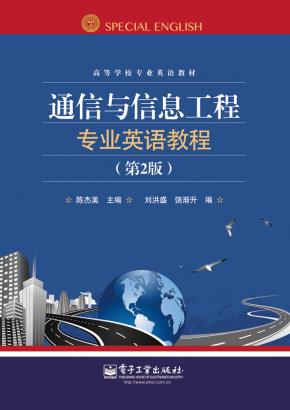
通信与信息工程专业英语教程(第2版)"
本书旨在培养和提高学生在通信专业方面的英语阅读、笔译能力,同时也有助于培养英语专业文章的写作能力和对专业问题的口头表达能力。本书简要介绍科技英语的基本知识和特点。本书课文精选自国外知名大学的通信工程教科书,涵盖现代电子通信的各个领域,系统性强,且行文流畅。各课皆附有生词表、难点注释和练习题。书后附有参考译文和参考文献。为方便教学,本书另配有电子教案和练习题参考答案,向采纳本书作为教材的教师免费提供。
前 言 科技专业英语是大学英语教学的重要组成部分, 是帮助和促进学生继续英语学习, 并学以致用的有效途径。本书旨在帮助通信与信息工程和相关专业的学生提高阅读、理解和笔译专业英语文献的能力, 以及培养用英语书写科技文章及其摘要的能力,也有助于通过课堂教学和其他方式, 培养用英语口头讨论专业问题的能力。 本书首先简要介绍科技英语的基本知识, 说明科技英语的特点和学习科技专业英语应注意的问题, 有助于后续课程的学习和教学, 这是本书的一个特点。随后分20课来展开通信专业英语的学习。书中课文均精选自国外知名大学近年编著的通信与信息工程教科书。之所以从教科书选材, 是因为行文流畅, 概念准确, 深入浅出, 生僻词少, 同时其内容又紧跟科学技术的发展, 最适于专业英语的学习。所选内容几乎涵盖了现代电子通信各个领域的基本知识, 有助于把专业英语的学习与专业知识的学习结合起来, 也有助于提高学生学习专业英语的兴趣,并学以致用。每课课文之后,均列出了该课文的生词及词意,以便学习时查阅。并给出课文中的难句、长句,以及难以理解的词组的解释。对一些专业知识背景做了说明,有利于对课文的正确、深入理解。每课均附有短小精悍的阅读材料,以便学生课后阅读。最后,笔者结合多年专业英语教学的经验,编撰了适量的、形式多样的练习题,以利于教与学的组织与开展,也便于学生自我检查。在本书书后附有各课课文(节选)的参考译文和参考文献,以便学生和教师查阅参考。 为了方便教学,本书另配有电子教案和练习题参考答案,向采纳本书作为教材的教师免费提供。(获取方式:登录电子工业出版社华信教育资源网www.hxedu.com.cn或电话联系01088254537获得)。 本书第0课、第1~6课由陈杰美编写,第7,10~12,17~19课由刘洪盛编写,第8,9,13~16,20课由饶渐升编写。全书由陈杰美教授统稿,由刘洪盛整理,由饶渐升校核。在本书的编写过程中,杜江、杨乐、张红英和电子科技大学的其他同仁给予了热情的鼓励和帮助,编者对他们表示衷心的感谢。 由于编者水平有限,书中疏漏或不妥之处在所难免,敬请读者指正。 反馈意见请发邮件至: jmchen@uestc.edu.cn或 jsrao@uestc.edu.cn。


CONTENTS Lesson 0 科技英语的基础知识 0.1 科技英语中的几个关键问题 (Some Key Problems in Scientific and Technical English) 0.1.1 词汇(Vocabularies or Words) 0.1.2 虚义词(Form Words) 0.1.3 长句(Long Sentences) 0.2 翻译的准则(Criteria of Translation) 0.3 翻译中的变换(Changes in Translation) 0.3.1 词类的变换(Changes Between Word Classes) 0.3.2 词序的变换(Changes in Word Order) 0.3.3 省略(Ellipsis) 0.3.4 补充(Supplements) 0.3.5 引申(Extensions) 0.4 关于数量(Numbers and Quantities) 0.4.1 数制(Number Systems) 0.4.2 量词的缩写(Abbreviations about Numbers) 0.4.3 关于数量的增减(About Increase and Decrease) 0.5 数学符号与数学式(Mathematic Symbols and Expressions) 0.5.1 常用数学符号(Mathematic Symbols) 0.5.2 常用希腊字母(Grecian Letters) 0.5.3 常用数学式(Mathematic Expressions) 0.6 论文标题与摘要的写作(How to Write a Thesis) 0.6.1 论文标题(How to Write the Title) 0.6.2 论文摘要(How to Write the Abstract) 0.6.3 论文摘要的常用句型(Some Useful Patterns Used in the Abstract) 0.6.4 例子(Examples) Lesson 1 Introduction to Electronic Communications 1.1 Historical Perspective 1.2 Electronic Communications Systems 1.3 The Electromagnetic Spectrum 1.4 Bandwidth and Information Capacity Reading Material Lesson 2 Information Sources 2.1 Speech and Music 2.2 Pictures 2.3 Computer Data 2.4 Noise Reading Material Lesson 3 Information Systems 3.1 Information and Data 3.2 Information System 3.3 Computerbased Information System 3.4 Business Information Systems Reading Material Lesson 4 Signal Generation 4.1 LC Circuits 4.2 Oscillators 4.3 IntegratedCircuit Waveform Generation 4.4 Digital Waveform Generation Reading Material Lesson 5 Random Processes 5.1 Introduction 5.2 Mathematical Definition of a Random Process 5.3 Stationary Process 5.4 Mean, Correlation, and Covariance Functions 5.5 Ergodic Processes 5.6 Gaussian Process Reading Material Lesson 6 Amplitude Modulation Transmission 6.1 Principles of Amplitude Modulation 6.2 Singleside Band Modulation 6.3 Generation of SSB Waves 6.4 Weaver SSB frequency shifting technique Reading Material Lesson 7 Angle Modulation 7.1 Representation of PM and FM Signals 7.2 Spectra of AngleModulated Signals 7.3 Narrowband Angle Modulation 7.4 Wideband Frequency Modulation 7.5 Preemphasis and Deemphasis in AngleModulated Systems Reading Material Lesson 8 Video Communications 8.1 Overview of Video communication 8.2 Typical Video applications 8.3 Communication Networks Reading Material Lesson 9 Transmission Lines 9.1 Types of Transmission Lines 9.2 Transmissionline Wave Propagation 9.3 Timedomain Reflectometry Reading Material Lesson 10 Electromagnetic Wave Propagation 10.1 Introduction 10.2 Optical Properties of Radio Waves 10.3 Terrestrial Propagation of Electromagnetic Waves Reading Material Lesson 11 Antennas and Waveguides 11.1 Introduction 11.2 Antenna Terminology and Definitions 11.3 Antenna Arrays and Array Antenna[14] 11.4 Waveguides Reading Material Lesson 12 Optical fiber communications 12.1 Fibers in communications 12.2 FiberOptic Communication Equipment 12.3 Transmitters Operational Considerations 12.4 WDM Systems Reading Material Lesson 13 Digital Modulation 13.1 Introduction 13.2 Factors That Influence the Choice of Digital Modulation 13.3 Binary Modulated Bandpass Signaling 13.4 Multilevel Modulated Bandpass Signaling Reading Material Lesson 14 Data Communications, Codes Error Control 14.1 Introduction 14.2 Data Communications Circuits 14.3 Data Communications Codes 14.4 Error Control Reading Material Lesson 15 Communication Networks 15.1 Telephone Networks 15.2 Computer Networks 15.3 Cable Television Networks 15.4 Wireless Networks Reading Material Lesson 16 Software Radio 16.1 Introduction 16.2 Characters of a Software Radio 16.3 The RF FrontEnd 16.4 Smart Antennas 16.5 Digital Generation of Signals Reading Material Lesson 17 Microwave Radio Communications 17.1 Introduction 17.2 FrequencyModulated Microwave Radio System 17.3 Digital Radio Systems Reading Material Lesson 18 Satellite Communication Systems 18.1 Introduction 18.2 Design of the Satellite Link 18.3 Network Architecture 18.4 Geostationary Satellite Systems Reading Material Lesson 19 Multiple Accessing 19.1 Introduction 19.2 Frequency Division Multiple Access 19.3 Time Division Multiple Access and ALOHA 19.4 Code Division Multiple Access Reading Material Lesson 20 Mobile Telephone Service 20.1 Introduction 20.2 Basic Cellular Telephone Concepts 20.3 Digital Cellular Telephone 20.4 Codedivision Multiple Accessing Reading Material 参考译文 参考文献
http://www.hxedu.com.cn/hxedu/fg/book/bookinfo.html?code=G0227760