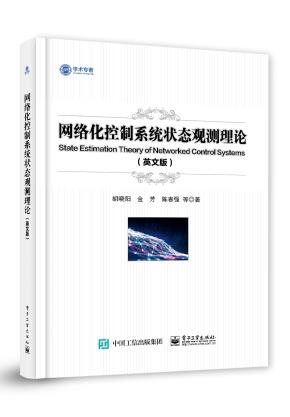
网络化控制系统状态观测理论(英文版) "
网络化控制系统(Networked Control Systems)是指系统中的设备经过通信网络交换信息的控制系统。网络化控制系统通过物联网连接了实体空间,可以在远距离下执行许多自动化控制任务。本书针对网络化控制系统中出现的数据传输延迟、数据包丢失、传输速率受限等情况,研究了线性系统状态观测问题,给出了量化器、编码器、解码器及控制器的设计方法,证明了确保系统可观测性和可稳定性的充分条件。 本书可作为高等学校自动化、检测技术、通信工程等相关专业大学本科生和研究生的双语教学用书,也可作为工程设计人员的参考书。
前言 物联网(Internet of Things )即“万物相连的互联网”,是在互联网基础上延伸和扩展的网络,是将各种信息传感设备与网络结合起来而形成的一个巨大网络,可以实现任何时间、任何地点的人、机、物的互联互通。网络化控制系统(Networked Control Systems)是指控制回路的元件通过物联网交换资料的控制系统。网络化控制系统通过物联网连接了实体空间,可以在远距离下执行许多自动化控制任务。网络化控制系统的优点有很多,如部件采用无线通信代替有线连接,可以节省系统成本;可以实现远距离的自动化控制;可以在大实体空间内整合信息,做出最优决策等。 5G不仅要解决人与人的通信问题,更要解决人与物、物与物的通信问题,满足移动医疗、车联网、智能家居、工业控制、环境监测等物联网应用的需求。最终,5G将渗透到经济社会的各行业领域,成为支撑经济社会数字化、网络化、智能化转型的关键新型基础设施。近年来,5G技术促进了网络化控制技术的发展,吸引了许多研究者的关注。5G技术的出现,使网络化控制系统中的一些关键性技术难题得到了根本解决。 北斗卫星导航产业是基于我国自主研发的北斗卫星导航系统,在军事、民用、科技等方面形成的庞大产业链,是我国未来的重要战略性新兴产业。北斗卫星导航系统的精准位置服务,已在国内的智能驾考、城市燃气管网中有了很好的示范应用,而在智能交通、无人驾驶、农机导航、灾害监测等领域也将大显身手。基于北斗卫星导航技术,网络化控制理论也将能够在智能交通、无人驾驶等系统中应用。 本书针对网络化控制系统中出现的数据传输延迟、数据包丢失、传输速率受限等情况,研究了线性系统状态观测问题,给出了量化器、编码器、解码器及控制器的设计方法,证明了确保系统可观测性和可稳定性的充分条件。 本书共6章。 第1章研究了网络化控制系统中的传输速率定理,分别证明了线性离散时间控制系统传输速率定理与线性连续时间控制系统传输速率定理。 第2章研究了在传输速率受限情况下,网络化控制系统的编码器、解码器设计方法,提出了固定长度编码和解码方法、可变长度编码和解码方法、时变长度编码和解码方法。 第3章在传输速率受限情况下,分别研究了一阶线性连续时不变系统、多输入多输出线性系统、具有约当标准型系统矩阵的线性系统可观测问题,并讨论了在极限速率情况下的离散时间线性系统和连续时间线性系统可观测问题。 第4章在传输速率受限情况下,研究了数据传输时间延迟对线性系统可观测性和可稳定性的影响,分别在固定时间延迟、随机延迟情况下证明了确保系统可观测的充分条件。 第5章在传输速率受限情况下,研究了数据包丢失对线性系统可观测性和可稳定性的影响,证明了在数据包丢失情况下的线性系统可观测性条件,同时考虑了数据包丢失和传输时间延迟对线性系统可观测性的影响。 第6章在传输速率受限情况下,研究了线性二次指标最优控制(LQ)问题。 沈阳理工大学胡晓阳老师撰写了第1章和第5章,沈阳理工大学金芳老师撰写了第2章和第6章,沈阳理工大学刘庆泉、党智慧、郭恒、刘孝齐,武汉大学卫星导航定位技术研究中心、中国科学院海西研究院高级工程师陈春强撰写了第3章和第4章。陈春强负责本书总体构思,并完成了大量的修改、校对等工作。另外,感谢福建省STS计划配套项目2019T3008和福州市重点科技专项2020FZZD0601的资助!书中难免有不妥和错误之处,殷切希望广大读者予以批评指正。 作者 2022年1月1日


Chapter 1 Data-Rate Theorem for Networked Control Systems 1 1.1 Linear Discrete-Time Systems 1 1.1.1 Introduction 1 1.1.2 Problem Formulation 4 1.1.3 State Estimation under Data-Rate Limitations 5 1.1.4 Numerical Examples and Simulations 19 1.2 Linear Continuous Time-Invariant Systems 21 1.2.1 Introduction 22 1.2.2 Problem Formulation 23 1.2.3 State Estimation under Information Limitations 24 1.2.4 Numerical Examples and Simulations 26 References 28 Chapter 2 Coding Schemes for Observability and Stabilizability under Data-Rate Limitations 31 2.1 Variable-Length Coding 31 2.1.1 Introduction 31 2.1.2 Problem Formulation 33 2.1.3 Quantization, Coding and Control Schemes 35 2.1.4 Sufficient Conditions for Observability and Stabilizability 40 2.1.5 Numerical Examples and Simulations 50 2.2 Fixed-Length Coding 53 2.2.1 Introduction 53 2.2.2 Problem Formulation 54 2.2.3 Quantization and Coding 55 2.2.4 Numerical Examples and Simulations 61 2.3 Time-Varying Coding 62 2.3.1 Introduction 63 2.3.2 Problem Formulation 64 2.3.3 Quantization and Coding 65 2.3.4 Numerical Examples and Simulations 72 References 74 Chapter 3 State Estimation under Data-Rate Limitations 78 3.1 Scalar Linear Continuous Time-Invariant Systems 78 3.1.1 Introduction 78 3.1.2 Problem Formulation 79 3.1.3 Conditions on the Constant Data Rate for Observability 80 3.1.4 Numerical Examples and Simulations 83 3.2 Multi-Input Multi-Output Linear Systems 85 3.2.1 Introduction 85 3.2.2 Problem Formulation 86 3.2.3 Conditions on the Constant Data Rate for Observability 88 3.2.4 Numerical Examples and Simulations 91 3.3 Jordan Canonical Form of System Matrix 93 3.3.1 Introduction 93 3.3.2 Problem Formulation 94 3.3.3 A Lower Bound on the Data Rate for Observability 96 3.4 Linear Discrete-Time Systems with Extreme Data-Rate Limitations 100 3.4.1 Introduction 100 3.4.2 Problem Formulation 101 3.4.3 Optimal Encoder and Decoder Design 102 3.4.4 Numerical Examples and Simulations 105 3.5 Linear Continuous-Time Systems with Extreme Data-Rate Limitations 106 3.5.1 Introduction 107 3.5.2 Problem Formulation 108 3.5.3 Conditions for Observability 109 3.5.4 Numerical Examples and Simulations 112 References 113 Chapter 4 Observability and Stabilizability of Linear Systems with Time Delays 117 4.1 Systems with Random Time Delays 117 4.1.1 Introduction 117 4.1.2 Problem Formulation 119 4.1.3 State Estimation over Channels with Random Time Delays 120 4.1.4 Numerical Examples and Simulations 124 4.2 Systems with Random Time Delays and Limited Data-Rates 126 4.2.1 Introduction 126 4.2.2 Problem Formulation 127 4.2.3 Optimal Encoder and Decoder Design 130 4.2.4 Conditions for Observability 132 4.2.5 Numerical Examples and Simulations 142 4.3 Systems with Fixed Time Delay 146 4.3.1 Introduction 146 4.3.2 Problem Formulation 147 4.3.3 Control under Communication Constraints 148 4.3.4 Numerical Examples and Simulations 152 References 154 Chapter 5 State Estimation over Limited Capacity and Dropout Channels 158 5.1 Observability over an AWGN Channel 158 5.1.1 Introduction 158 5.1.2 Problem Formulation 159 5.1.3 State Estimation over AWGN Channels 160 5.1.4 Numerical Examples and Simulations 163 5.2 Observability under Packet Dropout and Time Delay 165 5.2.1 Introduction 165 5.2.2 Problem Formulation 166 5.2.3 Sufficient Conditions for Observability 167 5.2.4 Numerical Examples and Simulations 170 References 173 Chapter 6 Linear Quadratic Control for Networked Control Systems with Information Limitations 176 6.1 LQ Cost for Plant States 176 6.1.1 Introduction 176 6.1.2 Problem Formulation 177 6.1.3 LQ Control under Information Limitations 178 6.2 LQ Cost for Plant States and Control Inputs 184 6.2.1 Introduction 184 6.2.2 Problem Formulation 186 6.2.3 Control Scheme under Information Rate Limitations 186 6.2.4 Numerical Examples and Simulations 190 References 192