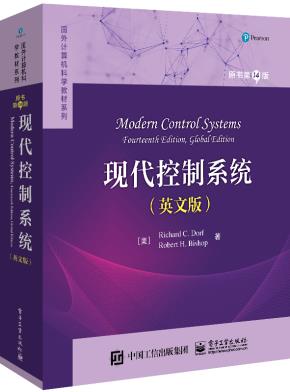
现代控制系统(原书第14版)(英文版) "
控制系统原理及相近课程是高等学校信息类和机电类等专业学生的核心课程之一,本书一直是此类课程畅销全球的教材范本,主要内容包括控制系统导论、系统数学模型、状态空间模型、反馈控制系统的特性、反馈控制系统的性能、线性反馈系统的稳定性、根轨迹法、频率响应法、频域稳定性、反馈控制系统设计、状态变量反馈系统设计、鲁棒控制系统和数字控制系统等。本书的例子和习题大多取材于现代科技领域中的实际问题,新颖而恰当。学习和解决这些问题,可以使学生的创造性素养得到潜移默化的提升。
Preface MODERN CONTROL SYSTEMS—THE BOOK Global issues such as climate change, clean water, sustainability, pandemics, waste management, emissions reduction, and minimizing raw material and energy use have led many engineers to re-think existing approaches to engineering design. One outcome of the evolving design strategy is to consider green engineering and human-centered design. The goal of these approaches to engineering is to design products that minimize pollution, reduce the risk to human health, and improve the living environment. Applying the principles of green engineering and human-centered design highlights the power of feedback control systems as an enabling technology. To reduce greenhouse gases and minimize pollution, it is necessary to improve both the quality and quantity of our environmental monitoring systems. One example is to use wireless measurements on mobile sensing platforms to measure the external environment. Another example is to monitor the quality of the delivered power to measure leading and lagging power, voltage variations, and waveform harmonics. Many green engineering systems and components require careful monitoring of current and voltages. For example, current transformers are used in various capacities for measuring and monitoring current within the power grid network of interconnected systems used to deliver electricity. Sensors are key components of any feedback control system because the measurements provide the required information as to the state of the system so the control system can take the appropriate action. The role of control systems will continue to expand as the global issues facing us require ever increasing levels of automation and precision. In the book, we present key examples from green engineering such as wind turbine control and modeling of a photovoltaic generator for feedback control to achieve maximum power delivery as the sunlight varies over time. The wind and sun are important sources of renewable energy around the world. Wind energy conversion to electric power is achieved by wind energy turbines connected to electric generators. The intermittency characteristic of the wind makes smart grid development essential to bring the energy to the power grid when it is available and to provide energy from other sources when the wind dies down or is disrupted. A smart grid can be viewed as a system comprised of hardware and software that routes power more reliably and efficiently to homes, businesses, schools, and other users of power in the presence of intermittency and other disturbances. The irregular character of wind direction and power also results in the need for reliable, steady electric energy by using control systems on the wind turbines themselves. The goal of these control devices is to reduce the effects of wind intermittency and the effect of wind direction change. Energy storage systems are also critical technologies for green engineering. We seek energy storage systems that are renewable, such as fuel cells. Active control can be a key element of effective renewable energy storage systems as well. Another exciting development for control systems is the evolution of the Internet of Things—a network of physical objects embedded with electronics, software, sensors and connectivity. As envisioned, each of the millions of the devices on the network will possess an embedded computer with connectivity to the Internet. The ability to control these connected devices will be of great interest to control engineers. Indeed, control engineering is an exciting and a challenging field. By its very nature, control engineering is a multidisciplinary subject, and it has taken its place as a core course in the engineering curriculum. It is reasonable to expect different approaches to mastering and practicing the art of control engineering. Since the subject has a strong mathematical foundation, we might approach it from a strictly theoretical point of view, emphasizing theorems and proofs. On the other hand, since the ultimate objective is to implement controllers in real systems, we might take an ad hoc approach relying only on intuition and hands-on experience when designing feedback control systems. Our approach is to present a control engineering methodology that, while based on mathematical fundamentals, stresses physical system modeling and practical control system designs with realistic system specifications. We believe that the most important and productive approach to learning is for each of us to rediscover and re-create anew the answers and methods of the past. Thus, the ideal is to present the student with a series of problems and questions and point to some of the answers that have been obtained over the past decades. The traditional method—to confront the student not with the problem but with the finished solution—is to deprive the student of all excitement, to shut off the creative impulse, to reduce the adventure of humankind to a dusty heap of theorems. The issue, then, is to present some of the unanswered and important problems that we continue to confront, for it may be asserted that what we have truly learned and understood, we discovered ourselves. The purpose of this book is to present the structure of feedback control theory and to provide a sequence of exciting discoveries as we proceed through the text and problems. If this book is able to assist the student in discovering feedback control system theory and practice, it will have succeeded. THE AUDIENCE This text is designed for an introductory undergraduate course in control systems for engineering students. There is very little demarcation between the various engineering areas in control system practice; therefore, this text is written without any conscious bias toward one discipline. Thus, it is hoped that this book will be equally useful for all engineering disciplines and, perhaps, will assist in illustrating the utility of control engineering. The numerous problems and examples represent all fields, and the examples of the sociological, biological, ecological, and economic control systems are intended to provide the reader with an awareness of the general applicability of control theory to many facets of life. We believe that exposing students of one discipline to examples and problems from other disciplines will provide them with the ability to see beyond their own field of study. Many students pursue careers in engineering fields other than their own. We hope this introduction to control engineering will give students a broader understanding of control system design and analysis. In its first thirteen editions, Modern Control Systems has been used in senior-level courses for engineering students at many colleges and universities globally. It also has been used in courses for engineering graduate students with no previous background in control engineering. THE FOURTEENTH EDITION In this edition, There are Over 20% new or updated problems. There are over 980 end-of-chapter exercises, problems, advanced problems, design problems, and computer problems. A companion website is also available to students and faculty using the fourteenth edition. The website contains many resources, including the m-files in the book, Laplace and z-Transform tables, written materials on matrix algebra and complex numbers, symbols, units, and conversion factors, and an introduction to MATLAB and to the LabVIEW MathScript RT Module. We continue the design emphasis that historically has characterized Modern Control Systems. Using the real-world engineering problems associated with designing a controller for a disk drive read system, we present the Sequential Design Example, which is considered sequentially in each chapter using the methods and concepts in that chapter. Disk drives are used in computers of all sizes and they represent an important application of control engineering. Various aspects of the design of controllers for the disk drive read system are considered in each chapter. For example, in Chapter 1 we identify the control goals, identify the variables to be controlled, write the control specifications, and establish the preliminary system configuration for the disk drive. Then, in Chapter 2, we obtain models of the process, sensors, and actuators. In the remaining chapters, we continue the design process, stressing the main points of the chapters. In the same spirit as the Sequential Design Example, we present a design problem that we call the Continuous Design Problem to give students the opportunity to build upon a design problem from chapter to chapter. High-precision machinery places stringent demands on table slide systems. In the Continuous Design Problem, students apply the techniques and tools presented in each chapter to the development of a design solution that meets the specified requirements. The computer-aided design and analysis component of the book continues to evolve and improve. Also, many of the solutions to various components of the Sequential Design Example utilize m-files with corresponding scripts included in the figures. A Skills Check section is included at the end of each chapter. In each Skills Check section, we provide three sets of problems to test your knowledge of the chapter material. This includes True or False, Multiple Choice, and Word Match problems. To obtain direct feedback, you can check your answers with the answer key provided at the conclusion of the end-of-chapter problems. PEDAGOGY The book is organized around the concepts of control system theory as they have been developed in the frequency and time domains. An attempt has been made to make the selection of topics, as well as the systems discussed in the examples and problems, modern in the best sense. Therefore, this book includes discussions on robust control systems and system sensitivity, state variable models, controllability and observability, computer control systems, internal model control, robust PID controllers, and computer-aided design and analysis, to name a few. However, the classical topics of control theory that have proved to be so very useful in practice have been retained and expanded. Building Basic Principles: From Classical to Modern. Our goal is to present a clear exposition of the basic principles of frequency and time-domain design techniques. The classical methods of control engineering are thoroughly covered: Laplace transforms and transfer functions; root locus design; Routh-Hurwitz stability analysis; frequency response methods, including Bode, Nyquist, and Nichols; steady-state error for standard test signals; second-order system approximations; and phase and gain margin and bandwidth. In addition, coverage of the state variable method is significant. Fundamental notions of controllability and observability for state variable models are discussed. Full state feedback design with Ackermann’s formula for pole placement is presented, along with a discussion on the limitations of state variable feedback. Observers are introduced as a means to provide state estimates when the complete state is not measured. Upon this strong foundation of basic principles, the book provides many opportunities to explore topics beyond the traditional. In the latter chapters, we present introductions into more advanced topics of robust control and digital control, as well as an entire chapter devoted to the design of feedback control systems with a focus on practical industrial lead and lag compensator structures. Problem solving is emphasized throughout the chapters. Each chapter (but the first) introduces the student to the notion of computer-aided design and analysis. Progressive Development of Problem-Solving Skills. Reading the chapters, attending lectures and taking notes, and working through the illustrated examples are all part of the learning process. But the real test comes at the end of the chapter with the problems. The book takes the issue of problem solving seriously. In each chapter, there are five problem types: . Exercises .Problems . Advanced Problems . Design Problems . Computer Problems For example, the problem set for Mathematical Models of Systems, Chapter 2 includes 31 exercises, 51 problems, 9 advanced problems, 6 design problems, and 10 computer-based problems. The exercises permit the students to readily utilize the concepts and methods introduced in each chapter by solving relatively straightforward exercises before attempting the more complex problems. The problems require an extension of the concepts of the chapter to new situations. The advanced problems represent problems of increasing complexity. The design problems emphasize the design task; the computer-based problems give the student practice with problem solving using computers. In total, the book contains more than 980 problems. The abundance of problems of increasing complexity gives students confidence in their problem solving ability as they work their way from the exercises to the design and computer-based problems. An instructor’s manual, available to all adopters of the text for course use, contains complete solutions to all end-of-chapter problems. A set of m-files, the Modern Control Systems Toolbox, has been developed by the authors to supplement the text. The m-files contain the scripts from each computer-based example in the text. Design Emphasis without Compromising Basic Principles. The all-important topic of design of real-world, complex control systems is a major theme throughout the text. Emphasis on design for real-world applications addresses interest in design by ABET and industry. The design process consists of seven main building blocks that we arrange into three groups: 1. Establishment of goals and variables to be controlled, and definition of specifications (metrics) against which to measure performance 2. System definition and modeling 3. Control system design and integrated system simulation and analysis In each chapter of this book, we highlight the connection between the design process and the main topics of that chapter. The objective is to demonstrate different aspects of the design process through illustrative examples. Various aspects of the control system design process are illustrated in detail in many examples across all the chapters, including applications of control design in robotics, manufacturing, medicine, and transportation (ground, air, and space). Each chapter includes a section to assist students in utilizing computer-aided design and analysis concepts and in reworking many of the design examples. Generally, m-files scripts are provided that can be used in the design and analyses of the feedback control systems. Each script is annotated with comment boxes that highlight important aspects of the script. The accompanying output of the script (generally a graph) also contains comment boxes pointing out significant elements. The scripts can also be utilized with modifications as the foundation for solving other related problems. Learning Enhancement. Each chapter begins with a chapter preview describing the topics the student can expect to encounter. The chapters conclude with an end-of-chapter summary, skills check, as well as terms and concepts. These sections reinforce the important concepts introduced in the chapter and serve as a refer-ence for later use. Color is used to add emphasis when needed and to make the graphs and figures easier to interpret. For example, consider the computer control of a robot to spray-paint an automobile. We might ask the student to investigate the closed-loop system stability for various values of the controller gain K and to determine the response to a unit step disturbance, Td (s) = 1/s, when the input R (s) = 0. The associated figure assists the student with (a) visualizing the problem, and (b) taking the next step to develop the transfer function model and to complete the analyses. THE ORGANIZATION Chapter 1 Introduction to Control Systems. Chapter 1 provides an introduction to the basic history of control theory and practice. The purpose of this chapter is to describe the general approach to designing and building a control system. Chapter 2 Mathematical Models of Systems. Mathematical models of physical systems in input–output or transfer function form are developed in Chapter 2. A wide range of systems are considered. Chapter 3 State Variable Models. Mathematical models of systems in state variable form are developed in Chapter 3. The transient response of control systems and the performance of these systems are examined. Chapter 4 Feedback Control System Characteristics. The characteristics of feed-back control systems are described in Chapter 4. The advantages of feedback are discussed, and the concept of the system error signal is introduced. Chapter 5 The Performance of Feedback Control Systems. In Chapter 5, the performance of control systems is examined. The performance of a control system is correlated with the s-plane location of the poles and zeros of the transfer function of the system. Chapter 6 The Stability of Linear Feedback Systems. The stability of feedback systems is investigated in Chapter 6. The relationship of system stability to the characteristic equation of the system transfer function is studied. The Routh-Hurwitz stability criterion is introduced. Chapter 7 The Root Locus Method. Chapter 7 deals with the motion of the roots of the characteristic equation in the s-plane as one or two parameters are varied. The locus of roots in the s-plane is determined by a graphical method. We also introduce the popular PID controller and the Ziegler-Nichols PID tuning method. Chapter 8 Frequency Response Methods. In Chapter 8, a steady-state sinusoid input signal is utilized to examine the steady-state response of the system as the frequency of the sinusoid is varied. The development of the frequency response plot, called the Bode plot, is considered. Chapter 9 Stability in the Frequency Domain. System stability utilizing frequency response methods is investigated in Chapter 9. Relative stability and the Nyquist criterion are discussed. Stability is considered using Nyquist plots, Bode plots, and Nichols charts. Chapter 10 The Design of Feedback Control Systems. Several approaches to designing and compensating a control system are described and developed in Chapter 10. Various candidates for service as compensators are presented and it is shown how they help to achieve improved performance. The focus is on lead and lag compensators. Chapter 11 The Design of State Variable Feedback Systems. The main topic of Chapter 11 is the design of control systems using state variable models. Full-state feedback design and observer design methods based on pole placement are discussed. Tests for controllability and observability are presented, and the concept of an internal model design is discussed. Chapter 12 Robust Control Systems. Chapter 12 deals with the design of highly accurate control systems in the presence of significant uncertainty. Five methods for robust design are discussed, including root locus, frequency response, ITAE methods for robust PID controllers, internal models, and pseudo-quantitative feedback. Chapter 13 Digital Control Systems. Methods for describing and analyzing the performance of computer control systems are described in Chapter 13. The stability and performance of sampled-data systems are discussed. ACKNOWLEDGMENTS We wish to express our sincere appreciation to the following individuals who have assisted us with the development of this Fourteenth edition, as well as all previous editions: John Hung, Auburn University; Zak Kassas, University of California-Irvine; Hanz Richter, Cleveland State Universtiy; Abhishek Gupta, The Ohio State University; Darris White, Embry Riddle Aeronautical University; John K. Schueller, University of Florida; Mahmoud A. Abdallah, Central Sate University (OH); John N. Chiasson, University of Pittsburgh; Samy El-Sawah, California State Polytechnic University, Pomona; Peter J. Gorder, Kansas State University; Duane Hanselman, University of Maine; Ashok Iyer, University of Nevada, Las Vegas; Leslie R. Koval, University of Missouri-Rolla; L. G. Kraft, University of New Hampshire; Thomas Kurfess, Georgia Institute of Technology; Julio C. Mandojana, Mankato State University; Luigi Mariani, University of Padova; Jure Medanic, University of Illinois at Urbana-Champaign; Eduardo A. Misawa, Oklahoma State University; Medhat M. Morcos, Kansas State University; Mark Nagurka, Marquette University; D. Subbaram Naidu, Idaho State University; Ron Perez, University of Wisconsin-Milwaukee; Carla Schwartz, The MathWorks, Inc.; Murat Tanyel, Dordt College; Hal Tharp, University of Arizona; John Valasek, Texas A & M University; Paul P. Wang, Duke University; and Ravi Warrier, GMI Engineering and Management Institute. Special thanks to Greg Mason, Seattle University, and Jonathan Sprinkle, University of Arizona, for developing the interactives and the video solutions. ACKNOWLEDGMENTS FOR THE GLOBAL EDITION Pearson would like to acknowledge and thank the following for the Global Edition. CONTRIBUTORS Benjamin Chong, University of Leeds Murat Do?ruel, Marmara University Quang Ha, University of Technology Sydney Ashish Rajeshwar Kulkarni, Delhi Technological University Savita Nema, Maulana Azad National Institute of Technology Bhopal Mark Ovinis, Universiti Teknologi PETRONAS Bidyadhar Subudhi, National Institute of Technology Rourkela REVIEWERS Quang Ha, University of Technology Sydney Shen Hin Lim, University of Waikato Mark Ovinis, Universiti Teknologi PETRONAS Fuwen Yang, Griffith University OPEN LINES OF COMMUNICATION The authors would like to establish a line of communication with the users of Modern Control Systems. We encourage all readers to send comments and suggestions for this and future editions. By doing this, we can keep you informed of any general-interest news regarding the textbook and pass along comments of other users. Keep in touch! Robert H. Bishop


CHAPTER 1 Introduction to Control Systems 控制系统导论 1.1 Introduction 引言 1.2 Brief History of Automatic Control 自动控制简史 1.3 Examples of Control Systems 控制系统实例 1.4 Engineering Design 工程设计 1.5 Control System Design 控制系统设计 1.6 Mechatronic Systems 机电一体化系统 1.7 Green Engineering 绿色工程 1.8 The Future Evolution of Control Systems 控制系统前瞻 1.9 Design Examples 设计实例 1.10?Sequential Design Example: Disk Drive Read System 循序渐进设计实例——磁盘驱动器读取系统 1.11?Summary 小结 Skills Check 技能自测 Exercises 基础练习题 Problems 一般习题 Advanced Problems 难题 Design Problems 设计题 Terms and Concepts 术语和概念 CHAPTER 2 Mathematical Models of Systems 系统数学模型 2.1 Introduction 引言 2.2 Differential Equations of Physical Systems 物理系统的微分方程(组) 2.3 Linear Approximations of Physical Systems 物理系统的线性近似 2.4 The Laplace Transform 拉普拉斯变换 2.5 The Transfer Function of Linear Systems 线性系统的传递函数 2.6 Block Diagram Models 框图模型 2.7 Signal-Flow Graph Models 信号流图模型 2.8 Design Examples 设计实例 2.9 The Simulation of Systems Using Control Design Software ?利用控制系统设计软件进行系统仿真 2.10?Sequential Design Example: Disk Drive Read System ?循序渐进设计实例——磁盘驱动器读取系统 2.11?Summary 小结 Skills Check 技能自测 Exercises 基础练习题 Problems 一般习题 Advanced Problems 难题 Design Problems 设计题 Computer Problems 计算机辅助设计题 Terms and Concepts 术语和概念 CHAPTER 3 State Variable Models 状态空间模型 3.1 Introduction 引言 3.2 The State Variables of a Dynamic System 动态系统的状态变量 3.3 The State Differential Equation 状态微分方程(组) 3.4 Signal-Flow Graph and Block Diagram Models 信号流图模型和框图模型 3.5 Alternative Signal-Flow Graph and Block Diagram Models ?其他形式的信号流图模型和框图模型 3.6 The Transfer Function from the State Equation 由状态方程求解传递函数 3.7 The Time Response and the State Transition Matrix 状态转移矩阵和系统时间响应 3.8 Design Examples 设计实例 3.9 Analysis of State Variable Models Using Control Design Software 利用控制系统设计软件分析状态空间模型 3.10?Sequential Design Example: Disk Drive Read System 循序渐进设计实例——磁盘驱动器读取系统 3.11?Summary 小结 Skills Check 技能自测 Exercises 基础练习题 Problems 一般习题 Advanced Problems 难题 Design Problems 设计题 Computer Problems 计算机辅助设计题 Terms and Concepts 术语和概念 CHAPTER 4 Feedback Control System Characteristics 反馈控制系统的特性 4.1 Introduction 引言 4.2 Error Signal Analysis 偏差信号分析 4.3 Sensitivity of Control Systems to Parameter Variations 控制系统对参数变化的灵敏度 4.4 Disturbance Signals in a Feedback Control System 反馈控制系统的干扰信号 4.5 Control of the Transient Response 系统瞬态响应的调控 4.6 Steady-State Error 稳态误差 4.7 The Cost of Feedback 反馈的代价 4.8 Design Examples 设计实例 4.9 Control System Characteristics Using Control Design Software 利用控制系统设计软件分析控制系统的特性 4.10?Sequential Design Example: Disk Drive Read System 循序渐进设计实例——磁盘驱动器读取系统 4.11?Summary 小结 Skills Check 技能自测 Exercises 基础练习题 Problems 一般习题 Advanced Problems 难题 Design Problems 设计题 Computer Problems 计算机辅助设计题 Terms and Concepts 术语和概念 CHAPTER 5 The Performance of Feedback Control Systems 反馈控制系统的性能 5.1 Introduction 引言 5.2 Test Input Signals 测试输入信号 5.3 Performance of Second-Order Systems 二阶系统的性能 5.4 Effects of a Third Pole and a Zero on the Second-Order System Response ?零点和第三个极点对二阶系统响应的影响 5.5 The s-Plane Root Location and the Transient Response s平面上特征根的位置与系统的瞬态响应 5.6 The Steady-State Error of Feedback Control Systems 反馈控制系统的稳态误差 5.7 Performance Indices 综合性能指标 5.8 The Simplification of Linear Systems 线性系统的简化 5.9 Design Examples 设计实例 5.10?System Performance Using Control Design Software 利用控制系统设计软件分析系统性能 5.11?Sequential Design Example: Disk Drive Read System ?循序渐进设计实例——磁盘驱动器读取系统 5.12?Summary 小结 Skills Check 技能自测 Exercises 基础练习题 Problems 一般习题 Advanced Problems 难题 Design Problems 设计题 Computer Problems 计算机辅助设计题 Terms and Concepts 术语和概念 CHAPTER 6 The Stability of Linear Feedback Systems 线性反馈系统的稳定性 6.1 The Concept of Stability 稳定性的概念 6.2 The Routh–Hurwitz Stability Criterion 劳斯–赫尔维茨稳定性判据 6.3 The Relative Stability of Feedback Control Systems 反馈控制系统的相对稳定性 6.4 The Stability of State Variable Systems 状态变量系统的稳定性 6.5 Design Examples 设计实例 6.6 System Stability Using Control Design Software ?利用控制系统设计软件分析系统的稳定性 6.7 Sequential Design Example: Disk Drive Read System ?循序渐进设计实例——磁盘驱动器读取系统 6.8 Summary 小结 Skills Check 技能自测 Exercises 基础练习题 Problems 一般习题 Advanced Problems 难题 Design Problems 设计题 Computer Problems 计算机辅助设计题 Terms and Concepts 术语和概念 CHAPTER 7 The Root Locus Method 根轨迹法 7.1 Introduction 引言 7.2 The Root Locus Concept 根轨迹的概念 7.3 The Root Locus Procedure 绘制根轨迹 7.4 Parameter Design by the Root Locus Method 应用根轨迹法进行参数设计 7.5 Sensitivity and the Root Locus 灵敏度与根轨迹 7.6 PID Controllers PID控制器 7.7 Negative Gain Root Locus 负增益根轨迹 7.8 Design Examples 设计实例 7.9 The Root Locus Using Control Design Software 利用控制系统设计软件分析根轨迹 7.10?Sequential Design Example: Disk Drive Read System 循序渐进设计实例——磁盘驱动器读取系统 7.11?Summary 小结 Skills Check 技能自测 Exercises 基础练习题 Problems 一般习题 Advanced Problems 难题 Design Problems 设计题 Computer Problems 计算机辅助设计题 Terms and Concepts 术语和概念 CHAPTER 8 Frequency Response Methods 频率响应法 8.1 Introduction 引言 8.2 Frequency Response Plots 频率响应图 8.3 Frequency Response Measurements 频率响应测量 8.4 Performance Specifications in the Frequency Domain 频域性能指标 8.5 Log-Magnitude and Phase Diagrams 对数幅相图 8.6 Design Examples 设计实例 8.7 Frequency Response Methods Using Control Design Software ?利用控制系统设计软件的频率响应方法 8.8 Sequential Design Example: Disk Drive Read System 循序渐进设计实例——磁盘驱动器读取系统 8.9 Summary 小结 Skills Check 技能自测 Exercises 基础练习题 Problems 一般习题 Advanced Problems 难题 Design Problems 设计题 Computer Problems 计算机辅助设计题 Terms and Concepts 术语和概念 CHAPTER 9 Stability in the Frequency Domain 频域稳定性 9.1 Introduction 引言 9.2 Mapping Contours in the s-Plane s平面上的围线映射 9.3 The Nyquist Criterion 奈奎斯特稳定性判据 9.4 Relative Stability and the Nyquist Criterion 相对稳定性与奈奎斯特稳定性判据 9.5 Time-Domain Performance Criteria in the Frequency Domain ?利用频域方法确定系统的时域性能指标 9.6 System Bandwidth 系统带宽 9.7 The Stability of Control Systems with Time Delays 时延系统的稳定性 9.8 Design Examples 设计实例 9.9 PID Controllers in the Frequency Domain 频域中的PID控制器 9.10?Stability in the Frequency Domain Using Control Design Software ?利用控制系统设计软件分析频域稳定性 9.11?Sequential Design Example: Disk Drive Read System ?循序渐进设计实例——磁盘驱动器读取系统 9.12?Summary 小结 Skills Check 技能自测 Exercises 基础练习题 Problems 一般习题 Advanced Problems 难题 Design Problems 设计题 Computer Problems 计算机辅助设计题 Terms and Concepts 术语和概念 CHAPTER 10 The Design of Feedback Control Systems 反馈控制系统设计 10.1 Introduction 引言 10.2 Approaches to System Design 系统设计方法 10.3 Cascade Compensators 串联校正器 10.4 Phase-Lead Design Using the Bode Plot 用伯德图法设计超前校正器 10.5 Phase-Lead Design Using the Root Locus 用根轨迹法设计超前校正器 10.6 System Design Using Integration Compensators 利用积分型校正器设计反馈控制系统 10.7 Phase-Lag Design Using the Root Locus 用根轨迹法设计滞后校正器 10.8 Phase-Lag Design Using the Bode Plot 用伯德图法设计滞后校正器 10.9 Design on the Bode Plot Using Analytical Methods??在伯德图上用解析法进行系统设计 10.10?Systems with a Prefilter 带前置滤波器的反馈控制系统 10.11?Design for Deadbeat Response 设计具有最小节拍响应的系统 10.12?Design Examples 设计实例 10.13?System Design Using Control Design Software 利用控制系统设计软件设计控制系统 10.14?Sequential Design Example: Disk Drive Read System??循序渐进设计实例——磁盘驱动器读取系统 10.15?Summary 小结 Skills Check 技能自测 Exercises 基础练习题 Problems 一般习题 Advanced Problems 难题 Design Problems 设计题 Computer Problems 计算机辅助设计题 Terms and Concepts 术语和概念 CHAPTER 11 The Design of State Variable Feedback Systems 状态变量反馈系统设计 11.1 Introduction 引言 11.2 Controllability and Observability 能控性和能观性 11.3 Full-State Feedback Control Design 全状态反馈控制设计 11.4 Observer Design 观测器设计 11.5 Integrated Full-State Feedback and Observer 观测器和全状态反馈控制的集成 11.6 Reference Inputs 参考输入信号 11.7 Optimal Control Systems 最优控制系统 11.8 Internal Model Design 内模设计 11.9 Design Examples 设计实例 11.10?State Variable Design Using Control Design Software??利用控制系统设计软件设计状态变量反馈 11.11?Sequential Design Example: Disk Drive Read System ?循序渐进设计实例——磁盘驱动器读取系统 11.12?Summary 小结 Skills Check 技能自测 Exercises 基础练习题 Problems 一般习题 Advanced Problems 难题 Design Problems 设计题 Computer Problems 计算机辅助设计题 Terms and Concepts 术语和概念 CHAPTER 12 Robust Control Systems 鲁棒控制系统 12.1 Introduction 引言 12.2 Robust Control Systems and System Sensitivity 鲁棒控制系统和系统灵敏度 12.3 Analysis of Robustness 鲁棒性分析 12.4 Systems with Uncertain Parameters 含有不确定参数的系统 12.5 The Design of Robust Control Systems 鲁棒控制系统设计 12.6 The Design of Robust PID-Controlled Systems 鲁棒PID控制器设计 12.7 The Robust Internal Model Control System 鲁棒内模控制系统 12.8 Design Examples 设计实例 12.9 The Pseudo-Quantitative Feedback System 伪定量反馈系统 12.10?Robust Control Systems Using Control Design Software 利用控制系统设计软件设计鲁棒控制系统 12.11?Sequential Design Example: Disk Drive Read System 循序渐进设计实例——磁盘驱动器读取系统 12.12?Summary 小结 Skills Check 技能自测 Exercises 基础练习题 Problems 一般习题 Advanced Problems 难题 Design Problems 设计题 Computer Problems 计算机辅助设计题 Terms and Concepts 术语和概念 CHAPTER 13 Digital Control Systems 数字控制系统 13.1 Introduction 引言 13.2 Digital Computer Control System Applications 数字控制系统应用概况 13.3 Sampled-Data Systems 采样控制系统 13.4 The z-Transform z变换 13.5 Closed-Loop Feedback Sampled-Data Systems 闭环反馈采样控制系统 13.6 Performance of a Sampled-Data, Second-Order System 二阶采样控制系统的性能 13.7 Closed-Loop Systems with Digital Computer Compensation 带有数字校正器的闭环系统 13.8 The Root Locus of Digital Control Systems 数字控制系统的根轨迹 13.9 Implementation of Digital Controllers 控制器的数字实现 13.10?Design Examples 设计实例 13.11?Digital Control Systems Using Control Design Software??利用控制系统设计软件设计数字控制系统 13.12?Sequential Design Example: Disk Drive Read System??循序渐进设计实例——磁盘驱动器读取系统 13.13?Summary 小结 Skills Check 技能自测 Exercises 基础练习题 Problems 一般习题 Advanced Problems 难题 Design Problems 设计题 Computer Problems 计算机辅助设计题 Terms and Concepts 术语和概念