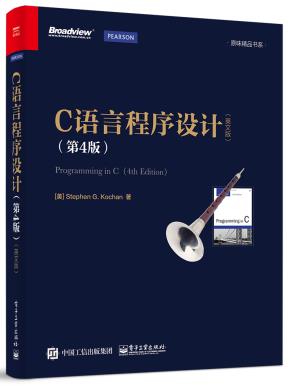
C语言程序设计(第4版)英文版"
本书全面介绍了C语言的各种特性,包括C11中增加的内容。书中包含大量完整的示例及详细的讲解。附录中详尽总结了C语言和C语言库,两者的组织形式都便于快速参考。 本书通过示例来教授C语言,每个新概念都有完整的C程序做演示。你不仅可以学习这门语言的基础知识,还能养成良好的程序设计习惯。另外,每章最后附有习题,便于课堂学习或自学。 无论是否拥有编程经验,你都可以通过本书透彻地理解C语言。
对于任何开始学习使用C语言编写程序的人来说,这本书都是极好的。这是一本优秀的入门教科书,拥有丰富的示例、出色的文字……我就是用这本书来学习C语言的——这是一本超棒的书。 ——Vinit S. Carpenter,Learn C/C++ Today


目录 Introduction 1 Some Fundamentals Programming Higher-Level Languages Operating Systems Compiling Programs Integrated Development Environments Language Interpreters 2 Compiling and Running Your First Program Compiling Your Program Running Your Program Understanding Your First Program Displaying the Values of Variables Comments Exercises 3 Variables, Data Types, and Arithmetic Expressions Understanding Data Types and Constants The Integer Type int The Floating Number Type float The Extended Precision Type double The Single Character Type char The Boolean Data Type _Bool Type Specifiers: long , long long , short , unsigned , and signed Working with Variables Working with Arithmetic Expressions Integer Arithmetic and the Unary Minus Operator Combining Operations with Assignment: The Assignment Operators Types _Complex and _Imaginary Exercises 4 Program Looping Triangular Numbers The for Statement Relational Operators Aligning Output Program Input Nested for Loops for Loop Variants The while Statement The do Statement The break Statement The continue Statement Exercises 5 Making Decisions The if Statement The if-else Construct Compound Relational Tests Nested if Statements The else if Construct The switch Statement Boolean Variables The Conditional Operator Exercises 6 Working with Arrays Defining an Array Using Array Elements as Counters Generating Fibonacci Numbers Using an Array to Generate Prime Numbers Initializing Arrays Character Arrays Base Conversion Using Arrays The const Qualifier Multidimensional Arrays Variable Length Arrays Exercises 7 Working with Functions Defining a Function Arguments and Local Variables Function Prototype Declaration Automatic Local Variables Returning Function Results Functions Calling Functions Calling... Declaring Return Types and Argument Types Checking Function Arguments Top-Down Programming Functions and Arrays Assignment Operators Sorting Arrays Multidimensional Arrays Global Variables Automatic and Static Variables Recursive Functions Exercises 8 Working with Structures The Basics of Structures A Structure for Storing the Date Using Structures in Expressions Functions and Structures A Structure for Storing the Time Initializing Structures Compound Literals Arrays of Structures Structures Containing Structures Structures Containing Arrays Structure Variants Exercises 9 Character Strings Revisiting the Basics of Strings Arrays of Characters Variable-Length Character Strings Initializing and Displaying Character Strings Testing Two Character Strings for Equality Inputting Character Strings Single-Character Input The Null String Escape Characters More on Constant Strings Character Strings, Structures, and Arrays A Better Search Method Character Operations Exercises 10 Pointers Pointers and Indirection Defining a Pointer Variable Using Pointers in Expressions Working with Pointers and Structures Structures Containing Pointers Linked Lists The Keyword const and Pointers Pointers and Functions Pointers and Arrays A Slight Digression About Program Optimization Is It an Array or Is It a Pointer? Pointers to Character Strings Constant Character Strings and Pointers The Increment and Decrement Operators Revisited Operations on Pointers Pointers to Functions Pointers and Memory Addresses Exercises 11 Operations on Bits The Basics of Bits Bit Operators The Bitwise AND Operator The Bitwise Inclusive-OR Operator The Bitwise Exclusive-OR Operator The Ones Complement Operator The Left Shift Operator The Right Shift Operator A Shift Function Rotating Bits Bit Fields Exercises 12 The Preprocessor The #define Statement Program Extendability Program Portability More Advanced Types of Definitions The # Operator The ## Operator The #include Statement System Include Files Conditional Compilation The #ifdef, #endif, #else, and #ifndef Statements The #if and #elif Preprocessor Statements The #undef Statement Exercises 13 Extending Data Types with the Enumerated Data Type, Type Definitions, and Data Type Conversions Enumerated Data Types The typedef Statement Data Type Conversions Sign Extension Argument Conversion Exercises 14 Working with Larger Programs Dividing Your Program into Multiple Files Compiling Multiple Source Files from the Command Line Communication Between Modules External Variables Static Versus Extern Variables and Functions Using Header Files Effectively Other Utilities for Working with Larger Programs The make Utility The cvs Utility Unix Utilities: ar, grep, sed, and so on 15 Input and Output Operations in C Character I/O: getchar() and putchar() Formatted I/O: printf() and scanf() The printf() Function The scanf() Function Input and Output Operations with Files Redirecting I/O to a File End of File Special Functions for Working with Files The fopen Function The getc() and putc() Functions The fclose() Function The feof Function The fprintf() and fscanf() Functions The fgets() and fputs() Functions stdin, stdout, and stderr The exit() Function Renaming and Removing Files Exercises 16 Miscellaneous and Advanced Features Miscellaneous Language Statements The goto Statement The null Statement Working with Unions The Comma Operator Type Qualifiers The register Qualifier The volatile Qualifier The restrict Qualifier Command-line Arguments Dynamic Memory Allocation The calloc() and malloc() Functions The sizeof Operator The free Function Exercises 17 Debugging Programs Debugging with the Preprocessor Debugging Programs with gdb Working with Variables Source File Display Controlling Program Execution Getting a Stack Trace Calling Functions and Setting Arrays and Structures Getting Help with gdb Commands Odds and Ends 18 Object-Oriented Programming What Is an Object Anyway? Instances and Methods Writing a C Program to Work with Fractions Defining an Objective-C Class to Work with Fractions Defining a C++ Class to Work with Fractions Defining a C# Class to Work with Fractions A C Language Summary 1.0 Digraphs and Identifiers 2.0 Comments 3.0 Constants 4.0 Data Types and Declarations 5.0 Expressions 6.0 Storage Classes and Scope 7.0 Functions 8.0 Statements 9.0 The Preprocessor B The Standard C Library Standard Header Files String Functions Memory Functions Character Functions I/O Functions In-Memory Format Conversion Functions String-to-Number Conversion Dynamic Memory Allocation Functions Math Functions General Utility Functions C Compiling Programs with gcc General Command Format Command-Line Options D Common Programming Mistakes E Resources The C Programming Language C Compilers and Integrated Development Environments Miscellaneous Index
Stephen G. Kochan 使用C语言设计软件已经有超过30年的时间。他是几本最畅销的C语言书籍的作者,包括Programming in C、Programming in Objective-C和Topics in C Programming。他在UNIX方面也有大量著述,是Exploring the UNIX System和UNIX Shell Programming等书的著者或合著者。__eol__对本书有贡献的作者__eol__Dean Miller 是一位作家和编辑,在出版和特许消费者产品领域都拥有超过20年的经验。他是Sams Teach Yourself C in One Hour a Day和Sams Teach Yourself Beginning Programming in 24 Hours最近几个版本的合著者。