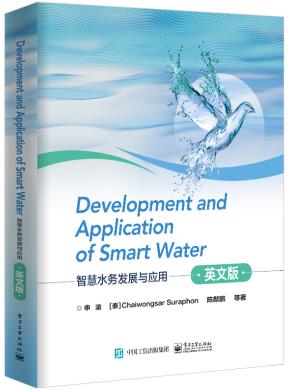
智慧水务发展与应用(英文版)"
智慧水务是近年来快速发展的行业,具有广阔的应用前景和市场需求。本书从水务系统发展演变出发,总结当前水务行业面临的挑战与机遇,汇总水务行业发展的瓶颈问题及潜在解决方案,分析判断水务系统智慧化升级的行业需求、政策引导、技术可行性和发展智慧水务大趋势;按照智慧供水和智慧污水两大类,系统梳理智慧水务应用现状,以及典型应用场景的原理和技术方案,对比国内外的智慧水务发展状况,从传感器、执行器、物联网和人工智能技术等层面讨论了智慧水务领域的发展前景。
Introduction As a rapidly developing industry in recent years, smart water has potential for broad application to meet market demands. Starting with the development and evolution of the water system, this book presents a summary of the challenges and opportunities faced by the current water industry, as well as the bottlenecks and potential solutions in the development of the water industry; an analysis and evaluation of the industry demand, policy guidance, and technical feasibility with regard to how to make the water system smarter, as well as the general trend of smart water development; systematic review of the status quo of smart water application by smart water supply and smart wastewater, and the principles and technical schemes for typical application scenarios; comparison of smart water developments at home and abroad; and discussions about the future of smart water development from the perspectives of sensors, actuators, Internet of Things and artificial intelligence. This book is intended for workers in the water industry and its upstream and downstream chain, as well as researchers who are newly involved in this field. It will help them to quickly understand the general picture of the water industry, its bottlenecks, and the current situation and development trend of smart water. 前??言 近年来,人工智能、物联网、移动互联网、大数据、云计算等新型信息技术快速发展并在各领域取得广泛应用,智慧交通、智慧水务等相关领域得到广泛关注和研究。随着水资源短缺和水环境污染等问题的日益突出,水务行业为更好地实现节约水资源、保护水环境、保障人民群众用水安全这一目标,需要充分利用新一代信息技术,深入挖掘和广泛运用水务信息资源,通过水务信息的采集、传输、存储、处理服务,实现水务行业的管理智能化、决策科学化,全面提升水务管理效率和服务水平。发展智慧水务是实现这一目标的可行技术方案,将成为传统水务转型升级的重要方向。 智慧水务是指将传统水务与现代信息化技术深度融合,以提高水务的管理和服务水平,在水务管控与调度、资源管理与协调、安全生产与环境保护、能源管理与优化等领域,进行业务创新,实现水务智慧化管理。本书由智慧水务领域的研究者、从业者共同撰写。从水务系统发展演变出发,总结当前水务行业面临的机遇与挑战,分析水务行业发展趋势及相关技术,系统梳理智慧水务典型应用场景的原理、技术和设计方案,并讨论了智慧水务领域的发展前景。智慧水务研究领域的一个普遍认识是:传感器+执行器+物联网+人工智能=智慧水务。按照该框架分析智慧水务的发展前景: 在传感器层面,水质、水量、水压等指标的准确、快捷、高频、经济、无污染监测将是未来的发展热点,卫星遥感、无人机遥测以及其他非接触式监测理论与技术是最有可能取得突破的方向。 在执行器层面,用于进水控制、精细曝气和精准投药的新型可控水泵、风机、阀门等已经上市,但其性能和价格需要进一步优化以便中小型自来水厂和污水处理厂能够承担设备升级改造的成本。 在物联网层面,智慧水务可能融入区块链、5G等新技术,保障云端与设备、设备与设备之间通信的稳定、及时和安全。 在人工智能层面,将深度融合机理模型和数据模型,充分发挥两类建模方案的优势,整合两个方向的新技术,构建更加完善的水务系统管理“智慧大脑”,满足不同工艺类型、不同处理规模的老厂、扩建厂和新建厂等情境下的智能管理需求。 本书第4~7章由申渝教授牵头撰写,约12万字;第3、9章由泰国兰纳皇家理工大学(Rajamangala University of Technology Lanna)副校长Chaiwongsar Suraphon博士牵头撰写,约7.8万字,第12~14章由陈猷鹏教授牵头撰写,约10万字;第8、10和11章由王建辉博士牵头撰写,约11万字;第1~2章由于歆老师牵头撰写,约8.6万字。所有章节内容均由高旭教授、泰国国家科学技术研究院清洁能源与环境学部(Thailand Institute of Scientific and Technological Research)主任Piyakuldumrong Prapun教授参与指导、建议和把关。感谢本课题组齐高相、郭智威、陈佳、范兴容、周月明、张冰等老师的支持和帮助,感谢课题组研究生游庆国、黄冬梅、李超、曾闻茹、万柯佚等参与资料收集、文献检索与整理工作。此外,感谢重庆中法环保研发中心有限公司冯东、鲜吉成、季久翠等工程师的倾囊相授,感谢重庆耐德自动化技术有限公司王万胜、李洪彪、石龙飞等工程师的倾力相助,他们从水务行业从业者角度给出许多宝贵的建议和帮助。 本书受到国家重点研发计划项目(2016YFE0205600)、重庆市科技局重点项目(cstc2018jszx-zdyfxmX0008和cstc2018jszx-cyztzxX0029)、工业污染控制新技术重庆市高校创新群体项目(CXQT19023)、管理科学与工程重庆市重点学科数据与信息管理团队项目(ZDPTTD201917)等的资助,受到重庆南向泰斯环保技术研究院、重庆智慧水务产业技术研究院以及重庆工商大学国家智能制造服务国际科技合作基地的支持。 智慧水务是近年来快速发展的行业,具有广阔的应用前景和市场需求,但无论是智慧水务的研究还是实践,在新技术应用、新理论创建和新装备开发等方面,还只是起步阶段,有很多难题需要解决。智慧水务处于不断发展的过程中,由于作者研究水平有限、情况了解有限、编写时间有限,书中肯定存在一些不足的地方,敬请广大读者批评指正。 作者 2020年4月于重庆 Preface In recent years, artificial intelligence, Internet of Things (IoT), mobile Internet, Big Data, Cloud computing and other emerging information technologies have experienced rapid growth and extensive application in various fields, with much attention and research on intelligent transportation and smart water. With water shortage and pollution of water environment becoming increasingly prominent, the water industry should make full use of the new-generation information technology, tap and utilize water information resources, and realize smart management of water industry, well-informed decision-making, and higher efficiency and service level in water management through the collection, transmission, storage and processing of water information. Developing smart water provides a feasible solution to achieve this goal. It will also lead the way to transformation and upgrading of traditional water affairs. Smart water aims to improve water management and service level through the deep integration of traditional water affairs and modern information technology, and requires business innovation to realize intelligent management of water affairs in terms of water control and dispatching, resource management and coordination, safe production and environmental protection, energy management and optimization. This book was jointly written by researchers and practitioners in the field of smart water. Starting with the development and evolution of the water system, it provides a summary of the existing opportunities and challenges faced by the water industry, analysis of the development trend and related technologies in the water industry, systematic review of the principles, technologies and design solutions under typical application scenarios of smart water, and discussions about the prospects of smart water development. A common understanding in smart water research is sensor + actuator + Internet of Things (IoT) + artificial intelligence = smart water. Under this framework, the prospect of smart water development is analyzed. At the sensor level, the future focus will be on accurate, fast, frequent, cost-effective, and pollution-free monitoring of water quality, water quantity and water pressure, and on satellite remote sensing, UAV remote sensing and other non-contact monitoring theories and technologies. At the actuator level, new controllable pumps, fans, valves, etc. used for water inflow control, fine aeration and precise dosing have been made available on the market. But their performance, and price, need to be further optimized so that small- and medium-sized waterworks and wastewater treatment plants can afford equipment upgrading. At the level of IoT, smart water may incorporate new technologies such as block chain and 5G communication to ensure stable, timely and safe communication between cloud and equipments, and between equipments and equipments. At the level of artificial intelligence, the mechanism model and the data model will be deeply integrated, bringing together the advantages of the two modeling approaches and new technologies in both directions to build a more perfect “intelligent brain” for water system management, and to meet the intelligent management requirements in different situations such as old plants, expansion plants and new plants with varying process types and capacity. Chapters 4–7 of this book, about 120,000 words, were written under the leadership of Professor Yu Shen; Chapters 3 and 9, about 78,000 words, were written under the leadership of Dr. Chaiwongsar Suraphon, Vice President of Rajamangala University of Technology Lanna, Thailand; Chapters 12–14, about 100,000 words, were written under the leadership of Professor Youpeng Chen; Chapters 8, 10 and 11, about 110,000 words, were written under the leadership of Dr. Jianhui Wang; Chapters 1–2, about 80,000 words, were written under the leadership of Teacher Xin Yu. Professor Xu Gao and Professor Piyakuldumrong Prapun, Director of Department of Clean Energy and Environment, Thailand Institute of Scientific and Technological Research, have participated in the guidance, suggestions and confirmation of all chapters. We would like to express our thanks to Gaoxiang Qi, Zhiwei Guo, Jia Chen, Xingrong Fan, Yueming Zhou, Bing Zhang and other teachers of our research group for their support and help, and thanks to Qingguo You, Dongmei Huang, Chao Li, Wenru Zeng, Keyi Wan and other graduate students in our research group for their participation in data collection, literature retrieval and collation. We would also like to extend my gratitude to Dong Feng, Jicheng Xian, Jiucui Ji and other engineers of Chongqing Sino French Environmental Excellence R&D Centre for their generous imparting, and thanks to Wansheng Wang, Hongbiao Li, Longfei Shi and other engineers of Chongqing Endurance Automation Solutions CO., LTD for their utmost aid. They have given many valuable suggestions and help from the perspective of water industry practitioners. This book has received funds from the National Key Research and Development Program of China (2016YFE0205600), Science and Technology Innovation Foundation of Chongqing (cstc2018jszx-zdyfxmX0008 and cstc2018jszx-cyztzxX0029), Innovation group of new technologies for industrial pollution control of Chongqing Education Commission (CXQT19023), and Scientific Research Team Project of Chongqing Technology and Business University (ZDPTTD201917). It is supported by Chongqing South-to-Thais Environmental Protection Technology Research Institute Co., Ltd., Chongqing Smart Water Industry Technology Research Institute and National Base of International Science and Technology Cooperation for Intelligent Manufacturing Service at Chongqing Technology and Business University. As a rapidly developing industry in recent years, smart water has potential for broad application to meet market demands. However, the research and practice of smart water have just started in the application of new technologies, the creation of new theories and the development of new equipment. Many challenges remain to be overcome. Smart water is still in the process of continuous development. Due to the authors’ limitations in research, understanding and the time for writing this book, it is surely not perfect. Readers are welcome to make comments and suggestions for its further improvement. Authors Chongqing, April 2020


Contents Part 1?Development of Water System Chapter 1?Current Situation and Challenges of Water System 2 1.1?Overview of water system 2 1.2?Current situation of water system 6 1.3?Challenges facing the water industry 7 Chapter 2?Comparison of Domestic and Overseas Water Development 11 2.1?Water supply in China 11 2.2?Wastewater treatment in China 15 2.3?Overseas water development 18 2.3.1?Water development in the US 18 2.3.2?Water development in the UK 20 2.3.3?Water development in Thailand 23 Chapter 3?Development Trend of Water Industry—Smart Water 26 3.1?Proposed measures for water industry development 26 3.1.1?Informatization of water affairs 26 3.1.2?Making software and hardware more intelligent 28 3.2?Overview of smart water 29 3.2.1?Introduction and advantages of smart water 29 3.2.2?Stages of smart water development 31 3.2.3?Prospect of smart water 32 3.3?Smart water related technologies 34 Part 2?Smart Water Supply System Chapter 4?Intelligent Management Technology for Drinking Water Sources 38 4.1?Current situation of drinking water sources in China 38 4.1.1?Classification of water sources and protected areas 38 4.1.2?Water quality and quantity standards for water sources 39 4.1.3?Assessment of water source safety 42 4.2?Water source management theory and technology 46 4.2.1?Water source management theory 46 4.2.2?Current situation and countermeasures of water source management 46 4.2.3?Intelligent management technology for water sources 49 4.3?Typical design scheme for intelligent management of water sources 52 4.3.1?Design of intelligent monitoring for water sources 52 4.3.2?Intelligent scheduling design for water sources 55 Chapter 5?Intelligent Control Technology for Water Supply Treatment System 56 5.1?Water supply treatment 56 5.1.1?Water supply treatment theory 56 5.1.2?Basic process of water supply treatment 56 5.1.3?Status quo of water supply treatment 57 5.1.4?Intelligent control of water supply treatment 58 5.2?Automatic control of core process units 59 5.2.1?Automatic control of water intake pumping station 59 5.2.2?Automatic control of dosing 60 5.2.3?Automatic control of filter tank 63 5.2.4?Automatic control of chlorination 63 5.3?Typical design scheme for intelligent control of water supply treatment system 65 5.3.1?Intelligent control system 66 5.3.2?Water quality management system 67 5.3.3?Equipment management system 69 Chapter 6?Smart Operation and Maintenance Technology for Water Supply Pipe ????? Network System 70 6.1?Monitoring methods for water supply pipe network 71 6.1.1?Water quality monitoring 71 6.1.2?Water pressure monitoring 73 6.1.3?Discharge monitoring 74 6.2?Model of water supply pipe network 75 6.2.1?Hydraulic model 76 6.2.2?BP neural network 81 6.3?Intelligent operation and maintenance of water supply pipe network 84 6.3.1?Optimal scheduling 84 6.3.2?Leakage control 85 6.3.3?Safeguards for secondary water supply 87 6.3.4?Visualization technology for operation and maintenance management 90 6.4?Typical design scheme for intelligent operation and maintenance of water supply pipe network 92 6.4.1?Monitoring system 94 6.4.2?Leakage control 95 6.4.3?Optimal scheduling 96 Chapter 7?Intelligent Service Technology at User Side 97 7.1?Intelligent monitoring and early warning services 98 7.1.1?Intelligent monitoring service 98 7.1.2?Intelligent early warning service 100 7.2?Intelligent customer service 100 7.2.1?Making customer service center intelligent 102 7.2.2?Online service platform 103 7.2.3?Intelligent business hall 103 7.3?Typical design scheme for intelligent service system at user side 104 Part 3?Smart Wastewater System Chapter 8?Forecast of Wastewater Quality and Quantity into WWTPs 108 8.1?Demand for forecast of wastewater quality and quantity 108 8.2?Wastewater quality and quantity forecast technology 109 8.2.1?Establishment of peripheral database 110 8.2.2?Prediction of wastewater quality and quantity 114 8.3?Typical design scheme 115 8.3.1?Technology adopted in the scheme 115 8.3.2?Specific design scheme 116 Chapter 9?Intelligent Operation Technology for Wastewater Treatment Facilities 119 9.1?Status quo and demand of wastewater treatment facilities 119 9.1.1?Status quo of wastewater treatment facilities 119 9.1.2?Problems with wastewater treatment facilities 125 9.1.3?Requirements of wastewater treatment facilities 130 9.2?Intelligent monitoring system for facilities 131 9.2.1?Significance of data monitoring 131 9.2.2?Main monitoring parameters 132 9.2.3?Monitoring data application 133 9.3?Intelligent control technology and equipment for facilities 134 9.3.1?Classification of automatic control technologies 134 9.3.2?Commonly used wastewater control strategies 136 9.3.3?Common intelligent control equipment 138 9.4?Typical design scheme for upgrading wastewater treatment facilities 141 9.4.1?Architecture and design of monitoring system 141 9.4.2?Design scheme for efficient lift pumping station 150 9.4.3?Design scheme for fine aeration system 153 9.4.4?Design scheme for intelligent dosing system 156 Chapter 10?Intelligent Management Technology for Wastewater Treatment System 158 10.1?Data modeling scheme 159 10.1.1?Scheme for ANN model 159 10.1.2?Scheme for support vector machine model 160 10.1.3?Scheme for regression analysis model 161 10.2?Scheme for mechanism model 162 10.2.1?Activated sludge model 163 10.2.2?ASM-based commercial software 165 10.3?Scheme for merging of mechanism and data models 165 10.3.1?Scheme for fusion of average values 166 10.3.2?Scheme for fusion weighted average values 166 10.3.3?Scheme for fusion of conservative values 167 10.3.4?Scheme for f (x,θ) fusion 168 10.4?Scheme for plan library 170 Chapter 11?Cloud Management Technology for WWTPs Group 173 11.1?Requirements for WWTPs group cloud management 174 11.1.1?Development status and competition pattern of wastewater treatment industry 175 11.1.2?Necessity of WWTPs group cloud management 178 11.1.3?Feasibility of WWTPs group cloud management 179 11.1.4?Value of applying WWTPs group cloud management 181 11.2?Principle and technology of WWTPs group cloud management 182 11.2.1?Basic principles of WWTPs group cloud management 182 11.2.2?Objectives of WWTPs group cloud management 183 11.2.3?WWTPs group cloud management technology and solution 185 11.2.4?Functions and description of WWTPs group cloud management 187 11.3?Design scheme for WWTPs group cloud management platform 188 11.3.1?Design principles of WWTPs group cloud management platform 188 11.3.2?Remote visual management of plant group site 190 11.3.3?Concentrated management and intelligent maintenance of equipment 191 11.3.4?Real-time monitoring of plant group production safety 192 11.3.5?Economic operation of plant group equipment 194 Part 4?Application Status and Prospect of Smart Water Chapter 12?Application of Smart Water Supply System 198 12.1?Intelligent and integrated water source management system 199 12.1.1?Intelligent management system of water source well 199 12.1.2?Intelligent management system of water intake pumping station 202 12.2?Intelligent management system of waterworks 204 12.2.1?System application 204 12.2.2?System composition 205 12.2.3?System functions 206 12.2.4?Equipment configuration 207 12.3?Intelligent management system of water supply pipe network 208 12.3.1?Intelligent management system of secondary water supply ?pump house 208 12.3.2?Water supply pipe network monitoring system 211 12.3.3?Intelligent management system for leakage/loss of water supply ?pipe network 213 12.3.4?Intelligent management system of fire hydrant and water cock 216 12.4?User-end intelligent and integrated management system 220 12.4.1?Wireless automatic meter reading system 220 12.4.2?Large user meter reading/urban water supply pipe network DMA ?measurement management system 222 Chapter 13?Application of Smart Wastewater System 227 13.1?Intelligent aeration control system 228 13.1.1?Aeration volume control system 228 13.1.2?Fine aeration control technology and operation decision support system 233 13.2?Intelligent and integrated management system 235 13.2.1?Wastewater service application system 235 13.2.2?Plant group cloud platform management system 237 13.3?Smart wastewater system in rural areas 240 13.3.1?Rural “smart water system” 240 13.3.2?Township and town sewage collection and treatment system 242 Chapter 14?Development Prospect of Smart Water 243 14.1?Development of water system with Chinese characteristics 243 14.1.1?Adaptation to local conditions 243 14.1.2?Strengthening independent innovation 244 14.1.3?Strengthening government regulation 245 14.1.4?Formulating emergency procedures 246 14.2?Combination with new technologies and theories 247 14.2.1?Artificial intelligence technology 247 14.2.2?Big Data analysis technology 248 14.2.3?Wastewater reclamation technology 249 14.2.4?Trenchless pipe repair technology 250 14.2.5?Water system security protection technology 251 14.2.6?Blockchain technology 254 14.2.7?5G technology 254 14.3?Prospect of smart water 255 14.3.1?Sensing module 256 14.3.2?Artificial intelligence module 260 14.3.3?Platform module 265 References 267 术语表(Glossary) 274