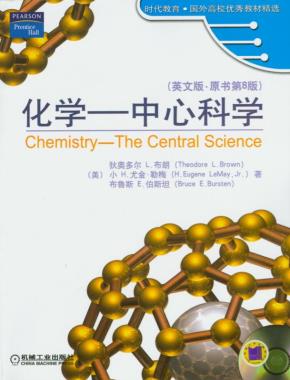
化学:中心科学(英文版)(原书第8版)(含1CD)"
国外高校优秀教材审定委员会 主任委员: 杨叔子 委员(按姓氏笔画为序) 王先逵 王大康 白峰杉 史荣昌 朱孝禄 陆启韶 张润琦 张三慧 张福润 张延华 吴宗泽 吴麒 宋心琦 李俊峰 佘远斌 陈文楷 陈立周 单辉祖 俞正光 赵汝嘉 郭可谦 翁海珊 龚光鲁 章栋恩 黄永畅 谭泽光


1 Introduction:Matter and Measurement
1.1 The Study of Chemistry
1.2 Classifications of Matter
1.3 Properties of Matter
1.4 Units of Measurement
1.5 Uncertainty in Measurement
1.6 Dimensional Analysis
2 Atoms,Molecules,and Ions
2.1 The Atomic Theory of Matter
2.2 The Discovery of Atomic Structure
2.3 The Modern View of Atomic Structure
2.4 The Periodic Table
2.5 Molecules and Molecular Compounds
2.6 Ions and Ionic Compounds
2.7 Naming Inorganic Compounds
3 Stoichiometry:Caculations with Chemical Formulas and Equations
3.1 Chemical Equatons
3.2 Patterns of Chemical Reactivity
3.3 Atomic and Molecular Weights
3.4 The Mole
3.5 Empirical Formulas from Analyses
3.6 Quantitative Information from Balanced Equations
3.7 Limiting Reactants
4 Aqueous Reactions and Solution Stoichiometry
4.1 General Properties of Aqueous Solutions
4.2 Precipitation Reactions
4.3 Acid-Base Reactions
4.4 Oxidation-Reduction Reactions
4.5 Concentrations of Solutions
4.6 Solution Stoichiometry and Chemical Analysis
5 Thermochemistry
5.1 The Nature of Energy
5.2 The First Law of Thermodynamics
5.3 Enthalpy
5.4 Enthalpies of Reaction
5.5 Calorimetry
5.6 Hess#s Law
5.7 Enthalpies of Formation
5.8 Foods and Fuels
6 Electronic Structure of Atoms
6.1 The Wave Nature of Light
6.2 Quantized Energy and Photons
6.3 Boh#s Model of the Hydrogen Atom
6.4 The Wave Behavior of Matter
6.5 Quantum Mechanics and Atomic Orbitals
6.6 Representations of Orbitals
6.7 Orbitals in Many-Electron Atoms
6.8 Electron Configurations
6.9 Electron Configurations and the Periodic Table
7 Periodic Properties of the Elements
7.1 Development of the Periodic Table
7.2 Electron Shells and the Sizes of Atoms
7.3 Ionization Energy
7.4 Electron Affinities
7.5 Metals, Nonmetals, and Metalloids
7.6 Group Trends for the Active Metals
7.7 Group Trends for Selected Nonmetals
8 Basic Concepts of Chemical bonding
8.1 Chemical Bonds, Lewis Symbols, and the Octet Rule
8.2 Ionic Bonding
8.3 Sizes of Ions
8.4 Covalent Bonding
8.5 Bond Polarity and Electronegativity
8.6 Drawing Lewis Structures
8.7 Resonace Structures
8.8 Exceptions to the Octet Rule
8.9 Strengths of Covalent Bonds
9 Molecular Geometry and Bonding theories
9.1 Molecular Shapes
9.2 The VSEPR Model
9.3 Polarity of Polyatomic Molecules
9.4 Covalent Bonding and Orbital Overlap
9.5 Hybrid Orbitals
9.6 Multiple Bonds
9.7 Molecular Orbitals
9.8 Second-Row Diatomic Molecules
10 Gases
10.1 Characteristics of Gases
10.2 Pressure
10.3 The Gas Laws
10.4 The Ideal-Gas Equation
10.5 Further Applications of the Ideal-Gas Equation
10.6 Gas Mixtures and Partial Pressures
10.7 Kinetic-Molecular Theory
10.8 Molecular Effusion and Diffusion
10.9 Real Gases: Deviations from Ideal Behavior
11 Intermolecular Forces,Liquids,and Solids
11.1 A Molecular Comparison of Liquids and Solids
11.2 Intermolecular Forces
11.3 Some Properties of Liquids
11.4 Phase Changes
11.5 Vapor Pressure
11.6 Phase Diagrams
11.7 Structures of Solids
11.8 Bonding in Solids
12 Modern Materials
12.1 Liquid Crystals
12.2 Polymers
12.3 Biomaterials
12.4 Ceramics
12.5 Thin Films
13 Properties of Solutions
13.1 The Solution Process
13.2 Saturated Solutions and Solubility
13.3 Factors Affecting Solubility
13.4 Ways of Expressing Concentration
13.5 Colligative Properties
13.6 Colloids
14 Chemical Kinetics
14.1 Reaction Rates
14.2 The Dependence of Rate on Concentration
14.3 The Change of Concentration with Time
14.4 Remperature and Rate
14.5 Reaction Mechanisms
14.6 Catalysis
15 Chemical Equilibrium
15.1 The Concept of Equilibrium
15.2 The Equilibrium Constant
15.3 Heterogeneous Equilibria
15.4 Calculation Equilibrium Constants
15.5 Applications of Equilibrium Constants
15.6 Le Chatelier#s Principle
16 Acid-Base Equilibria
16.1 Acids and Bases: A Brief Review
16.2 Bronsted-Lowry Acids and Bases
16.3 The Autoionization of Water
16.4 The Ph Scale
16.5 Strong Acids and Bases
16.6 Weak Acids
16.7 Weak Bases
16.8 Relationship Between Ka and Kb
16.9 Acid-Base Properties of Salt Solutions
16.10 Acid-Base Behavior and Chemical Structure
16.11 Lewis Acids and Bases
17 Additional Aspects of Aqueous Equilibria
17.1 The Common-Ion Effect
17.2 Buffered Solutions
17.3 Acid-Base Titrations
17.4 Solubility Equilibria
17.5 Factors That Affect Solubility
17.6 Precipitation and Separation of Ions
17.7 Qualitative Analysis for Metallic Elements
18 Chemistry of the Environment
18.1 Earth#s Atmosphere
18.2 The Outer Regions of the Atmosphere
18.3 Ozone in the Upper Atmosphere
18.4 Chemistry of the Troposphere
18.5 The World Ocean
18.6 Freshwater
19 Chemical Thermodynamics
19.1 Spontaneous Processes
19.2 Entropy and the Second Law of Thermodynamics
19.3 The Molecular Interpretation of Entropy
19.4 Calculation of Entropy Changes
19.5 Gibbs Free Energy
19.6 Free Energy and Temperature
19.7 Free Energy and the Equilibrium Constant
20 electrochemistry
20.1 Oxidation-Reduction Reactions
20.2 Balancing Oxidation-Reduction Equations
20.3 Voltaic Cells
20.4 Cell EMF
20.5 Spontaneity of Redox Reactions
20.6 Effect of Concentration on Cell EMF
20.7 Batteries
20.8 Corrosion
20.9 Electrolysis
21 nuclear Chemistry
21.1 Radioactivity
21.2 Patterns of Nuclear Stability
21.3 Nuclear Transmutations
21.4 Rates of Radioactive Decay
21.5 Detection of Radioactivity
21.6 Energy Changes in Nuclear Reactions
21.7 Nuclear Fission
21.8 Nuclear Fusion
21.9 Biological Effects of Radiation
22 Chemistry of the Nonmetals
22.1 General Concepts: Periodic Trends and Chemical Reactions
22.2 Hydrogen
22.3 Group 8A: The Noble Gases
22.4 Group 7A: The Halogens
22.5 Oxygen
22.6 The Other Group 6A Elements: S, Se, Te, and Po
22.7 Nitrogen
22.8 The Other Group 5A Elements: P, As,Sb, and Bi
22.9 Carbon
22.10 The Other Group 4A Elements: Si, Ge, Sn, and Pb
22.11 Boron
23 Metals and Metallurgy
23.1 Occurrence and Distribution of Metals
23.2 Pyrometallurgy
23.3 Hydrometallurgy
23.4 Electrometallurgy
23.5 Metallic Bonding
23.6 Alloys
23.7 Transition Metals
23.8 Chemistry of Selected Transition Metals
24 Chemistry of Coordination Compounds
24.1 The Structure of Complexes
24.2 Chelates
24.3 Isomerism
24.4 Color and Magnetism
24.5 Crystal-Field Theory
25 The Chemistry of Life:Organic and biological
25.1 A Look Back
25.2 Introduction to Hydrocarbons
25.3 Alkanes
25.4 Unsaturated Hydrocarbons
25.5 Functional Groups; Alcohols and Ethers
25.6 Compounds with a Carbonys Group
25.7 Chirality in Organic Chemistry
25.8 Introduction to Biochemistry
25.9 Proteins
25.10 Carbohydrates
25.11 Nucleic Acids
Appendices
A Mathematical Operations
B Properties of Water
C Thermodynamic Quantities for Selected Substances at 298.15K(25℃)
D Aqueous-Equilibrium Constants
E Standard Reduction Potentials at 25℃
Answers to Selected Exercises
Glossary
Photo/Art Credits
Index