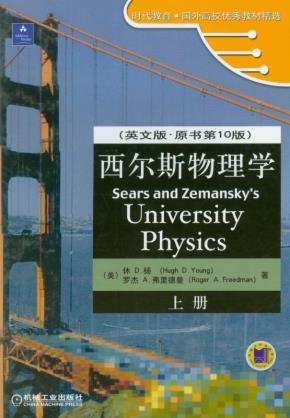
西尔斯物理学(上、下册)"
本书是一本在美国被普遍认可而广泛采用的大学物理教科书。内容包括力学、热学、振动与波、电磁学、光学、狭义相对论等。本书的特色是注重概念、原理的讲解,非常注意教给学生解答物理习题的方法;除配有大量、合适的例题外,还适时地总结列出利用原理解答习题的思路和步骤,并在学生易发生误解和错误的地方及时地加注;本书还引用了大量生动的生活实例,从实际出发,激发学生的学习兴趣,开阔学生的眼界。本书适用于一般工科院校,特别是双语教学。


MECHANICS
CHAPTER1 Units, Physical Quantities, and Vectors
1.1 Introduction
1.2 The Nature of Physics
1.3 Idealized Models
1.4 Standards an Units
1.5 Unit Consistency and Conversions
1.6 Uncertainty and Significant Figures
1.7 Estimates and Orders of Magnitude
1.8 Vectors and Vector Addition
1.9 Components of Vectors
1.10 Unit Vectors
1.11 Products of Vectors
Summary/Key Terms
Questions/Exercises/Problems
CHAPTER2 Motion Along a Straight Line
2.1 Introduction
2.2 Displacement, Time, and Average Velocity
2.3 Instantaneous Velocity
2.4 Average and Instantaneous Accleration
2.5 Motion with Constant Acceleration
2.6 Freely Falling Bodies
*2-7 Velocity and Position by Integratin
Summary/Key Terms
Questions/Exercises/Problems
CHAPTER3 Motion in Two or Three Dimensions
3.1 Introduction
3.2 Position and Velocity Vectors
3.3 The Acceleration Vector
3.4 Projectile Motion
3.5 Motion in a Circle
3.6 Relative Velocity
Summary/Key Terms
Questions/Exercises/Problems
CHAPTER4 Newton#s Laws of Motion
4.1 Introduction
4.2 Force and Interactions
4.3 Newtion#s First Law
4.4 Newton#s Second Law
4.5 Mass and Weight
4.6 Newton#s Third Law
4.7 Using Newton#s Laws
4.8 Free-Body Diagrams Visualized
Summary/Key Terms
Questions/Exercises/Problems
CHAPTER5 Applications of Newton#s Laws
5.1 Introduction
5.2 Using Newton#s First Law: Particles in Equilibrium
5.3 Using Newton#s Second Law: Dynamics of Particles
5.4 Frictional Forces
5.5 Dynamics of Circular Motion
*5.6 The Fundamental Forces of Nature
5.7 Projectile Motion with Air Resistance: A Case Study in Computer Analysis
Summary/Key Terms
Questions/Exercises/Problems
CHAPTER6 Work and Kinetic Energy
6.1 Introduction
6.2 Work
6.3 Work and Kinetic Energy
6.4 Work and Energy with Varying Forces
6.5 Power
6.6 Automotive Power: A Case Study in Energy Relations
Summary/Key Terms
Questions/Exercises/Problems
CHAPTER7 Potential Energy and Energy Conservation
7.1 Introduction
7.2 Gravitational Potential Energy
7.3 Elastic Potential Energy
7.4 Conservative and Nonconservative Forces
7.5 Force and Potential Energy
7.6 Energy Diagrams
Summary/Key Terms
Questions/Exercises/Problems
CHAPTER8 Momentum, Impulse, and Collisions
8.1 Introduction
8.2 Momentum and Impulse
8.3 Conservation of Momentum
8.4 Inelastic Collisions
8.5 Elastic Collisions
8.6 Center of Mass
*8.7 Rocket Propulsion
8.8 The Neutrino: A Case Study in Modern Physics
Summary/Key Terms
Questions/Exercises/Problems
CHAPTER9 Rotation of Rigid Bodies
9.1 Introduction
9.2 Angular Velocity and Acceleration
9.3 Rotation with Constant Angular Acceleration
9.4 Relating Linear and Angular Kinematics
9.5 Energy in Rotational Motion
9.6 Parallel-Axis Theorem
*9.7 Moment of Inertia Calculations
Summary/Key Terms
Questions/Exercises/Problems
CHAPTER10 Dynamics of Rotational Motion
10.1 Introduction
10.2 Torque
10.3 Torque and Angular Acceleration for a Rigid Body
10.4 Rigid-Body Rotation about a Moving Axis
10.5 Work and Power in Rotational Motion
10.6 Angular Momentum
10.7 Conservation of Angular Momentum
10.8 Gyroscopes and Precession
Summary/Key Terms
Questions/Exercises/Problems
CHAPTER11 Equilibrium and Elasticity
11.1 Introduction
11.2 Conditions for Equilibrium
11.3 Center of Gravity
11.4 Solving Rigid-Body Equilibrium Problems
11.5 Stress, Strain, and Elastic Moduli
11.6 Bulk Stress and Strain
11.7 Shear Stress and Strain
11.8 Elasticity and Plasticity
Summary/Key Terms
Questions/Exercises/Problems
CHAPTER12 Gravitation
12.1 Introduction
12.2 Newton#s Law of Gravitation
12.3 Weight
12.4 Gravitational Potential Energy
12.5 The Motion of Satellites
12.6 The Motion of Planets
*12.7 Spherical Mass Distributions
*12.8 Apparent Weight and the Earth#s Rotation
12.9 Black Holes: A Case Study in Modern Physics
Summary/Key Terms
Questions/Exercises/Problems
CHAPTER13 Periodic Motion
13.1 Introduction
13.2 The Causes of Oscillation
13.3 Simple Harmonic Motion
13.4 Energy in Simple Harmonic Motion
13.5 Applications of Simple Harmonic Motion
13.6 The Simple Pendulum
13.7 The Physical Pendulum
13.8 Damped Oscillations
13.9 Forced Oscillations, Resonance, and Chaos
Summary/Key Terms
Questions/Exercises/Problems
CHAPTER14 Fluid Mechanics
14.1 Introduction
14.2 Density
14.3 Pressure in a Fluid
14.4 Buoyancy
14.5 Surface Tension
14.6 Fluid Flow
14.7 Bernoulli#s Equation
14.8 Turbulence
14.9 Viscosity
Summary/Key Terms
Questions/Exercises/Problems
THERMODYNAMICS
CHAPTER15 Temperature and Heat
15.1 Introduction
15.2 Temperature and Thermal Equilibrium
15.3 Thermometers and Temperature Scales
15.4 Gas Thermometers and the Kelvin Scale
15.5 Thermal Expansion
15.6 Quantity of Heat
15.7 Calorimetry and Phase Changes
15.8 Mechanisms of Heat Transfer
15.9 Integrated Circuits:A Case Study in Heat Transfer
Summary/Key Terms
Questions/Exercises/Problems
CHAPTER16 Thermal Properties of Matter
16.1 Introduction
16.2 Equations of State
16.3 Molecular Properties of Matter
16.4 Kinetic-Melecular Model of an Indeal Gas
16.5 Heat Capacities
*16.6 Molecular Speeds
16.7 Phases of Matter
Summary/Key Terms
Questions/Exercises/Problems
CHAPTER17 The First Law of Thermodynamics
17.1 Introduction
17.2 Thermodynamic Systems
17.3 Work Done During Volume Changes
17.4 Paths Between Thermodynamic States
17.5 Internal Energy and the First Law of Thermodynamics
17.6 Kinds of Thermodynamic Processes
17.7 Internal Energy of an Ideal Gas
17.8 Heat Capacities of an Ideal Gas
17.9 Adiabatic Processes for an Ideal Gas
Summary/Key Terms
Questions/Exercises/Problems
CHAPTER18 The Second Law of Thermodynamics
18.1 Introduction
18.2 Directions of Thermodynamic Processes
18.3 Heat Engines
18.4 Internal-Combustion Engines
18.5 Refrigerators
18.6 The Second Law of Thermodynamics
18.7 The Carnot Cycle
*18.8 The Kelvin Temperature Scale
*18.9 Entropy
*18.10 Microscopic Interpretation of Entropy
18.11 Energy Resources: A Case Study in Thermodynamics
Summary/Key Terms
Questions/Exercises/Problems
WAVES/ACOUSTICS
CHAPTER19 Mechanical Waves
19.1 Introduction
19.2 Types of Mechanical Wavese
19.3 Periodic Waves
19.4 Mathematical Description of a Wave
19.5 Speed of a Transverse Wave
19.6 Speed of a Longitudinal Wave
19.7 Sound Wave Motion
19.8 Energy in Wave Motion
Summary/Key Terms
Questions/Exercises/Problems
CHAPTER20 Wave Interference and Normal Modes
20.1 Introduction
20.2 Boundary Conditions for a String and the Principle of Superposition
20.3 Standing Waves on a String
20.4 Normal Modes of a String
20.5 Longitudinal Standing Waves and Normal Modes
20.6 Interference of Waves
20.7 Resonace
Summary/Key Terms
Questions/Exercises/Problems
CHAPTER21 Sound and Hearing
21.1 Introduction
21.2 Sound Waves
21.3 Sound Intensity
21.4 Beats
21.5 The Doppler Effect
*21-6 Shock Waves
Summary/Key Terms
Questions/Exercises/Problems
ELECTROMAGNETISM
CHAPTER22 Electric Charge and Electric Field
22.1 Introduction
22.2 Electric Charge
22.3 Electric Charge and the Structure of Matter
22.4 Conductors, Insulators, and Induced Charges
22.5 Coulomb#s Law
22.6 Electric Field and Electric Forces
22.7 Electric-Field and Calculations
22.8 Electric Field Lines
22.9 Electric Dipoles
Summary/Key Terms
Questions/Exercises/Problems
CHAPTER23 Gauss#s Law
23.1 Introduction
23.2 Electric Charge and Electric Flux
23.3 Calculating Electric Flux
23.4 Gauss#s Law
23.5 Applications of Gauss#s Law
23.6 Charges of Conductors
Summary/Key Terms
Questions/Exercises/Problems
CHAPTER24 Electric Potential
24.1 Introduction
24.2 Electric Potential Energy
24.3 Electric Potential
24.4 Calculating Electric Potential
24.5 Equipotential Surfaces
24.6 Potential Gradient
24.7 The Cathode-Ray Tube
24.8 Calculating Potentials Due to Charged Conductors: A Case Study in Conputer Analysis
Summary/Key Terms
Questions/Exercises/Problems
CHAPTER25 Capacitance and Dielectrics
25.1 Introduction
25.2 Capacitors and Capacitance
25.3 Capacitors in Series and Parallel
25.4 Energy Storage in Capacitors and Electric-Field Energy
25.5 Dielectrics
*25.6 Molecular Model of Induced Charge
*25.7 Gauss#s Law in Dielectrics
Summary/Key Terms
Questions/Exercises/Problems
CHAPTER26 Current, Resistance, and Electromotive Force
26.1 Introduction
26.2 Current
26.3 Resistivity
26.4 Resistance
25.5 Electromotive Force and Circuits
*26.6 Energy and Power in Electric Circuits
*26.7 Theory of Metallic Conduction
*26.8 Physiological Effects of Currents
Summary/Key Terms
Questions/Exercises/Problems
CHAPTER27 Direct-Current Circuits
27.1 Introduction
27.2 Resistors in Series and Parallel
27.3 Kirchhoff#s Rules
27.4 Electrical Measuring Instruments
27.5 Resistance-Capacitance Circuits
27.6 Power Distribution Systems: A Case Study in Circuit Analysis
Summary/Key Terms
Questions/Exercises/Problems
CHAPTER28 Magnetic Field and Magnetic Forces
28.1 Introduction
28.2 Magnetism
28.3 Magnetic Field
28.4 Magnetic Field Lines and Magnetic Flux
28.5 Motion of Charged Particles in a Magnetic Field
28.6 Applications of Motion of Charged Particles
28.7 Magnetic Force on a Current-Carrying Conductor
28.8 Force and Torque on a Current Loop
*28.9 The Direct-Current Motor
*28.10 The Hall Effect
Summary/Key Terms
Questions/Exercises/Problems
CHAPTER29 Sources of Magnetic Field
29.1 Introduction
29.2 Magnetic Field of a Moving Charge
29.3 Magnetic Field of a Current Element
29.4 Magnetic Field of a Straight Current-Carrying Conductor
29.5 Force between Parallel Conductors
29.6 Magnetic Field of a Circular Current Loop
29.7 Ampere#s Law
28.8 Applications of Ampere#s Law
*29.9 Magnetic Materials
29.10 Displacement Current
Summary/Key Terms
Questions/Exercises/Problems
CHAPTER30 Electromagnetic Induction
30.1 Introduction
30.2 Induction Experiments
30.3 Faraday#s Law
30.4 Lenz#s Law
30.5 Motional Electromotive Force
30.6 Induced Electric Fields
*30.7 Eddy Currents
30.8 Maxwell#s Equations
*30.9 Superconductivity: A Case Study in Magnetic Properties
Summary/Key Terms
Questions/Exercises/Problems
CHAPTER31 Inductance
31.1 Introduction
31.2 Mutual Inductance
31.3 Self-Inductance and Inductors
31.4 Magnetic-Field Energy
31.5 The R-L Circuit
31.6 The L-C Circuit
31.7 The L-R-C Series Circuit
Summary/Key Terms
Questions/Exercises/Problems
CHAPTER32 Alternating Current
32.1 Introduction
32.2 Phasors and Alternating Currents
32.3 Resistance and Reactance
32.4 The L-R-C Series Circuit
32.5 Power in Alternating-Current Circuits
32.6 Resonance in Alternating-Current Circuits
32.7 Transformers
Summary/Key Terms
Questions/Exercises/Problems
CHAPTER33 Electromagnetic Waves
33.1 Introduction
33.2 Maxwell#s Equations and Electromagnetic
33.3 Plane Electromagnetic Waves and the Speed of Light
33.4 Sinusoidal Electromagnetic Waves
33.5 Energy and Momentum in Electromagnetic Waves
*33-6 Electromagnetic Waves in Matter
33.7 Standing Electromagnetic Waves
33.8 The Electromagnetic Spectrum
*33-9 Radiation from an Antenna
Summary/Key Terms
Questions/Exercises/Problems
CHAPTER34 The Nature and Propagation of Light
34.1 Introduction
34.2 The Nature of Light
34.3 Reflection and Refraction
34.4 Total Internal Reflection
*34-5 Dispersion
34-6 Polarization
*34-7 Scattering of Light
37.8 Huygen#s Principle
CHAPTER35 Geometric Optics
35.1 Introduction
35.2 Reflection and Refraction at a Plance Surface
35.3 Reflection at a Spherical Surface
35.4 Graphical Methods for Mirrors
35.5 Refraction at a Spherical Surface
35.6 Thin Lenses
35.7 Graphical Methods for Lenses
Summary/Key Terms
Questions/Exercises/Problems
CHAPTER36 Optical Instruments
36.1 Introduction
36.2 Cameras and Projectors
36.3 The Eye
36.4 The Magnifier
36.5 The Microscope
36.6 Telescopes
*36.7 Lens Aberrations
Summary/Key Terms
Questions/Exercises/Problems
CHAPTER37 Interference
37.1 Introduction
37.2 Interference and Coherent Sources
37.3 Two-Source Interference of Light
37.4 Intensity in Interference Patterns
37.5 Interference in Thin Films
37.6 The Michelson Interferometer
37.7 The Photon: A Case Study in Quantum Physics
Summary/Key Terms
Questions/Exercises/Problems
CHAPTER38 Diffraction
38.1 Introduction
38.2 Fresnel and Fraunhofer Diffraction
38.3 Diffraction from a Single Slit
38.4 Intensity in the Single-Slit Pattern
38.5 Multiple Slits
38.6 The Diffraction Grating
38.7 X-Ray Diffraction
38.8 Circular Apertures and Resolving Power
38.9 Holography
Summary/Key Terms
Questions/Exercises/Problems
MODERN PHYSICS
CHAPTER39 Relativity
39.1 Introduction
39.2 Invariance of Physical Laws
39.3 Relativity of Simultaneity
39.4 Relativity of Time Intervals
39.5 Relativity of Length
39.6 The Lorentz Transformations
39.7 Spacetime Diagrams
39.8 The Doppler Effect for Electromagnetic Waves
39.9 Relativistic Momentum
39.10 Relativistic Work and Energy
39.11 Newtonian Mechanics and Relativity
Summary/Key Terms
Questions/Exercises/Problems
Appendices
A The International System of Units
B Useful Mathematical Relations
C The Greek Alphabet
D Periodic Table of the Elements
E Unit Conversion Factors
F Numerical Constants
Answers to Odd-Numbered Problems
Credits
Index