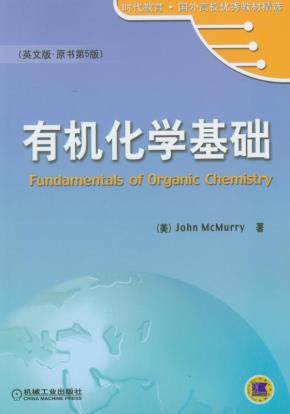
有机化学基础(英文版)(原书第4版)"
本书作者是美国著名的Cornell大学的教授,所写基础有机化学和高等有机化学教材均有很高水平,内容十分丰富,国内外采用者甚多。这本教材是他专门撰写的一本简明教材。按照他在序言中的说法,写此书是因为喜爱,他喜欢把一个复杂的课题试着从另外的角度,用更加简单的方式来描述。我认为他达到了这个目的。 本书所用体系为传统的功能团体系,有关生物分子和生物化学过程的内容占有较大篇幅。另外,书中简要地介绍了有机分子结构测定中应用最多的红外光谱、紫外光谱和核磁共振谱方法,由于作者选择了一些比较典型的例子,对于初学者已够用了。 本书具体内容包括结构和键、酸和碱;有机化合物的特性:烷烃;烯烃:有机化学反应的本质;烯烃和炔烃;芳香化合物;立体化学;卤化烷;醇、醚和酚;醛和酮:亲核加成反应;羧酸和衍生物;羰基а取代反应和缩合反应;胺;化学结构的测定;原生质:碳水化合物;生物分子:氨基酸、肽和蛋白质;生物分子:类脂和核酸;新陈代谢途径的有机化学。 本书在每章之后,除附有用以扩展视野的阅读材料和习题外,还附有关键词和反应小结,这在一般教科书中很少见到。该书版面明快,文字简洁流畅,使人有一种爱不释手的感觉。此书作为教材或双语教学时的参考书都很适合。


1 Structure and Bonding: Acids and Bases
1.1 Atomic Structure
1.2 Electron Configuration of Atoms
1.3 Development of Chemical Bonding Theory
1.4 The Nature of Chemical Bonds:Ionic Bonds
1.5 The Nature of Chemical Bonds:Covalent Bonds
1.6 Formation of Covalent Bonds
1.7 Hybridization: sp3 Orbitals and the Structure of Methane
1.8 The Structure of Ethane
1.9 Hybridization:sp2 Orbitals and the Structure of Ethylene
1.10 Hybridization:sp Orbitals and the Structure of Acetylene
1.11 Bond Polarity and Electronegativity
1.12 Acids and Bases: The Brnsted-Lowry Definition
1.13 Acids and Bases: The Lewis Definition
Interlude-Chemicals, Toxicity , and Risk
Summary and Key Words
Working Problems
Additional Problems
2 The Nature od Organic Compounds: Alkanes
2.1 Functional Groups
2.2 Alkanes and Alkyl Groups: Isomers
2.3 Naming Branched-Chain Alkanes
2.4 Properties of Alkanes
2.5 Conformations of Ethane
2.6 Drawing Chemical Structures
2.7 Cycloalkanes
2.8 Cis-Trans Isomerism in Cycloalkanes
2.9 Conformations of Some Common Cycloalkanes
2.10 Axial and Equatorial Bonds in Cyclohexane
2.11 Conformational Mobility of Cyclohexane
Interlude-Petroleum
Summary and Key Words
Additional Problems
3 Alkenes:The Nature of Organic Reactions
3.1 Naming Alkenes
3.2 Electronic Structure of Alkenes
3.3 Cis-Trans Isomers of Alkenes
3.4 Sequence Rules: The E, Z Designation
3.5 Kinds of Organic Reactions
3.6 How Reactions Occur: Mechanisms
3.7 An Example of a Polar Reaction: Addition of HCl to Ethylene
3.8 The Mechanism of an Organic Reaction:Addition of HCl to Ethylene
3.9 Describing a Reaction: Rates and Equilibria
3.10 Describing a Reaction: Reaction Energy Diagrams and Transtion States
3.11 Describing a Reaction:Intermedicates
Interlude-Carrots, Alkenes, and the Chemistry of Vision
Summary and Key Words
Additional Problems
4 Alkenes and Alkynes
4.1 Addition of HX to Alkenes: Hydrohalogenation
4.2 Orientation of Alkene Addition Reactions:Markovnikov#s Rule
4.3 Carbocation Structure and Stability
4.4 Addition of H2O to Alkenes: Hydration
4.5 Addition of X2 to Alkenes: Halogenation
4.6 Addition of H2 to Alkenes: Hydrogenation
4.7 Oxidation of Alkenes
4.8 Alkene Polymers
4.9 Preparation of Alkenes: Elimination Reactions
4.10 Conjugated Dienes
4.11 Stability of Allylic Carbocations: Resonance
4.12 Drawing and Interpreting Resonance Forms
4.13 Alkynes
4.14 Reaction of Alkynes: Addition of H2, HX, and X2
4.15 Addition of H2O to Alkynes
4.16 Alkyne Acidity: Formation of Acetylide Anions
Interlude-Natural Rubber
Summary and Key Words
Summary of Reactions
Additional Problems
5 Aromatic Compounds
5.1 Structure of Benzene:The Kekule Proposal
5.2 Stability of Benzene
5.3 Structure of Benzene:The Resonance Proposal
5.4 Naming Aromatic Compounds
5.5 Chemistry of Benzene:Electrophilic Aromatic Substitution Reactions
5.6 Bromination of Benzene
5.7 Other Electrophilic Aromatic Substitution Reations
5.8 The Friedel-Crafts Alkylation and Acylation Reactions
5.9 Substituent Effects in Electrophilic Aromatic Substitution
5.10 An Explanation of Substituent Effects
5.11 Oxidation and Reduction of Aromatic Compounds
5.12 Polycyclic Aromatic Hydrocarbons
5.13 Organic Synthesis
Interlude-Aspirin and Other Aromatic NSAID#S
Summary and Key Words
Summary of Reactions
Additional Problems
6 Stereochemistry
6.1 Stereochemistry and the Tetrahedral Carbon
6.2 The Reason for Handedness in Molecules:Chirality
6.3 Optical Activity
6.4 Specific Rotation
6.5 Pasteur#s Discovery of Enantiomers
6.6 Sequence Rules for Specifying Configuration
6.7 Diastereomers
6.8 Meso Compounds
6.9 Molecules with More Than Two Stereocenters
6.10 Racemic Mixtures and the Resolution of Enantiomers
6.11 Physical Properties of Stereoisomers
6.12 A Brief Review of Isomerism
6.13 Stereochemistry of Reactions: Addition of HBr to Alkenes
6.14 Chirality in Nature
Interlude-Chiral Drugs
Summary and Key Words
Additional Problems
7 Alkyl Halides
7.1 Naming Alkyl Halides
7.2 Preparation of Alkyl Halides:Radical Chlorination of Alkanes
7.3 Alkyl Halides from Alcohols
7.4 Reactions of Alkyl Halides:Grignard Reagents
7.5 Nucleophilic Substitution Reactions : The Discovery
7.6 Kinds of Nucleophilic Substitution Reactions
7.7 The SN2 Reaction
7.8 The SN1 Reaction
7.9 Eliminations: The E2 Reaction
7.10 Eliminations: The E1 Reaction
7.11 A Summary of Reactivity: SN1, SN2, E1, E2
7.12 Substitution Reactions in Living Organohalogen Compounds
Interlude-Naturally Occurring Organohalogen Compounds
Summary and Key Words
Summary of Reactions
Additional Problems
8 Alcohols, Ethers, and Phenols
8.1 Naming Alcohols, Phenols, and Ethers
8.2 Properties of Alcohols, Phenols, and Ethers:Hydrogen Bonding
8.3 Properties of Alcohols and Phenols:Acidity
8.4 Synthesis of Alcohols
8.5 Alcohols from Carbonyl Compounds
8.6 Ethers from Alcohols: The Williamson Ether Synthesis
8.7 Reactions of Alcohols
8.8 Synthesis and Reactions of Phenols
8.9 Reactions of Ethers: Acidic Cleavage
8.10 Cyclic Ethers: Epoxides
8.11 Ring-Opening Reactions of Epoxides
8.12 Thiols and Sulfiedes
Interlude-Ethanol as Chemical, Drug ,and Poison
Summary and Key Words
Summary of Reactions
Additional Problems
9 Aldehydes and Ketones : Nucleophilic Addition Reactions
9.1 Kinds of Carbonyl Compounds
9.2 Structure and Properties of Carbonyl Groups
9.3 Naming Aldehydes and Ketones
9.4 Synthesis of Aldehydes and Ketones
9.5 Oxidation of Aldehydes
9.6 Reactions of Aldehydes and Ketones: Nucleophilic Additions
9.7 Nucleophilic Addition of Water: Hydration
9.8 Nucleophilic Addition of Alcohols: Acetal Formation
9.9 Nucleophilic Addition of Amines: Imine Formation
9.10 Nucleophilic Addition of Grignard Reagents: Alcohol Formation
9.11 Some Biological Nucleophilic Addition Reactions
Interlude-Insect Antifeedants
Summary and Key Words
Summary of Reactions
Additional Problems
10 Carboxylic Acids and Derivatives
10.1 Naming Carboxylic Acids and Derivatives
10.2 Occurrence, Structure, and Properties of Carboxylic Acids
10.3 Acidity of Carboxylic Acids
10.4 Synthesis of Carboxylic Acids
10.5 Nucleophilic Acyl Substitution Reactions
10.6 Reactions of Carboxylic Acids
10.7 Chemistry of Acid Halides
10.8 Chemistry of Acid Anhydrides
10.9 Chemistry of Esters
10.10 Chemistry of Amides
10.11 Chemistry of Nitriles
10.12 Nylons and Polyesters: Step-Growth Polymers
Interlude-β-Lactam Antibiotics
Summary and Key Words
Summary of Reactions
Additional Problems
11 Carbonyl Alpha-Substitution Reactions and Condensation Reactons
11.1 Keto-Enol Tautomerism
11.2 Reactivity of Enols: The Mechanism of Alpha-Substitution
11.3 Alpha Halogenation of Aldehydes and Ketones
11.4 Acidity of Alpha Hydrogen Atoms: Enolate Ion Formation
11.5 Reactivity of Enolate Ions
11.6 Alkylation of Enolate Ions
11.7 Carbonyl Condensation Reactions
11.8 Condensations of Aldehydes and Ketones: The Aldol Reaction
11.9 Dehydration of Aldol Products: Synthesis of Enones
11.10 Condensations of Esters: The Claisen Condensation Reaction
Interlude-Carbonyl Compounds in Metabolism
Summary and Key Words
Summary of Reactions
Additional Problems
12 Amines
12.1 Naming Amines
12.2 Structure and Properties of Amines
12.3 Amine Basicity
12.4 Synthesis of Amines
12.5 Reactions of Amines
12.6 Heterocyclic Amines
Interlude-Naturally Occurring Amines: Morphine Alkaloids
Summary and Key Words
Summary of Reactions
Additional Problems
13 Structure Determination
13.1 Infrared Spectroscopy and the Electromagnetic Spectrum
13.2 Infrared Spectroscopy of Organic Molecules
13.3 Ultraviolet Spectroscopy
13.4 Interpreting Ultraviolet Spectra: The Effect of Conjugation
13.5 Nuclear Magnetic Resonance Spectroscopy
13.6 The Nature of NMR Absorptions
13.7 Chemical Shifts
13.8 Chemical Shifts in 1H NMR Spectra
13.9 Integration of 1H NMR Spectra: Proton Counting
13.10 Spin-Spin Splitting in 1H NMR Spectra
13.11 Uses of 1H NMR Spectra
13.12 13C NMR Spectroscopy
Interlude-Magnetic Resonance Imaging (MRI)
Summary and Key Words
Additional Problems
14 Biomolecules: Carbohydrates
14.1 Classification of Carbohydrates
14.2 Configurations of Monosaccharides: Fischer Projections
14.3 D,L Sugars
14.4 Configurations of Aldoses
14.5 Cyclic Structures of Monosaccharides: Hemiacetal Formation
14.6 Monosaccharide Anomers: Mutarotation
14.7 Conformation of Monosaccharides
14.8 Reactions of Monosaccharides
14.9 Disaccharides
14.10 Polysaccharides
14.11 Other Important Carbohydrates
14.12 Cell-Surface Carbohydrates
Interlude-Sweetness
Summary and Key Words
Additional Problems
15 Biomolecules: Amino Acids, Peptides, and Proteins
15.1 Structures of Amino Acids
15.2 Dipolar Structure of Amino Acids
15.3 Isoelectric Points
15.4 Peptides and Proteins
15.5 Covalent Bonding in Peptides
15.6 Peptide Structure Determination: Amino Acid Analysis
15.7 Peptide Synthesis
15.8 Peptide Synthesis
15.9 Classification of Proteins
15.10 Protein Structure
15.11 Enzymes
15.12 Structure and Classification of Enzymes
Interlude-Protein and Nutrition
Summary and Key Words
Additional Problems
16 Biomolecules: Lipids and Nucleic Acids
16.1 Lipids
16.2 Fats and Oils
16.3 Soaps
16.4 Phospholipids
16.5 Steroids
16.6 Nucleic Acids and Nucleotides
16.7 Structure of DNA
16.8 Base Pairing in DNA: The Watson- Crick Modes
16.9 Nucleic Acids and Heredity
16.10 Replication of DNA
16.11 Structure and Synthesis of RNA: Transcription
16.12 RNA and Protein Biosynthesis: Translation
16.13 Sequencing DNA
16.14 Sequencing DNA
Interlude-Cholesterol and Heart Disease
Summary and Key Words
Additional Problems
17 The Organic Chemistry of Metabolic Pathwas
17.1 An Overview of Metabolism and Biochemical Energy
17.2 Catabolism of Fats: β-Oxidaton Pathway
17.3 Catabolism of Carbohydrates: Glycolysis
17.4 The Citric Acid Cycle
17.5 Catabolism of Proteins: Transamination
Interlude-Basal Metabolism
Summary and Key Words
Additional Problems
Appendix A Nomenclature of Polyfunctional Organic Compounds
Appendix B Glossary
Appendix C Answers to Selected In-Text-Problems Index