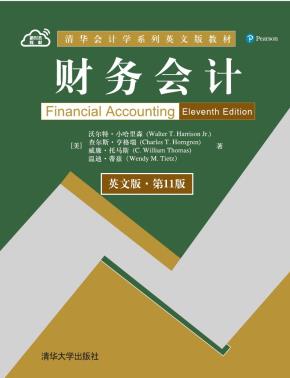
财务会计(英文版·第11版)"
本书涵盖了财务会计的基本概念、原则和理论方法,内容完整。
作者在写作过程中,注意理论联系实际,书中例题、案例以及书后习题绝大多数为世界著名大公司的实例,容易引起读者的兴趣。教材在一开始即强调会计信息与决策的关系,各章节都体现了作者对决策与会计信息关系的重视。本书另一个特点是现金流量表项目贯穿始终。教材中各章节均注意强调会计处理中存在的职业道德问题,这对于会计师这一行业来说十分重要。书后还附有大量习题与案例。
Financial Accounting gives readers a solid foundation in the fundamentals of accounting and the basics of finan-
cial statements, and then builds upon that foundation to offer more advanced and challenging concepts and
problems. This scaffolded approach helps students to better understand the meaning and relevance of financial
information, see its significance within a real-world context, as well as develop the skills needed to analyze
financial information in both their courses and career.
Financial Accounting has a long-standing reputation in the marketplace for being readable and easy to
understand. It drives home fundamental concepts using relevant examples from real-world companies in a
reader-friendly way without adding unnecessary complexity. While maintaining hallmark features of accuracy,
readability, and ease of understanding, the Eleventh Edition includes updated explanations, coverage, and ratio
analysis with decision-making guidelines. These time-tested methodologies with the latest technology ensures
that students learn basic concepts in accounting in a way that is relevant, stimulating, and fun, while exercises
and examples from real-world companies help students gain a better grasp of the course material.
Changes for the eleventh edition1. The first three chapters of the book cover the accounting cycle and how financial statements are constructed.
In previous editions of the book, we used separate companies in each of Chapters 1, 2, and 3 to illustrate
various phases of the accounting cycle. In the Eleventh Edition, we switched to using a single, very
familiar company (The Walt Disney Company) to illustrate all phases of the accounting cycle. In Chapter
1, we give an overview of the company’s financial statements and explain what each contains. In Chapter
2, we cover transactions—how they impact the accounting equation and how they are journalized, posted,
and summarized. In Chapter 3, we discuss the latter stages of the accounting cycle for the same company
and what goes on at the end of the cycle to convert the books into financial statements—adjusting entries,
closing entries, and financial statement preparation. Thus, the Eleventh Edition should have more
continuity in the early chapters; tell a more integrated, unified story; and cover the accounting cycle in a
chronological sequence. The hypothetical company (Alladin Travel, Inc.) that we have created in Chapter 1
and carried through Chapter 3 is a company that conceivably fits into Disney’s business model.
2. A scaffolding approach has been implemented in the book and its resources. Chapter content and the end-
of-chapter material builds from the basic short exercise featuring one basic concept to more advanced
problems featuring multiple learning objectives. This allows the student to practice at the basic level and
then build upon that success to advance to more challenging problems.
3. The ethical component of accounting has been enhanced in the Eleventh Edition by adding a section on
the AICPA’s Code of Professional Conduct, located at the end of Chapter 1. The principles section of the
code is included, explaining CPAs’ responsibilities to act in the public interest, to have integrity and
objectivity, and to exercise due professional care. In each chapter, there are short exercises that demonstrate
the application of these principles.
4. Short exercises, exercises, and problems are more clearly labeled by learning objective (LO). Short
exercises have been shortened and simplified in this edition to cover only one LO each. They can be used
better to briefly cover single concepts as illustrations or class exercises. Exercises might cover two or three
LOs, and problems cover multiple LOs.
5. In Chapters 3, 5, and 11, we have updated and provided complete coverage of the revised FASB account-
ing standard on revenue recognition, impacting the accounting for sales returns and sales discounts. We
provide the most accurate up-to-the-minute information available for this critical area. End-of-chapter
short exercises, exercises, and problems have also been revised to reflect application of the new revenue
recognition standard at an appropriate and understandable level for beginning students in accounting.
6. Chapter 4 contains a new hypothetical case study to introduce the concepts of fraud and how it can be
prevented by internal control. This fictionalized case study is based on an actual company in Texas whose
highly trusted and loyal controller and his wife systematically stole $16 million over the space of 10 years
by issuing company checks to pay off their personal credit card bills. The scheme was enabled by weak
internal controls. Executives of the company allowed the controller to have access to the check-signing
PreFACexvA01_
xvi Prefacemachine and electronic signature of the company president. Chapter 4 also contains updated
illustrations of electronic bank statements.
7. In Chapter 5, using Apple Inc. as the book’s Appendix A focus company, we emphasize
proper revenue recognition, accounting for accounts and notes receivable, and measuring
and evaluating collectability through the allowance for doubtful accounts. The coverage of
the days’ sales outstanding (DSO) ratio has been updated, improved, and made more
consistent with the coverage of days’ inventory outstanding (DIO) in Chapter 6 and days’
payable outstanding (DPO) in Chapter 9. We first introduce the computation of accounts
receivable turnover (net sales/average accounts receivable) and explain its meaning. We
then convert the turnover to DSO by dividing the turnover by 365. In previous editions, the
primary computation was average daily sales (net sales/365), followed by division of
average AR by average daily sales.
8. In Chapter 6, the coverage of inventory and cost of goods sold has been updated, using
Under Armour, Inc., the textbook’s Appendix B focus company. The products sold by
Under Armour should be highly familiar to college students, and the study of inventory is
made more interesting by applying it to this fascinating and fast-growing company.
9. In Chapter 9, based on feedback we received from adopters who only have time to cover
straight-line amortization for bond premium or discount, we added a new self-contained
section at the beginning of the coverage for bonds payable: Accounting for Bonds Payable
Using Straight-Line Amortization. We moved the coverage of amortization by the
effective-interest method back one section. Thus, users who only want to cover issuance of
bonds and recognition of interest expense based on straight-line amortization of bond
premium or discount may use only that section. Separate problems using the straight-line
method or amortization at the end of the chapter allow these users to easily skip the more
complex effective-interest method altogether.
10. In every chapter, after relevant concepts are covered, a text box labeled “Try it” is introduced.
This employs the following learning philosophy: 1. read it; 2. try it; 3. practice it.
11. In many cases, we add “Try It in Excel” to illustrate use of Excel and a business
problem-solving tool. We feel that students should be exposed early and frequently in their
business education to Excel applications. At the beginning of every chapter, we give
students instructions as to how to access the most current financial statements of the
chapter’s focus company in Excel format from the Securities and Exchange Commission
(SEC) website (http://www.sec.gov). Throughout the book, most exhibits and journal
entries are formatted as Excel worksheets. In addition, at certain points throughout the text,
we include examples that show students step-by-step how to build Excel templates to
facilitate the solutions of specific accounting problems. The following provides examples
of these applications by chapter:
Chapter 1: Preparing basic financial statements (income statement, retained earnings
statement, balance sheet)
Chapter 2: Processing business transactions, preparation of trial balanceChapter 3: Adjusting journal entries, preparation of adjusted trial balance, final
financial statementsChapter 4: Preparation of bank reconciliation, cash budgetChapter 5: Accounts receivable aging analysisChapter 6: Computation of cost of goods sold and gross profitChapter 7: Calculation of depreciation expense and accumulated depreciation by three
methods: straight-line, units-of-production, and double-declining balanceChapter 8: Calculation of present valueChapter 9: Calculation of bond discount and premium amortization tables using
effective-interest methodChapter 13: Horizontal and vertical analysis of financial statementsA01_xvi Prefacemachine and electronic signature of the company president. Chapter 4 also contains updated
illustrations of electronic bank statements.
7. In Chapter 5, using Apple Inc. as the book’s Appendix A focus company, we emphasize
proper revenue recognition, accounting for accounts and notes receivable, and measuring
and evaluating collectability through the allowance for doubtful accounts. The coverage of
the days’ sales outstanding (DSO) ratio has been updated, improved, and made more
consistent with the coverage of days’ inventory outstanding (DIO) in Chapter 6 and days’
payable outstanding (DPO) in Chapter 9. We first introduce the computation of accounts
receivable turnover (net sales/average accounts receivable) and explain its meaning. We
then convert the turnover to DSO by dividing the turnover by 365. In previous editions, the
primary computation was average daily sales (net sales/365), followed by division of
average AR by average daily sales.
8. In Chapter 6, the coverage of inventory and cost of goods sold has been updated, using
Under Armour, Inc., the textbook’s Appendix B focus company. The products sold by
Under Armour should be highly familiar to college students, and the study of inventory is
made more interesting by applying it to this fascinating and fast-growing company.
9. In Chapter 9, based on feedback we received from adopters who only have time to cover
straight-line amortization for bond premium or discount, we added a new self-contained
section at the beginning of the coverage for bonds payable: Accounting for Bonds Payable
Using Straight-Line Amortization. We moved the coverage of amortization by the
effective-interest method back one section. Thus, users who only want to cover issuance of
bonds and recognition of interest expense based on straight-line amortization of bond
premium or discount may use only that section. Separate problems using the straight-line
method or amortization at the end of the chapter allow these users to easily skip the more
complex effective-interest method altogether.
10. In every chapter, after relevant concepts are covered, a text box labeled “Try it” is introduced.
This employs the following learning philosophy: 1. read it; 2. try it; 3. practice it.
11. In many cases, we add “Try It in Excel” to illustrate use of Excel and a business
problem-solving tool. We feel that students should be exposed early and frequently in their
business education to Excel applications. At the beginning of every chapter, we give
students instructions as to how to access the most current financial statements of the
chapter’s focus company in Excel format from the Securities and Exchange Commission
(SEC) website (http://www.sec.gov). Throughout the book, most exhibits and journal
entries are formatted as Excel worksheets. In addition, at certain points throughout the text,
we include examples that show students step-by-step how to build Excel templates to
facilitate the solutions of specific accounting problems. The following provides examples
of these applications by chapter:
Chapter 1: Preparing basic financial statements (income statement, retained earnings
statement, balance sheet)
Chapter 2: Processing business transactions, preparation of trial balanceChapter 3: Adjusting journal entries, preparation of adjusted trial balance, final
financial statementsChapter 4: Preparation of bank reconciliation, cash budgetChapter 5: Accounts receivable aging analysisChapter 6: Computation of cost of goods sold and gross profitChapter 7: Calculation of depreciation expense and accumulated depreciation by three
methods: straight-line, units-of-production, and double-declining balanceChapter 8: Calculation of present valueChapter 9: Calculation of bond discount and premium amortization tables using
effective-interest methodChapter 13: Horizontal and vertical analysis of financial statementsA01_
Preface xvii12. Ethics is a vital part of accounting. Several sections of the text are dedicated to discussing
potential ethical problems that can arise in dealing with that particular subject matter and
how they should be properly handled.
13. In all chapters, we emphasize how accounting information covered in that chapter is ana-
lyzed and used to help managers make various kinds of business decisions. User-relevant
information and key ratios that are covered in various chapters include the following:
Chapter 3: Debt-paying ability: net working capital, current ratio, debt ratioChapter 4: Internal control: importance of internal control to preserve the integrity of
financial information; the significance of cash and cash flowChapter 5: Liquidity: quick (acid-test) ratio, accounts receivable turnover, days’ sales
in receivablesChapter 6: Profitability: gross profit percentage, inventory turnover, days’ inventory
outstandingChapter 7: Profitability: introduction rate of return on total assets (ROA) using Du
Pont Analysis (profit margin × asset turnover)
Chapter 8: Time value: time value of money and how it impacts investing and lending
decisionsChapter 9: Liquidity: accounts payable turnover, days’ payable outstanding, cash
collection cycle (days’ sales in receivables + days inventory outstanding – days’
payable outstanding). Leverage: continuation of Du Pont Analysis by introducing
leverage ratio (average total assets/average stockholders’ equity)
Chapter 10: Profitability: rate of return on common stockholders’ equity using
expanded Du Pont Analysis Model (ROA [introduced in Chapter 7] × leverage ratio
[introduced in Chapter 9])
Chapter 11: Evaluating performance: earnings quality, earnings per share, book value
per share, dividend yield, capitalization of earnings from operations to estimate future
profitability and stock priceChapter 12: Cash flow: use of cash flow information by creditors and investors; free
cash flowChapter 13: Statement analysis: comprehensive financial statement analysis, incorpo-
rating all of the ratios covered in the previous chapters, applying them to the book’s
two appendix focus companies, Under Armour, Inc. and Apple Inc.
xvi Prefacemachine 7. 8. 9. 10. 11.


viiiPreface xvVisual Walk-Through xviiiChapter 1
The Financial Statements 1Spotlight The Walt Disney Company 1Explain Why Accounting Is the Language of
Business 4Who Uses Accounting Information? 4Two Kinds of Accounting: Financial Accounting and
Management Accounting 5Organizing a Business 5Explain and Apply Underlying Accounting Concepts,
Assumptions, and Principles 7The Entity Assumption 8The Continuity (Going-Concern) Assumption 8The Historical Cost Principle 9The Stable-Monetary-Unit Assumption 9Apply the Accounting Equation to Business
Organizations 11Assets and Liabilities 11Owners’ Equity 12Evaluate Business Operations Through the Financial
Statements 14The Income Statement Measures Operating
Performance 15The Statement of Retained Earnings Shows What a
Company Did with Its Net Income 18The Balance Sheet Measures Financial Position 19The Statement of Cash Flows Measures Cash Receipts
and Payments 22Construct Financial Statements and Analyze the
Relationships Among Them 24Evaluate Business Decisions Ethically 26American Institute of Certified Public Accountants
Code of Professional Conduct 28End-of-Chapter Summary Problem 30Chapter 2
Transaction Analysis 52Spotlight The Walt Disney Company
records Millions of Transactions a Year! 52Explain What a Transaction Is 53Define “Account,” and List and Differentiate Between
Different Types of Accounts 54Assets 54Liabilities 55Stockholders’ (Owners’) Equity 55Show the Impact of Business Transactions on the
Accounting Equation 56Example: Alladin Travel, Inc. 56Transactions and Financial Statements 62Mid-Chapter Summary Problem 65Analyze the Impact of Business Transactions on
Accounts 67The T-Account 67Increases and Decreases in the Accounts: The Rules of
Debit and Credit 67Additional Stockholders’ Equity Accounts: Revenues and
Expenses 69Record (Journalize and Post) Transactions in the
Books 70Copying Information (Posting) from the Journal to the
Ledger 71The Flow of Accounting Data 72Accounts after Posting to the Ledger 76Construct and Use a Trial Balance 77Analyzing Accounts 78Correcting Accounting Errors 79Chart of Accounts 79The Normal Balance of an Account 80Account Formats 80Analyzing Transactions Using Only T-Accounts 81End-of-Chapter Summary Problem 83CoNTeNTsA01_the A thurosxiii
vii
ixChapter 3
Accrual Accounting & Income 106Spotlight september Is Busy at Walt
Disney World Headquarters 106Explain How Accrual Accounting Differs from
Cash-Basis Accounting 107Accrual Accounting and Cash Flows 108The Time-Period Concept 109Apply the Revenue and Expense Recognition
Principles 109The Revenue Principle 109The Expense Recognition Principle 110Ethical Issues in Accrual Accounting 112Adjust the Accounts 112Which Accounts Need to Be Updated
(Adjusted)? 112Categories of Adjusting Entries 113Prepaid Expenses 113Depreciation of Plant Assets 116Accrued Expenses 119Accrued Revenues 120Unearned Revenues 121Summary of the Adjusting Process 123The Adjusted Trial Balance 125Construct the Financial Statements 126Mid-Chapter Summary Problem 128Close the Books 133Classifying Assets and Liabilities Based on Their
Liquidity 135Reporting Assets and Liabilities: The Walt Disney
Company 135Formats for the Financial Statements 135Analyze and Evaluate a Company’s Debt-Paying
Ability 137Net Working Capital 138Current Ratio 138Debt Ratio 139How Do Transactions Affect the Ratios? 139End-of-Chapter Summary Problem 143Chapter 4
Internal Control & Cash 173Spotlight Cooking the Books
at Green Valley Coffee Company:
$10 Million Is a Lot of Beans! 173Describe Fraud and Its Impact 176Fraud and Ethics 178Explain the Objectives and Components
of Internal Control 178The Sarbanes-Oxley Act (SOX) 179The Components of Internal Control 180Internal Control Procedures 181Information Technology 183Safeguard Controls 184Internal Controls for E-Commerce 184Security Measures 185The Limitations of Internal Control—Costs
and Benefits 185Design and Use a Bank
Reconciliation 186Signature Card 186Deposit Ticket 186Check 186Bank Statement 187Bank Reconciliation 187Preparing the Bank Reconciliation 188Online Banking 191Mid-Chapter Summary
Problem 193Evaluate Internal Controls Over Cash
Receipts and Cash Payments 195Cash Receipts over the Counter 195Cash Receipts by Mail 195Controls over Payment by Check 196Construct and Use a Cash Budget 198Report Cash on the Balance Sheet 200Compensating Balance Agreements 200End-of-Chapter Summary
Problem 201Contents ixA01_
viii
x ContentsChapter 5
Short-Term Investments &
Receivables 217Spotlight Amazing Apple!
short-Term Investments and Accounts
receivable Are 14 Times as Large as
Inventories! 217Account for Short-Term Investments 219Reasons to Invest in Other Companies 219Trading Securities 220Reporting on the Balance Sheet and the Income
Statement 224Ethics and the Current Ratio 224Mid-Chapter Summary Problem 225Apply GAAP for Proper Revenue
Recognition 226Shipping Terms 229Collection Within (vs. Outside) the Discount
Period 229Sales Refunds, Returns, and Allowances 229Account for and Control Accounts
Receivable 231Types of Receivables 231Internal Controls Over Cash Collections on
Account 232How Do We Manage the Risk of Not
Collecting? 232Evaluate Collectibility Using the Allowance for
Uncollectible Accounts 234Allowance Method 235Direct Write-Off Method 240Computing Cash Collections from
Customers 240Account for Notes Receivable 241Accounting for Notes Receivable 242Show How to Speed Up Cash Flow from
Receivables 244Credit Card or Bankcard Sales 244Selling (Factoring) Receivables 245Reporting on the Statement of Cash
Flows 245Evaluate Liquidity Using Two New Ratios 246Quick (Acid-Test) Ratio 246Accounts Receivable Turnover and Days’ Sales
Outstanding 246End-of-Chapter Summary Problem 248Chapter 6
Inventory & Cost of Goods
Sold 268Spotlight under Armour, Inc.: It’s
About More than Clothing! 268Show How to Account for Inventory 271Sale Price vs. Cost of Inventory 272Accounting for Inventory in the Perpetual
System 274Apply and Compare Various Inventory Cost
Methods 276What Goes into Inventory Cost? 276Apply the Various Inventory Costing
Methods 277Compare the Effects of FIFO, LIFO, and
Average Cost on Cost of Goods Sold,
Gross Profit, and Ending Inventory 279Keeping Track of Perpetual Inventories
under LIFO and Weighted-Average Cost
Methods 280The Tax Advantage of LIFO 281Mid-Chapter Summary Problem 282Explain and Apply Underlying GAAP for
Inventory 284Disclosure Principle 284Lower-of-Cost-or-Market Rule 284Compute and Evaluate Gross Profit (Margin)
Percentage, Inventory Turnover, and Days’
Inventory Outstanding (DIO) 286Gross Profit Percentage 286Inventory Turnover 287Use the COGS Model to Make Management
Decisions 288Computing Budgeted Purchases 289Estimating Inventory by the Gross Profit
Method 289A01_
Contents xiAnalyze Effects of Inventory Errors 290End-of-Chapter Summary Problem 293Chapter 7
Plant Assets, Natural Resources, &
Intangibles 317Spotlight Fedex Corporation 317Measure and Account for the Cost of Plant
Assets 320Land 320Buildings, Machinery, and Equipment 320Land Improvements and Leasehold
Improvements 321Lump-Sum (or Basket) Purchases of Assets 321Distinguish a Capital Expenditure from an
Immediate Expense 322Measure and Record Depreciation on Plant
Assets 324How to Measure Depreciation 325Depreciation Methods 325Comparing Depreciation Methods 330Mid-Chapter Summary Problem 332Other Issues in Accounting for
Plant Assets 333Depreciation for Tax Purposes 333Depreciation for Partial Years 335Changing the Useful Life of a Depreciable
Asset 335Fully Depreciated Assets 337Analyze the Effect of a Plant Asset
Disposal 337Disposing of a Fully Depreciated Asset for No
Proceeds 338Selling a Plant Asset 338Exchanging a Plant Asset 339T-Accounts for Analyzing Plant Asset
Transactions 340Apply GAAP for Natural Resources and
Intangible Assets 342Accounting for Natural Resources 342Accounting for Intangible Assets 343Accounting for Specific Intangibles 343Accounting for Research and Development
Costs 345Explain the Effect of an Asset Impairment on the
Financial Statements 345Analyze Rate of Return on Assets 347DuPont Analysis: A More Detailed View of
ROA 348Analyze the Cash Flow Impact of Long-Lived
Asset Transactions 349End-of-Chapter Summary Problem 352Chapter 8
Long-Term Investments & the Time
Value of Money 374Spotlight Intel Holds several Different
Types of Investments 374Stock and Bond Prices 376Reporting Investments on the Balance Sheet 376Analyze and Report Investments in Held-to-
Maturity Debt Securities 377Analyze and Report Investments in Available-for-
Sale Securities 379Accounting Methods for Long-Term Stock
Investments 379The Fair Value Adjustment 381Selling an Available-for-Sale Investment 382Analyze and Report Investments in Affiliated
Companies Using the Equity Method 383Buying a Large Stake in Another Company 383Accounting for Equity-Method Investments 384Analyze and Report Controlling Interests in
Other Corporations Using Consolidated
Financial Statements 386Why Buy Controlling Interest in Another
Company? 386Consolidation Accounting 386The Consolidated Balance Sheet and the Related
Work Sheet 387Goodwill and Noncontrolling Interest 388Income of a Consolidated Entity 388Mid-Chapter Summary Problem 390A01_
xii ContentsConsolidation of Foreign Subsidiaries 392Foreign Currencies and Exchange Rates 392The Foreign-Currency Translation Adjustment 393Report Investing Activities on the Statement of
Cash Flows 394Explain the Impact of the Time Value of Money
on Certain Types of Investments 395Present Value 396Present-Value Tables 397Present Value of an Ordinary Annuity 398Using Microsoft Excel to Calculate Present
Value 399Using the PV Model to Compute Fair Value of
Available-for-Sale Investments 401Present Value of an Investment in Bonds 401End-of-Chapter Summary Problems 403Chapter 9
Liabilities 422Spotlight southwest Airlines: Flying
High! 422Account for Current and Contingent
Liabilities 424Current Liabilities of Known Amount 424Current Liabilities That Must Be Estimated 430Contingent Liabilities 431Are All Liabilities Reported on the Balance
Sheet? 432Summary of Current Liabilities 433Mid-Chapter Summary Problem 433Account for Bonds Payable and Interest Expense
with Straight-Line Amortization 434Bonds: An Introduction 434Issuing Bonds Payable at Par (Face Value) 437Issuing Bonds Payable at a Discount 439Issuing Bonds Payable at a Premium 440Account for Bonds Payable and Interest Expense
with Effective Interest Amortization 442Issuing Bonds Payable at a Discount 442Interest Expense on Bonds Issued at a
Discount 443Partial-Period Interest Amounts 446Issuing Bonds Payable at a Premium 446Should We Retire Bonds Payable Before Their
Maturity? 449Convertible Bonds and Notes 450Analyze and Differentiate Financing with
Debt Versus Equity 451The Leverage Ratio 452The Times-Interest-Earned Ratio 453Understand Other Long-Term
Liabilities 454Leases 454Types of Leases 454Do Lessees Prefer Operating Leases or Capital
Leases? 455Pensions and Postretirement Liabilities 456Report Liabilities on the Financial
Statements 457Disclosing the Fair Value of Long-Term Debt 458Reporting Financing Activities on the
Statement of Cash Flows 458End-of-Chapter Summary
Problems 459Chapter 10
Stockholders’ Equity 484Spotlight The Home Depot:
Building Toward success 484Explain the Features of a Corporation 486Organizing a Corporation 487Stockholders’ Rights 488Stockholders’ Equity 489Classes of Stock 489Account for the Issuance of Stock 491Common Stock 491A Stock Issuance for Other Than Cash Can
Create an Ethical Challenge 494Preferred Stock 495Mid-Chapter Summary Problem 496Authorized, Issued, and Outstanding Stock 497A01_
Contents xiiiShow How Treasury Stock Affects a
Company 498How Is Treasury Stock Recorded? 498Retirement of Treasury Stock 499Resale of Treasury Stock 499Issuing Stock for Employee Compensation 500Summary of Treasury-Stock Transactions 501Account for Retained Earnings, Dividends,
and Splits 501Should the Company Declare and Pay Cash
Dividends? 502Cash Dividends 502Analyzing the Stockholder’s Equity Accounts 503Dividends on Preferred Stock 504Stock Dividends 505Stock Splits 506Summary of the Effects on Assets, Liabilities, and
Stockholders’ Equity 507Use Stock Values in Decision Making 507Market, Redemption, Liquidation, and Book
Value 507ROE: Relating Profitability to Stockholder
Investment 509Report Stockholders’ Equity Transactions in the
Financial Statements 511Statement of Cash Flows 511Statement of Stockholders’ Equity 512A Detailed Stockholders’ Equity Section of the
Balance Sheet 513End-of-Chapter Summary Problems 515Chapter 11
Evaluating Performance: Earnings
Quality, the Income Statement, &
the Statement of Comprehensive
Income 541Spotlight The Gap, Inc.: It’s About
earnings 541Evaluate Quality of Earnings 543Revenue Recognition 544Cost of Goods Sold and Gross Profit
(Gross Margin) 545Operating and Other Expenses 546Operating Income (Earnings) 546Account for Foreign-Currency Gains and
Losses 547Dollars Versus Foreign Currency 547Reporting Foreign-Currency Gains and Losses on
the Income Statement 548Reporting Foreign-Currency Exchange Gains and
Losses on Cash and Cash Equivalents in the
Statement of Cash Flows 549Should We Hedge Our Foreign-Currency-
Transaction Risk? 549Account for Other Items on the Income
Statement 549Interest Expense and Interest Income 549Corporate Income Taxes 549Which Income Number Predicts Future
Profits? 551Discontinued Operations 552Accounting Changes 553Compute Earnings per Share 554Analyze the Statement of Comprehensive
Income, Footnotes, and Supplemental
Disclosures 555Reporting Comprehensive Income 555For Additional Details, Don’t Forget the
Footnotes 556Nonfinancial Reports 558Differentiate Management’s and Auditors’
Responsibilities in Financial Reporting 558Management’s Responsibility 558Auditor Report 558End-of-Chapter Summary Problems 561Chapter 12
The Statement of Cash Flows 582Spotlight Google: The ultimate Answer
(and Cash) Machine 582Identify the Purposes of the Statement of Cash
Flows 584How’s Your Cash Flow? Telltale Signs of Financial
Difficulty 585
xiv ContentsDistinguish Among Operating, Investing, and
Financing Activities 586Two Formats for Operating Activities 587Prepare a Statement of Cash Flows by the
Indirect Method 587Cash Flows from Operating Activities 589Cash Flows from Investing Activities 593Cash Flows from Financing Activities 594Noncash Investing and Financing Activities 597Mid-Chapter Summary Problem 598Prepare a Statement of Cash Flows by the Direct
Method 601Cash Flows from Operating Activities 603Depreciation, Depletion, and Amortization
Expense 604Cash Flows from Investing Activities 604Cash Flows from Financing Activities 604Noncash Investing and Financing Activities 604Computing Operating Cash Flows by the Direct
Method 606Computing Investing and Financing Cash
Flows 609Measuring Cash Adequacy: Free Cash Flow 610End-of-Chapter Summary Problems 612Chapter 13
Financial Statement Analysis 640Spotlight under Armour, Inc., Is a
“red-Hot” Competitor! 640It Starts with the Big Picture 642Perform Horizontal Analysis 644Illustration: Under Armour, Inc. 644Trend Percentages 648Perform Vertical Analysis 649Illustration: Under Armour, Inc. 649Prepare Common-Size Financial Statements 652Benchmarking 652Benchmarking Against a Key Competitor 653Analyze the Statement of Cash Flows 653Mid-Chapter Summary Problem 656Use Ratios to Make Business Decisions 657Remember to Start at the Beginning: Company and
Industry Information 658Now Let’s Do the Numbers 660Measuring Ability to Pay Current Liabilities 660Measuring Turnover and the Cash Conversion
Cycle 663Measuring Leverage: Overall Ability to Pay
Debts 666Measuring Profitability 667Analyzing Stock as an Investment 671The Limitations of Ratio Analysis 673Use Other Measures to Make Investment
Decisions 674Economic Value Added (EVA). 674Red Flags in Financial Statement Analysis 675Efficient Markets 675End-of-Chapter Summary Problems 678AppEndix A:
Apple Inc. Annual Report 2014 709AppEndix B:
Under Armour, Inc. Annual Report 2014 709AppEndix C:
Typical Charts of Accounts for Different Types of
Businesses 709AppEndix d:
Summary of Generally Accepted Accounting Principles
(GAAP) 709AppEndix E:
Summary of Differences Between U.S. GAAP and IFRS
Cross Referenced to Chapter 709A01_
由四位美国著名会计学者编著的中级财务会计教材,涵盖了财务会计的基本概念、原则和理论方法,包括财务报表编制(资产负债表、损益表和现金流量表)、会计循环和财务报表分析。作者在写作过程中,注意理论联系实际,书中例题、案例以及书后习题绝大多数为世界著名大公司的实例,容易引起读者的兴趣。本书适合会计学、审计学、财务学专业本科生作为财务会计教材,也可作为金融学、管理学、经济学各专业学生会计学课程的参考教材。
沃尔特·小哈里森(Walter T. Harrison, Jr.)是美国贝勒大学会计学院教授。查尔斯·亨格瑞(Charles T. Horngren)是美国斯坦福大学会计学教授,美国会计学界和教育界享有盛誉的杰出学者,会计名人堂成员。威廉·托马斯(C. William Thomas)是美国贝勒大学会计学院教授。