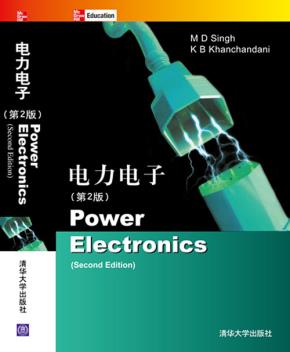
电力电子(第2版)"
电力电子技术是一门融合了电力、功率半导体和控制学科领域的综合性技术。随着电力电子技术的不断发展,它在工业生产、电力牵引、新能源发电、家用电器和国防工业等许多国民经济领域中得到越来越广泛的应用,成为国民经济发展中的关键支撑技术,并为电气工程学科的技术创新提供了源源不断的动力。因此,对于正在学习或者正在应用电力电子技术的学者或者工程技术人员,有必要对电力电子学科的发展及技术现状有一个系统而深入的认识,特推荐该书作为学习电力电子技术基础的重要参考书。
该书的作者M D Singh博士和K B Khanchandani博士都在电力电子技术领域有多年的科研和教学经验,他们在本书中系统、全面、细致地讲述了经典电力电子技术及现代电力电子技术基础。从电力电子技术系统的总体认识、晶闸管的基本原理和特性、晶闸管的门极触发和晶闸管的串并联使用,到相控变换器、双向变换器、斩波器、逆变器、交交变流器、交流调节器和谐振变换器,进而到器件的保护和冷却、直流传动控制和交流传动控制,直至电力电子技术的各种应用,都进行了详细的介绍和分析。该书以经典电力电子技术内容为主,也包括了一些现代电力电子技术的内容,比如关于自关断器件IGBT、MOSFET、IGCT等及其相关换流电路的介绍。该书作为一本电力电子技术基础教材,具有以下一些突出特点:
(1)概念清晰,描述细致。
(2)插图精致,信息量大。
(3)计算推导严格,实例数据详尽。
(4)每章后面的思考题和计算题丰富。
由此可见,该书是一本关于经典电力电子技术系统介绍和现代电力电子技术快速入门难得的专门教材和参考书,对于那些想深入系统地了解经典电力电子技术,同时又想对现代电力电子技术有所了解的电气工程、自动控制、电子技术等专业的本科生、研究生或者业内工程技术人员,该书是一本很好的参考书。
赵争鸣
2011年3月于清华园


1. POWER ELECTRONIC SYSTEMS: AN OVERVIEW 1
1.1 Introduction 1
1.2 History of Power Electronics Development 2
1.3 Power Electronic Systems 2
1.4 Power Semiconductor Devices 4
1.5 Power Electronic Converters 11
1.6 Power Electronic Applications 12
1.7 Computer Simulation of Power Electronic Circuits 14 Review Questions 15 References 16
2. THYRISTOR: PRINCIPLES AND CHARACTERISTICS 17
2.1 Introduction 17
2.2 Principle of Operation of SCR 18
2.3 Static Anode.Cathode Characteristics of SCR 19
2.4 The Two-transistor Model of SCR (Two Transistor Analogy) 23
2.5 Thyristor Construction 25
2.6 Gate Characteristics of SCR 27
2.7 Turn-on Methods of a Thyristor 33
2.8 Dynamic Turn-on Switching Characteristics 35
2.9 Turn-off Mechanism (Turn-off Characteristic) 37
2.10 Turn-off Methods 38
2.11 Thyristor Ratings 55
2.12 Measurement of Thyristor Parameters 63
2.13 Comparison between Transistors and Thyristors 65 Review Questions 66 Problems 67 References 69
viii ........
3. GATE TRIGGERING CIRCUITS 70
3.1 Introduction 70
3.2 Firing of Thyristors 71
3.3 Pulse Transformers 76
3.4 Optical Isolators (Optoisolators) 78
3.5 Gate Trigger Circuits 81
3.6 Unijunction Transistor 87
3.7 The Programmable Unijunction Transistor (PUT) 100
3.8 Phase Control using Pedestal-And-Ramp Triggering 106
3.9 Microprocessor Interfacing to Power Thyristor 108 Review Questions 110 Problems 111 References 113
4. SERIES AND PARALLEL OPERATION OF THYRISTORS 114
4.1 Introduction 114
4.2 Series Operations of Thyristors 115
4.3 Need for Equalising Network 1
5
4.4 Equalising Network Design 118
4.5 Triggering of Series Connected Thyristors 121
4.6 Parallel Operation of Thyristors 124
4.7 Methods for Ensuring Proper Current Sharing 126
4.8 Triggering of Thyristors in Parallel 129
4.9 String Efficiency 130
4.10 Derating 131 Review Questions 133 Problems 133 References 134
5. POWER SEMICONDUCTOR DEVICES 135
5.1 Introduction 135
5.2 Historical Perspective 137
5.3 Power Semiconductor Devices 139
5.4 Phase Controlled Thyristors 141
5.5 Inverter-Grade Thyristors 141
5.6 Asymmetrical Thyristor (ASCR) 142
5.7 Reverse Conducting Thyristor (RCT) 144
5.8 Bidirectional Diode Thyristor (Diac) 145
5.9 Bidirectional Triode Thyristor (TRIAC) 146
5.10 Silicon Unilateral Switch (SUS) 156
5.11 Silicon Bilateral Switch (SBS) 156
5.12 Silicon Controlled Switch (SCS) 156
5.13 Light-Activated Silicon-Controlled Rectifiers (LASCR) 158
........
5.14 Power MOSFETs 159
5.15 Insulated Gate Bipolar Transistors (IGBTs) 187
5.16 Gate Turn-off Thyristors (GTOs or Latching Transistors) 212
5.17 Static Induction Devices 222
5.18 MOS Controlled Thyristor (MCT) 224
5.19 Integrated Gate-Commutated Thyristor (IGCT) 231
5.20 MOS Turn-off Thyristor (MTO) 235
5.21 Emitter Turn-Off Thyristor (ETO) 236
5.22 Power Integrated Circuit (PICs) 244
5.23 Comparison of Power Devices 247
5.24 Silicon Carbide Devices 250 Review Questions 250 Problems 254 References 256
6. PHASE CONTROLLED CONVERTERS
6.1 Introduction 258
6.2 Control Techniques 259
6.3 Single Phase Half-Wave Controlled Rectifier 263
6.4 Single-Phase Full-Wave Controlled Rectifier (Two-quadrant Converters) 273
6.5 Single-Phase Half Controlled Bridge-Rectifier 291
6.6 Performance Factors of Line-commutated Converters 302
6.7 The Performance Measures of Two-pulse Converters 303
6.8 Three-Phase Controlled Converters 307
6.9 Three-Pulse Converters (M3 Connection) 308
6.10. Six-Pulse Converters 323
6.11 Three-Phase Fully Controlled Bridge Converter 329
6.12 Three-Phase Half Controlled Bridge Converter (Three-Phase Semiconverters) 346
6.13 The External Performance Measures of Six-Pulse Converters 359
6.14 The Effect of Input Source Impedance 361
6.15 Performance of Converter Circuits with Battery Load (Or Effect of Load Inductance) 378
6.16 Selection of Converter Circuits 380
6.17 Power Factor Improvement 380
6.18 Microprocessor-Based Firing Scheme for Three-Phase Fully-Controlled Bridge Converter 395 Review Questions 402 Problems 407 References 411
x ........
7. DUAL CONVERTERS 412
7.1 Introduction 412
7.2 Principle of Dual Converter (Ideal Dual Converter) 415
7.3 Practical Dual Converter 416
7.4 Dual Converter without Circulating Current Operation 417
7.5 Dual Converter with Circulating Current Operation 421
7.6 Dual-Mode Dual Converter 426
7.7 Comparison between Non-Circulating Current Mode and Circulating Current Mode 428
7.8 Microprocessor Based-Firing Scheme for a Dual Converter 429 Review Questions 432 Problems 433 References 433
8. CHOPPERS 434
8.1 Introduction 434
8.2 Basic Chopper Classification 436
8.3 Basic Chopper Operation 437
8.4 Control Strategies 444
8.5 Chopper Configuration 447
8.6 Thyristor Chopper Circuits 481
8.7 Jones Chopper 496
8.8 Morgan Chopper 502
8.9 A.C. Choppers 504
8.10 Source Filter 505
8.11 Multiphase Chopper 508
8.12 Flyback Converters [Switching Regulators] 510 Review Questions 530 Problems 532 References 534
9. INVERTERS 535
9.1 Introduction 535
9.2 Classification of Inverters 537
9.3 Single-Phase Half-Bridge Voltage-Source Inverters 538
9.4 Single-Phase Full-Bridge Inverters 545
9.5 Performance Parameters of Inverters 551
9.6 Voltage Control of Single-Phase Inverters 554
9.7 Pulse-Width Modulated (PWM) Inverters 565
9.8 Three-Phase Inverters 574
9.9 Voltage Control of Three-Phase Inverters 593
9.10 Thyristor-Based Inverters 593
........
9.11 Series Inverters (Series Resonant Inverters) 594
9.12 Self-Commutated Inverters 606
9.13 Parallel Inverter 609
9.14 The Single-Phase SCR Bridge Inverter 615
9.15 Current Source Inverters 643
9.16 Performance Comparisons of PWM, AVI and CSI 651
9.17 Harmonic Reduction 653
9.18 Harmonic Filters 657
Review Questions 664 Problems 667 References 669
10. CYCLOCONVERTERS 670
10.1 Introduction 670
10.2 The Basic Principle of Operation 671
10.3 Single-phase to Single-phase Cycloconverter 673
10.4 Three-phase Half-wave Cycloconverters 680
10.5 Cycloconverter Circuits for Three-Phase Output 686
10.6 Output Voltage Equation 686
10.7 Control Circuit 689
10.8 Comparison between Cycloconverter and
D.C. Link Converter 697
10.9 Load-Commutated Cycloconverter 698
Review Questions 701 Problems 702 References 703
11. A.C. REGULATORS 704
11.1 Introduction 704
11.2 Single-Phase A.C. Regulators 705
11.3 Sequence Control of A.C. Regulators 723
11.4 Three-phase A.C. Regulators 729
11.5 A.C. Regulators to Feed Transformers 740
Review Questions 742 Problems 744 References 745
12. RESONANTCONVERTERS 746
12.1 Introduction 746
12.2 Basic Resonance Circuit Concepts 747
12.3 Classification of Resonant Converters 752
12.4 Load Resonant Converters (Self-Commutating Converters) 753
12.5 Parallel Resonant Inverters 767
xii ........
12.6 Class-E Resonant Inverters 768
12.7 Class-E Resonant Rectifier 770
12.8 Resonant-Switch Converters 772
12.9 ZVS Three-Level PWM-Converter 787
12.10 Resonant DC Link Inverters 793 Review Questions 795 Problems 796 References 797
13. PROTECTION AND COOLING OF POWER SWITCHING 798 DEVICES
13.1 Introduction 798
13.2 Overvoltage Conditions 799
13.3 Overvoltage Protection 803
13.4 Practical Overvoltage Protection in Naturally-Commutated Circuits 815
13.5 Overvoltage Protection in Forced-Commutated Circuits 816
13.6 Overcurrent Fault Conditions 816
13.7 Overcurrent Protection 821
13.8 Gate Protection 827
13.9 Heat Sinks 833
13.10 Thyristor Mounting Techniques 838
13.11 SCR Reliability 839 Review Questions 843 Problems 844 References 845
14. CONTROL OF D.C. DRIVES 846
14.1 Introduction 846
14.2 Basic Machine Equations 847
14.3 Schemes for D.C. Motor Speed Control 849
14.4 Single-Phase Separately Excited Drives 851
14.5 Braking Operation of Rectifier Controlled Separately Excited Motor 870
14.6 Single-Phase Series D.C. Motor Drives 871
14.7 Three-Phase Separately Excited Drives 879
14.8 D.C. Chopper Drives 888
14.9 Phase-Locked Loop (PLL) Control of D.C. Drives 893
14.10 Microcomputer Control of D.C. Drives 895 Review Questions 898 Problems 899 References 902
........ xiii
15. CONTROL OF A.C. DRIVES 903
15.1 Introduction 903
15.2 Basic Principle of Operation 905
15.3 Speed Control of Induction Motors 912
15.4 Stator Voltage Control 913
15.5 Variable Frequency Control 917
15.6 Rotor Resistance Control 942
15.7 Slip Power Recovery Scheme 949
15.8 Synchronous Motor Drives 959
15.9 The Drive Selection 978 Review Questions 981 Problems 983 References 985
16. POWER ELECTRONIC APPLICATIONS 987
16.1 Introduction 987
16.2 Uninterruptible Power Supply 988
16.3 Switched Mode Power Supplies (SMPS) 998
16.4 High Voltage D.C. Transmission 1024
16.5 Static VAR Compensators 1029
16.6 RF Heating 1031
16.7 Switch-Mode Welding 1041
16.8 Electronic Lamp Ballast 1042
16.9 Battery Charger 1042
16.10 Emergency Lighting System 1044
16.11 Static Circuit Breaker 1045
16.12 Time-Delay Circuit 1047
16.13 Flasher Circuits 1047
16.14 Integral Cycle Triggering (Or Burst Firing) 1049 Review Questions 1051 Problems 1053 References 1053
APPENDIX A : Simulation Tools for Power Electronic Circuits 1054 APPENDIX B : High Voltage Gate Driver ICs (HVICs), Power
Modules and Intelligent Power Modules 1060
INDEX 1065