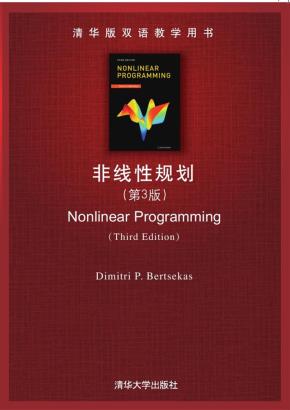
非线性规划(第3版)"
本书涵盖非线性规划的主要内容,包括无约束优化、凸优化、拉格朗日乘子理论和算法、对偶理论及方法等,包含了大量的实际应用案例. 本书从无约束优化问题入手,通过直观分析和严格证明给出了无约束优化问题的最优性条件,并讨论了梯度法、牛顿法、共轭方向法等基本实用算法. 进而本书将无约束优化问题的最优性条件和算法推广到具有凸集约束的优化问题中,进一步讨论了处理约束问题的可行方向法、条件梯度法、梯度投影法、双度量投影法、近似算法、流形次优化方法、坐标块下降法等. 拉格朗日乘子理论和算法是非线性规划的核心内容之一,也是本书的重点.
Preface to the Third Edition
The third edition of the book is a thoroughly rewritten version of the 1999
second edition. New material was included, some of the old material was
discarded, and a large portion of the remainder was reorganized or revised.
The total number of pages has increased by about 10 percent.
Aside from incremental improvements, the changes aim to bring the
book up-to-date with recent research progress, and in harmony with the major
developments in convex optimization theory and algorithms that have
occurred in the meantime. These developments were documented in three
of my books: the 2015 book “Convex Optimization Algorithms,” the 2009
book “Convex Optimization Theory,” and the 2003 book “Convex Analysis
and Optimization” (coauthored with Angelia Nedi′c and Asuman Ozdaglar).
A major difference is that these books have dealt primarily with convex, possibly
nondifferentiable, optimization problems and rely on convex analysis,
while the present book focuses primarily on algorithms for possibly nonconvex
differentiable problems, and relies on calculus and variational analysis.
Having written several interrelated optimization books, I have come to
see nonlinear programming and its associated duality theory as the lynchpin
that holds together deterministic optimization. I have consequently set as an
objective for the present book to integrate the contents of my books, together
with internet-accessible material, so that they complement each other and
form a unified whole. I have thus provided bridges to my other works with
extensive references to generalizations, discussions, and elaborations of the
analysis given here, and I have used throughout fairly consistent notation and
mathematical level.
Another connecting link of my books is that they all share the same style:
they rely on rigorous analysis, but they also aim at an intuitive exposition that
makes use of geometric visualization. This stems from my belief that success
in the practice of optimization strongly depends on the intuitive (as well as
the analytical) understanding of the underlying theory and algorithms.
Some of the more prominent new features of the present edition are:
(a) An expanded coverage of incremental methods and their connections to
stochastic gradient methods, based in part on my 2000 joint work with
Angelia Nedi′c; see Section 2.4 and Section 7.3.2.
(b) A discussion of asynchronous distributed algorithms based in large part
on my 1989 “Parallel and Distributed Computation” book (coauthored
xvii
xviii Preface to the Third Edition
with John Tsitsiklis); see Section 2.5.
(c) A discussion of the proximal algorithm and its variations in Section 3.6,
and the relation with the method of multipliers in Section 7.3.
(d) A substantial coverage of the alternating direction method of multipliers
(ADMM) in Section 7.4, with a discussion of its many applications and
variations, as well as references to my 1989 “Parallel and Distributed
Computation” and 2015 “Convex Optimization Algorithms” books.
(e) A fairly detailed treatment of conic programming problems in Section
6.4.1.
(f) A discussion of the question of existence of solutions in constrained optimization,
based on my 2007 joint work with Paul Tseng [BeT07], which
contains further analysis; see Section 3.1.2.
(g) Additional material on network flow problems in Section 3.8 and 6.4.3,
and their extensions to monotropic programming in Section 6.4.2, with
references to my 1998 “Network Optimization” book.
(h) An expansion of the material of Chapter 4 on Lagrangemultiplier theory,
using a strengthened version of the Fritz John conditions, and the notion
of pseudonormality, based on my 2002 joint work with Asuman Ozdaglar.
(i) An expansion of the material of Chapter 5 on Lagrange multiplier algorithms,
with references to my 1982 “Constrained Optimization and
Lagrange Multiplier Methods” book.
The book contains a few new exercises. As in the second edition, many
of the theoretical exercises have been solved in detail and their solutions have
been posted in the book’s internet site
http://www.athenasc.com/nonlinbook.html
These exercises have been marked with the symbolsWWW. Many other exercises
contain detailed hints and/or references to internet-accessible sources.
The book’s internet site also contains links to additional resources, such as
many additional solved exercises from my convex optimization books, computer
codes, my lecture slides from MIT Nonlinear Programming classes, and
full course contents from the MIT OpenCourseWare (OCW) site.
I would like to express my thanks to the many colleagues who contributed
suggestions for improvement of the third edition. In particular, let
me note with appreciation my principal collaborators on nonlinear programming
topics since the 1999 second edition: Angelia Nedi′c, Asuman Ozdaglar,
Paul Tseng, Mengdi Wang, and Huizhen (Janey) Yu.
Dimitri P. Bertsekas
June, 2016


Contents
1. Unconstrained Optimization: Basic Methods . . . . . . p. 1
1.1. OptimalityConditions . . . . . . . . . . . . . . . . . . . p. 5
1.1.1. Variational Ideas . . . . . . . . . . . . . . . . . . . . p. 5
1.1.2. MainOptimalityConditions . . . . . . . . . . . . . . . p. 15
1.2. GradientMethods –Convergence . . . . . . . . . . . . . . p. 28
1.2.1. DescentDirections and StepsizeRules . . . . . . . . . . p. 28
1.2.2. ConvergenceResults . . . . . . . . . . . . . . . . . . p. 49
1.3. GradientMethods –Rate ofConvergence . . . . . . . . . . p. 67
1.3.1. The LocalAnalysisApproach . . . . . . . . . . . . . . p. 69
1.3.2. TheRole of theConditionNumber . . . . . . . . . . . . p. 70
1.3.3. ConvergenceRateResults . . . . . . . . . . . . . . . . p. 82
1.4. Newton’sMethod andVariations . . . . . . . . . . . . . . p. 95
1.4.1. ModifiedCholeskyFactorization . . . . . . . . . . . . p. 101
1.4.2. TrustRegionMethods . . . . . . . . . . . . . . . . p. 103
1.4.3. Variants ofNewton’sMethod . . . . . . . . . . . . . p. 105
1.4.4. Least Squares and theGauss-NewtonMethod . . . . . . p. 107
1.5. Notes and Sources . . . . . . . . . . . . . . . . . . . p. 117
2. Unconstrained Optimization: Additional Methods . . p. 119
2.1. ConjugateDirectionMethods . . . . . . . . . . . . . . . p. 120
2.1.1. TheConjugateGradientMethod . . . . . . . . . . . . p. 125
2.1.2. ConvergenceRate ofConjugateGradientMethod . . . . p. 132
2.2. Quasi-NewtonMethods . . . . . . . . . . . . . . . . . p. 138
2.3. NonderivativeMethods . . . . . . . . . . . . . . . . . p. 148
2.3.1. CoordinateDescent . . . . . . . . . . . . . . . . . p. 149
2.3.2. Direct SearchMethods . . . . . . . . . . . . . . . . p. 154
2.4. IncrementalMethods . . . . . . . . . . . . . . . . . . p. 158
2.4.1. IncrementalGradientMethods . . . . . . . . . . . . . p. 161
2.4.2. IncrementalAggregatedGradientMethods . . . . . . . p. 172
2.4.3. IncrementalGauss-NewtonMethods . . . . . . . . . . p. 178
2.4.3. IncrementalNewtonMethods . . . . . . . . . . . . . p. 185
2.5. DistributedAsynchronousAlgorithms . . . . . . . . . . . p. 194
v
vi Contents
2.5.1. Totally andPartiallyAsynchronousAlgorithms . . . . . p. 197
2.5.2. TotallyAsynchronousConvergence . . . . . . . . . . . p. 198
2.5.3. PartiallyAsynchronousGradient-LikeAlgorithms . . . . p. 203
2.5.4. ConvergenceRate ofAsynchronousAlgorithms . . . . . p. 204
2.6. Discrete-TimeOptimalControlProblems . . . . . . . . . p. 210
2.6.1. Gradient andConjugateGradientMethods for . . . . . . . .
OptimalControl . . . . . . . . . . . . . . . . . . . p. 221
2.6.2. Newton’sMethod forOptimalControl . . . . . . . . . p. 222
2.7. SolvingNonlinearProgrammingProblems - Some . . . . . . . .
PracticalGuidelines . . . . . . . . . . . . . . . . . . . p. 227
2.8. Notes and Sources . . . . . . . . . . . . . . . . . . . p. 232
3. Optimization Over a Convex Set . . . . . . . . . . p. 235
3.1. ConstrainedOptimizationProblems . . . . . . . . . . . . p. 236
3.1.1. Necessary and SufficientConditions forOptimality . . . . p. 236
3.1.2. Existence ofOptimal Solutions . . . . . . . . . . . . p. 246
3.2. FeasibleDirections -ConditionalGradientMethod . . . . . p. 257
3.2.1. DescentDirections and StepsizeRules . . . . . . . . . p. 257
3.2.2. TheConditionalGradientMethod . . . . . . . . . . . p. 262
3.3. GradientProjectionMethods . . . . . . . . . . . . . . . p. 272
3.3.1. FeasibleDirections and StepsizeRulesBasedon . . . . . . . .
Projection . . . . . . . . . . . . . . . . . . . . . p. 272
3.3.2. ConvergenceAnalysis . . . . . . . . . . . . . . . . . p. 283
3.4. Two-MetricProjectionMethods . . . . . . . . . . . . . p. 292
3.5. Manifold SuboptimizationMethods . . . . . . . . . . . . p. 298
3.6. ProximalAlgorithms . . . . . . . . . . . . . . . . . . p. 307
3.6.1. Rate ofConvergence . . . . . . . . . . . . . . . . . p. 312
3.6.2. Variants of theProximalAlgorithm . . . . . . . . . . p. 318
3.7. BlockCoordinateDescentMethods . . . . . . . . . . . . p. 323
3.7.1. Variants ofCoordinateDescent . . . . . . . . . . . . p. 327
3.8. NetworkOptimizationAlgorithms . . . . . . . . . . . . . p. 331
3.9. Notes and Sources . . . . . . . . . . . . . . . . . . . p. 338
4. LagrangeMultiplierTheory . . . . . . . . . . . . p. 343
4.1. NecessaryConditions forEqualityConstraints . . . . . . . p. 345
4.1.1. ThePenaltyApproach . . . . . . . . . . . . . . . . p. 349
4.1.2. TheEliminationApproach . . . . . . . . . . . . . . p. 352
4.1.3. The LagrangianFunction . . . . . . . . . . . . . . . p. 356
4.2. SufficientConditions and SensitivityAnalysis . . . . . . . . p. 364
4.2.1. TheAugmentedLagrangianApproach . . . . . . . . . p. 365
4.2.2. TheFeasibleDirectionApproach . . . . . . . . . . . . p. 369
4.2.3. Sensitivity . . . . . . . . . . . . . . . . . . . . . p. 370
4.3. InequalityConstraints . . . . . . . . . . . . . . . . . . p. 376
4.3.1. Karush-Kuhn-Tucker Necessary Conditions . . . . . . . p. 378
Contents vii
4.3.2. SufficientConditions and Sensitivity . . . . . . . . . . p. 383
4.3.3. Fritz JohnOptimalityConditions . . . . . . . . . . . p. 386
4.3.4. ConstraintQualifications andPseudonormality . . . . . p. 392
4.3.5. Abstract SetConstraints and theTangentCone . . . . . p. 399
4.3.6. Abstract SetConstraints,Equality, and Inequality . . . . . . .
Constraints . . . . . . . . . . . . . . . . . . . . . p. 415
4.4. LinearConstraints andDuality . . . . . . . . . . . . . . p. 429
4.4.1. ConvexCostFunction andLinearConstraints . . . . . . p. 429
4.4.2. DualityTheory: ASimpleFormforLinear . . . . . . . . . .
Constraints . . . . . . . . . . . . . . . . . . . . . p. 432
4.5. Notes and Sources . . . . . . . . . . . . . . . . . . . p. 441
5. Lagrange Multiplier Algorithms . . . . . . . . . . p. 445
5.1. Barrier and InteriorPointMethods . . . . . . . . . . . . p. 446
5.1.1. PathFollowingMethods forLinearProgramming . . . . p. 450
5.1.2. Primal-DualMethods forLinearProgramming . . . . . . p. 458
5.2. Penalty andAugmentedLagrangianMethods . . . . . . . . p. 469
5.2.1. TheQuadraticPenaltyFunctionMethod . . . . . . . . p. 471
5.2.2. MultiplierMethods –Main Ideas . . . . . . . . . . . . p. 479
5.2.3. ConvergenceAnalysis ofMultiplierMethods . . . . . . . p. 488
5.2.4. Duality and SecondOrderMultiplierMethods . . . . . . p. 492
5.2.5. Nonquadratic Augmented Lagrangians - The Exponential . . .
Method ofMultipliers . . . . . . . . . . . . . . . . p. 494
5.3. ExactPenalties – SequentialQuadraticProgramming . . . . p. 502
5.3.1. NondifferentiableExactPenaltyFunctions . . . . . . . p. 503
5.3.2. SequentialQuadraticProgramming . . . . . . . . . . p. 513
5.3.3. DifferentiableExactPenaltyFunctions . . . . . . . . . p. 520
5.4. LagrangianMethods . . . . . . . . . . . . . . . . . . p. 527
5.4.1. First-OrderLagrangianMethods . . . . . . . . . . . . p. 528
5.4.2. Newton-LikeMethods forEqualityConstraints . . . . . p. 535
5.4.3. GlobalConvergence . . . . . . . . . . . . . . . . . p. 545
5.4.4. AComparisonofVariousMethods . . . . . . . . . . . p. 548
5.5. Notes and Sources . . . . . . . . . . . . . . . . . . . p. 550
6. Duality andConvexProgramming . . . . . . . . . p. 553
6.1. Duality andDualProblems . . . . . . . . . . . . . . . p. 554
6.1.1. GeometricMultipliers . . . . . . . . . . . . . . . . p. 556
6.1.2. TheWeakDualityTheorem . . . . . . . . . . . . . . p. 561
6.1.3. Primal andDualOptimal Solutions . . . . . . . . . . p. 566
6.1.4. Treatment ofEqualityConstraints . . . . . . . . . . . p. 568
6.1.5. SeparableProblems and theirGeometry . . . . . . . . p. 570
6.1.6. Additional IssuesAboutDuality . . . . . . . . . . . . p. 575
6.2. ConvexCost –LinearConstraints . . . . . . . . . . . . . p. 582
6.3. ConvexCost –ConvexConstraints . . . . . . . . . . . . p. 589
viii Contents
6.4. ConjugateFunctions andFenchelDuality . . . . . . . . . p. 598
6.4.1. ConicProgramming . . . . . . . . . . . . . . . . . p. 604
6.4.2. MonotropicProgramming . . . . . . . . . . . . . . . p. 612
6.4.3. NetworkOptimization . . . . . . . . . . . . . . . . p. 617
6.4.4. Games and theMinimaxTheorem . . . . . . . . . . . p. 620
6.4.5. ThePrimalFunction and SensitivityAnalysis . . . . . . p. 623
6.5. DiscreteOptimization andDuality . . . . . . . . . . . . p. 630
6.5.1. Examples ofDiscreteOptimizationProblems . . . . . . p. 631
6.5.2. Branch-and-Bound . . . . . . . . . . . . . . . . . . p. 639
6.5.3. LagrangianRelaxation . . . . . . . . . . . . . . . . p. 648
6.6. Notes and Sources . . . . . . . . . . . . . . . . . . . p. 660
7. DualMethods . . . . . . . . . . . . . . . . . . p. 663
7.1. Dual Derivatives and Subgradients . . . . . . . . . . . . p. 666
7.2. Dual Ascent Methods for Differentiable Dual Problems . . . p. 673
7.2.1. CoordinateAscent forQuadraticProgramming . . . . . p. 673
7.2.2. SeparableProblems andPrimalStrictConvexity . . . . . p. 675
7.2.3. Partitioning andDual StrictConcavity . . . . . . . . . p. 677
7.3. Proximal andAugmentedLagrangianMethods . . . . . . . p. 682
7.3.1. TheMethod ofMultipliers as aDual . . . . . . . . . . . . .
ProximalAlgorithm . . . . . . . . . . . . . . . . . p. 682
7.3.2. EntropyMinimization andExponential . . . . . . . . . . .
Method ofMultipliers . . . . . . . . . . . . . . . . p. 686
7.3.3. IncrementalAugmentedLagrangianMethods . . . . . . p. 687
7.4. AlternatingDirectionMethods ofMultipliers . . . . . . . . p. 691
7.4.1. ADMMApplied to SeparableProblems . . . . . . . . . p. 699
7.4.2. ConnectionsBetweenAugmentedLagrangian- . . . . . . . .
RelatedMethods . . . . . . . . . . . . . . . . . . . p. 703
7.5. Subgradient-Based Optimization Methods . . . . . . . . . p. 709
7.5.1. Subgradient Methods . . . . . . . . . . . . . . . . . p. 709
7.5.2. Approximate and Incremental Subgradient Methods . . . p. 714
7.5.3. Cutting PlaneMethods . . . . . . . . . . . . . . . . p. 717
7.5.4. Ascent andApproximateAscentMethods . . . . . . . . p. 724
7.6. DecompositionMethods . . . . . . . . . . . . . . . . . p. 735
7.6.1. LagrangianRelaxation of theCouplingConstraints . . . . p. 736
7.6.2. Decomposition byRight-Hand SideAllocation . . . . . . p. 739
7.7. Notes and Sources . . . . . . . . . . . . . . . . . . . p. 742
Appendix A: Mathematical Background . . . . . . . . p. 745
A.1. Vectors andMatrices . . . . . . . . . . . . . . . . . . p. 746
A.2. Norms, Sequences,Limits, andContinuity . . . . . . . . . p. 749
A.3. SquareMatrices andEigenvalues . . . . . . . . . . . . . p. 757
A.4. Symmetric andPositiveDefiniteMatrices . . . . . . . . . p. 760
A.5. Derivatives . . . . . . . . . . . . . . . . . . . . . . p. 765
Contents ix
A.6. ConvergenceTheorems . . . . . . . . . . . . . . . . . p. 770
AppendixB:ConvexAnalysis . . . . . . . . . . . . p. 783
B.1. Convex Sets andFunctions . . . . . . . . . . . . . . . p. 783
B.2. Hyperplanes . . . . . . . . . . . . . . . . . . . . . . p. 793
B.3. Cones andPolyhedralConvexity . . . . . . . . . . . . . p. 796
B.4. ExtremePoints andLinearProgramming . . . . . . . . . p. 798
B.5. Differentiability Issues . . . . . . . . . . . . . . . . . . p. 803
Appendix C: Line Search Methods . . . . . . . . . . p. 809
C.1. Cubic Interpolation . . . . . . . . . . . . . . . . . . . p. 809
C.2. Quadratic Interpolation . . . . . . . . . . . . . . . . . p. 810
C.3. TheGolden SectionMethod . . . . . . . . . . . . . . . p. 812
Appendix D: Implementation of Newton’s Method . . . p. 815
D.1. CholeskyFactorization . . . . . . . . . . . . . . . . . p. 815
D.2. Application to aModifiedNewtonMethod . . . . . . . . . p. 817
References . . . . . . . . . . . . . . . . . . . . p. 821
Index . . . . . . . . . . . . . . . . . . . . . . . p. 857
本书为解决连续优化问题提供了全面而实用的方法。内容基于严格的数学分析,但尽量用可视化的方法来讲述。本书将重点放在最新的发展以及它们在很多领域的广泛的应用,例如大规模供给系统、信号处理和机器学习等。特色二:编写上主要采用“表达科普化、图表并茂”方式,强调“可操作性”,易学易用。图书出版与课程网站相辅相成,辅导读物和思考题在课程网站上体现。
本书为解决连续优化问题提供了全面而实用的方法。内容基于严格的数学分析,但尽量用可视化的方法来讲述。本书将重点放在最新的发展以及它们在很多领域的广泛的应用,例如大规模供给系统、信号处理和机器学习等。特色二:编写上主要采用“表达科普化、图表并茂”方式,强调“可操作性”,易学易用。图书出版与课程网站相辅相成,辅导读物和思考题在课程网站上体现。