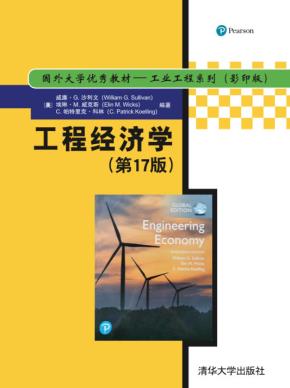
工程经济学(第17版)"
本书系统介绍了工程经济分析的理论、原理、方法和应用案例。全书共分为3部分。第1部分是工程经济基本原理,主要阐述工程经济分析的基本原则、重要的成本概念和估计技术、货币时间价值原理等工程经济学的基本概念和原理;第2部分介绍工程经济基本方法,深入分析了投资方案的赢利性评价方法和比选方法,折旧、所得税、通货膨胀等队评价方法的影响,设备更新分析方法,不确定性分析方法;第3部分为工程经济分析方法特别专题, 内容包括公共项目的费用效益分析方法、风险分析技术和融资及资本预算方法。
PREFACE
We live in a sea of economic decisions. —Anonymous
Proudly serving engineering educators and students for over 75 years
About Engineering Economy
A succinct job description for an engineer consists of two words: problem solver. Broadly speaking, engineers use knowledge to .nd new ways of doing things economically. Engineering design solutions do not exist in a vacuum but within the context of a business opportunity. Given that every problem has multiple solutions, the issue is, How does one rationally select the design with the most favorable economic result? The answer to this question can also be put forth in two words: engineering economy. Engineering economy provides a systematic framework for evaluating the economic aspects of competing design solutions. Just as engineers model the stress on a support column, or the thermodynamic response of a steam turbine, they must also model the economic impact of their recommendations.
Engineering economy—what is it, and why is it important? The initial reaction of many engineering students to these questions is, “Money matters will be handled by someone else. They are not something I need to worry about.” In reality, any engineering project must be not only physically realizable but also economically affordable. This book is about how to make smart economic choices.
Understanding and applying economic principles to engineering have never been more important. Engineering is more than a problem-solving activity focusing on the development of products, systems, and processes to satisfy a need or demand. Beyond function and performance, solutions must also be viable economically. Design decisions affect limited resources such as time, material, labor, capital, and natural resources, not only initially (during conceptual design) but also through the remaining phases of the life cycle (e.g., detailed design, manufacture and distribution, service, retirement, and disposal). A great solution can die a certain death if it is not pro.table.
. MyLab Engineering is available with Engineering Economy, 17/e and provides a powerful homework and test manager which lets instructors create, import, and manage online homework assignments, quizzes, and tests that are automatically
16 PREFACE
graded. You can choose from a wide range of assignment options, including time limits, proctoring, and maximum number of attempts allowed. The bottom line: MyLab Engineering means less time grading and more time teaching.
.
Automatically graded and algorithmic-generated homework assignments, quizzes, and tests that directly correlate to the textbook.
.
Automatic grading that tracks students’ results.
.
Assignable Auto-Graded Excel Projects let students master key Excel skills within the application and receive immediate feedback on their work.
.
Interactive “Help Me Solve This” tutorials provide opportunity for point-of-use help and more practice.
.
Learning Objectives mapped to ABET outcomes provide comprehensive reporting tools.
.
Video Solutions are available to help explain concepts or walk students through example exercises from the book.
What’s New to This Edition?
Our intent in revising the text is to continue integrating computer technology and realistic examples to facilitate learning engineering economy. Here are the highlights of changes made in the publication of the seventeenth edition:
.
Approximately half of all end-of-chapter problems have been replaced with fresh, new problems.
.
The “Try Your Skills” problem sets at the end of Chapters 1 through 8 have been doubled in problem count. “Try Your Skills” problem sets have also been added for Chapters 9 through 11.
.
Appendix A, a description of accounting fundamentals, has been rewritten and added to the book.
.
Group in-class problem exercises have been added to the majority of chapters in the seventeenth edition. These exercises are ideal for in-class, team-based problem solving with three to four students in each group.
.
Appendix H, which features answers to selected end-of-chapter problems, has been added to this new edition.
.
Problem-solution videos have been updated and expanded. These videos provide students with step-by-step solution methods and demonstrate both by-hand and spreadsheet solutions. These complement the MyLab Engineering software that has been a popular feature of previous editions.
Strategies of This Book
This book has two primary objectives: (1) to provide students with a sound understanding of the principles, basic concepts, and methodology of engineering economy; and (2) to help students develop pro.ciency with these methods and with the process for making rational decisions they are likely to encounter in professional practice. Interestingly, an engineering economy course may be a student’s only college
PREFACE 17
exposure to the systematic evaluation of alternative investment opportunities. In this regard, Engineering Economy is intended to serve as a text for classroom instruction and as a basic reference for use by practicing engineers in all specialty areas (e.g., chemical, civil, computer, electrical, industrial, and mechanical engineering). The book is also useful to persons engaged in the management of technical activities.
This book is written to appeal to engineering students with a wide variety of personal interests and majors. Our students are like most college students, varied in their educational and career interests and eager for challenging work that will inspire them. The explanations and examples in the book are student-centered and eminently practical in real-life situations. In addition, multimedia resources are available online in MyLab Engineering for students and instructors looking to supplement the print book’s contents.
As a textbook, the seventeenth edition is written principally for the .rst formal course in engineering economy. A three-credit-hour semester course should be able to cover the majority of topics in this edition, and there is suf.cient depth and breadth to enable an instructor to arrange course content to suit individual needs. Representative syllabi for a three-credit and a two-credit semester course in engineering economy are provided in Table P-1. Moreover, because several advanced topics are included, this book can also be used for a second course in engineering economy.
All chapters and appendices have been revised and updated to re.ect current trends and issues. Also, numerous exercises that involve open-ended problem statements and iterative problem-solving skills are included throughout the book. A large number of the 750-plus end-of-chapter exercises are new, and many solved examples representing realistic problems that arise in various engineering disciplines are presented.
In the 21st century, the world is turning over a new leaf for environmental sustainability. We have worked hard to capture this spirit in many of our examples and end-of-chapter problems. In fact, more than 160 “green” problems and examples have been integrated throughout this edition. They are listed in the Green Content section following the Preface.
FE Practice Problems are included to help prepare engineering students for milestone examinations similar to the Fundamentals of Engineering written examination in the United States and a few other countries.
It is generally advisable to teach engineering economy at the upper division level. Here, an engineering economy course incorporates the accumulated knowledge students have acquired in other areas of the curriculum and also deals with iterative problem solving, open-ended exercises, creativity in formulating and evaluating feasible solutions to problems, and consideration of realistic constraints (economic, aesthetic, safety, etc.) in problem solving.
Also available to adopters of this edition is an instructor’s solutions manual and other classroom resources. In addition, PowerPoint visual aids are readily available to instructors. Visit www.pearsonglobaleditions.com for more information.


CONTENTS
Preface 15 Green Content 23
CHAPTER 1
Introduction to Engineering Economy 31
1.1 Introduction 32
1.2 The Principles of Engineering Economy 33
1.3 Engineering Economy and the Design Process 36
1.4 Using Spreadsheets in Engineering Economic Analysis 45
1.5 Try Your Skills 45
1.6 Summary 46
CHAPTER 2
Cost Concepts and Design Economics 50
2.1 Cost Terminology 51
2.2 The General Economic Environment 57
2.3 Cost-Driven Design Optimization 67
2.4 Present Economy Studies 72
2.5 Case Study—The Economics of Daytime Running Lights 79
2.6 In-Class Exercise 80
2.7 Try Your Skills 80
2.8 Summary 82
CHAPTER 3
Cost-Estimation Techniques 92
3.1 Introduction 93
3.2 An Integrated Approach 95
3.3 Selected Estimating Techniques (Models) 103
3.4 Parametric Cost Estimating 108
3.5 Case Study—Demanufacturing of Computers 119
3.6 Electronic Spreadsheet Modeling: Learning Curve 121
3.7 In-Class Exercise 123
9
10 CONTENTS
3.8 Try Your Skills 123
3.9 Summary 126
CHAPTER 4
The Time Value of Money 134
4.1 Introduction 135
4.2 Simple Interest 136
4.3 Compound Interest 137
4.4 The Concept of Equivalence 137
4.5 Notation and Cash-Flow Diagrams and Tables 140
4.6 Relating Present and Future Equivalent Values of Single Cash Flows 144
4.7 Relating a Uniform Series (Annuity) to Its Present and Future Equivalent Values 150
4.8 Summary of Interest Formulas and Relationships for Discrete Compounding 160
4.9 Deferred Annuities (Uniform Series) 161
4.10 Equivalence Calculations Involving Multiple Interest Formulas 163
4.11 Uniform (Arithmetic) Gradient of Cash Flows 169
4.12 Geometric Sequences of Cash Flows 174
4.13 Interest Rates that Vary with Time 179
4.14 Nominal and Effective Interest Rates 181
4.15 Compounding More Often than Once per Year 183
4.16 Interest Formulas for Continuous Compounding and Discrete Cash Flows 186
4.17 Case Study—Understanding Economic “Equivalence” 189
4.18 In-Class Exercise 192
4.19 Try Your Skills 192
4.20 Summary 201
CHAPTER 5
Evaluating a Single Project 218
5.1 Introduction 219
5.2 Determining the Minimum Attractive Rate of Return (MARR) 220
5.3 The Present Worth Method 221
5.4 The Future Worth Method 228
5.5 The Annual Worth Method 229
5.6 The Internal Rate of Return Method 234
5.7 The External Rate of Return Method 245
5.8 The Payback (Payout) Period Method 247
5.9 Case Study—A Proposed Capital Investment to Improve Process Yield 250
CONTENTS 11
5.10 Electronic Spreadsheet Modeling: Payback Period Method 252
5.11 In-Class Exercise 254
5.12 Try Your Skills 254
5.13 Summary 260 Appendix 5-A The Multiple Rate of Return Problem with the IRR Method 271
CHAPTER 6
Comparison and Selection among Alternatives 276
6.1 Introduction 277
6.2 Basic Concepts for Comparing Alternatives 277
6.3 The Study (Analysis) Period 281
6.4 Useful Lives Are Equal to the Study Period 283
6.5 Useful Lives Are Unequal among the Alternatives 300
6.6 Personal Finances 313
6.7 Case Study—Ned and Larry’s Ice Cream Company 317
6.8 Postevaluation of Results 320
6.9 Project Postevaluation Spreadsheet Approach 320
6.10 In-Class Exercise 323
6.11 Try Your Skills 324
6.12 Summary 334
CHAPTER 7
Depreciation and Income Taxes 352
7.1 Introduction 353
7.2 Depreciation Concepts and Terminology 353
7.3 The Classical (Historical) Depreciation Methods 356
7.4 The Modi.ed Accelerated Cost Recovery System 361
7.5 A Comprehensive Depreciation Example 370
7.6 Introduction to Income Taxes 374
7.7 The Effective (Marginal) Corporate Income Tax Rate 377
7.8 Gain (Loss) on the Disposal of an Asset 380
7.9 General Procedure for Making After-Tax Economic Analyses 381
7.10 Illustration of Computations of ATCFs 385
7.11 Economic Value Added 397
7.12 In-Class Exercise 399
7.13 Try Your Skills 399
7.14 Summary 402
12 CONTENTS
CHAPTER 8
Price Changes and Exchange Rates 415
8.1 Introduction 416
8.2 Terminology and Basic Concepts 417
8.3 Fixed and Responsive Annuities 423
8.4 Differential Price Changes 428
8.5 Spreadsheet Application 430
8.6 Foreign Exchange Rates and Purchasing Power Concepts 432
8.7 Case Study-Selecting Electric Motors to Power an Assembly Line 437
8.8 In-Class Exercise 440
8.9 Try Your Skills 440
8.10 Summary 442
CHAPTER 9
Replacement Analysis 452
9.1 Introduction 453
9.2 Reasons for Replacement Analysis 453
9.3 Factors that Must Be Considered in Replacement Studies 454
9.4 Typical Replacement Problems 457
9.5 Determining the Economic Life of a New Asset (Challenger) 460
9.6 Determining the Economic Life of a Defender 464
9.7 Comparisons in Which the Defender’s Useful Life Differs from that of the Challenger 467
9.8 Retirement without Replacement (Abandonment) 470
9.9 After-Tax Replacement Studies 471
9.10 Case Study—Replacement of a Hospital’s Emergency Electrical Supply System 479
9.11 In-Class Exercise 483
9.12 Try Your Skills 483
9.13 Summary 484
CHAPTER 10
Evaluating Projects with the Bene.t.Cost Ratio Method 493
10.1 Introduction 494
10.2 Perspective and Terminology for Analyzing Public Projects 495
10.3 Self-Liquidating Projects 496
10.4 Multiple-Purpose Projects 496
10.5 Dif.culties in Evaluating Public-Sector Projects 499
10.6 What Interest Rate Should Be Used for Public Projects? 500
10.7 The Bene.t.Cost Ratio Method 502
CONTENTS 13
10.8 Evaluating Independent Projects by B.C Ratios 508
10.9 Comparison of Mutually Exclusive Projects by B.C Ratios 510
10.10 Case Study—Improving a Railroad Crossing 515
10.11 Try Your Skills 517
10.12 Summary 518
CHAPTER 11
Breakeven and Sensitivity Analysis 525
11.1 Introduction 526
11.2 Breakeven Analysis 526
11.3 Sensitivity Analysis 533
11.4 Multiple Factor Sensitivity Analysis 539
11.5 Try Your Skills 543
11.6 Summary 544
CHAPTER 12
Probabilistic Risk Analysis 553
12.1 Introduction 554
12.2 Sources of Uncertainty 555
12.3 The Distribution of Random Variables 555
12.4 Evaluation of Projects with Discrete Random Variables 559
12.5 Evaluation of Projects with Continuous Random Variables 568
12.6 Evaluation of Risk and Uncertainty by Monte Carlo Simulation 573
12.7 Performing Monte Carlo Simulation with a Computer 577
12.8 Decision Trees 581
12.9 Real Options Analysis 586
12.10 Summary 589
CHAPTER 13
The Capital Budgeting Process 597
13.1 Introduction 598
13.2 Debt Capital 600
13.3 Equity Capital 601
13.4 The Weighted Average Cost of Capital (WACC) 604
13.5 Project Selection 608
13.6 Postmortem Review 612
13.7 Budgeting of Capital Investments and Management Perspective 613
13.8 Leasing Decisions 614
13.9 Capital Allocation 616
13.10 Summary 622
14 CONTENTS
CHAPTER 14
Decision Making Considering Multiattributes 626
附录及索引
14.1 Introduction 627
14.2 Examples of Multiattribute Decisions 627
14.3 Choice of Attributes 629
14.4 Selection of a Measurement Scale 629
14.5 Dimensionality of the Problem 630
14.6 Noncompensatory Models 630
14.7 Compensatory Models 635
14.8 Summary 643
Appendix A Accounting Fundamentals 649 Appendix B Abbreviations and Notation 659 Appendix C Interest and Annuity Tables for Discrete Compounding 663 Appendix D Interest and Annuity Tables for Continuous Compounding 682 Appendix E Standard Normal Distribution 686 Appendix F Selected References 689 Appendix G Solutions to Try Your Skills 692 Appendix H Answers to Selected Problems 733
Index 737
工程经济学领域的畅销教材
威廉?G.沙利文(William G. Sullivan),弗吉尼亚理工学院暨州立大学(Virginia Polytechnic Institute and Stete University)教授