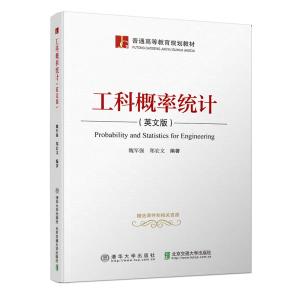
工科概率统计(英文版)"
Probability and Statistics is a mathematical discipline which studies stochastic phenomena. Now it is widely used in industry, economics, science and technologies. This course is one of the important basic courses for engineering majors in comprehensive universities. The textbook will include the general conceptions and methods about probability and statistics. The main topics are as the following.
Basic probability concepts; Random experiment; Sample spaces; Rules of probability; Counting techniques; Conditional probability; Independence. Discrete and continuous random variables. Sampling methods, Descriptive Statistics, Sampling distributions, The Student-t distribution, F-distribution and Chi-Square distribution, Point estimation. Confidence intervals. Testing hypotheses. Statistical software like Excel and/or Matlab will be used.
Preface
Randomness is the main characteristics in all fields of science. It is widely used in electrical power engineering, and other engineering sciences. Understanding how to model uncertainty and how to analyze its effects is—or should be—an essential part of an engineer’s education. The main aim of the book is, naturally, to give students the fundamental notions and instruments in probability and mathematical statistics.
One may wonder why we decided to write a book in probability and mathematical statistics despite the fact that there are many excellent books such as [1-6]. Our reasons can be summarized as follows. Firstly, we try to fit the course to the needs of the students in electrical engineering and the students in other engineering science who would like to get more knowledge in stochastic mathematics. Secondly, we constructed all expositions in the book in such a way to help engineering students to learn mathematics and the proof making in mathematics in a convenient and simple manner. Thirdly, since the hours given to this course in engineering departments are rather limited, we propose a slightly different way of teaching this course. Namely, we do not try to give all proofs of all theorems presented in the course. Some theorems which are not proved are illustrated via figures and examples, and we illustrated all notions appealing to statistical intuition. The main notions are always supported with engineering examples. The book provides many exercises referring to pure mathematics and engineering.
The book consists of nine chapters. Chapter 1 contains the introduction to the concepts of sample space and random events, and discusses some core examples from the engineering reality. Chapter 2 deals with random variables and their distributions. In chapter 3 we analyze random vectors and their distributions. The numerical characters are calculated respectively in chapter 4. The covariance and the correlation are introduced to reveal the relationship between marginal distributions. Chapter 5 introduces the basic theory of probability (the law of large number), and ends with the central limit theorem. Chapter 6 discusses statistics and their distributions. Here the notion of three sampling distributions is introduced, which are very important in statistical inference. Chapter 7 deals with one of the important case of statistical inference—parameter estimation. We estimate the parameters in the population by the moment method and the idea of maximum likelihood method. In addition, the confidence intervals of unknown parameters are constructed. In chapter 8 we consider hypothesis tests. This is another important case of statistical inference. We apply the concepts developed to treat the sample problems from the one or two normal distribution population. Several widely used statistical softwares are briefly introduced in the last chapter.
We observe during the years of our teaching experience that statistical parts create some difficulties among students. So, we explain the statistical thinking in a rather more different way. Each chapter ends with the number of problems which allow better understanding the issues considered. The structure of the book was proposed in the lectures given by the authors in the last decade in North China Electric Power University. And most parts of the course were given for oversea students and “2+2” international students in North China Electric Power University. We have tried to make the explanations as clear as we can. However, as limit of our knowledge, it’s not perfect. If you find something that is unclear or should be added to this book, please let us know. We’ll appreciate it if you could send all error reports and suggestions for improvement to weijunqiang@ncepu.edu.cn.
It is a pleasure to thank a number of people who have made contributions to this book in one way or another. The authors thank the Fund by Teaching Affairs Department of North China Electric Power University for partial financial support (Grant No. XM17032). We would also like to thank colleagues from School of Mathematical and Physical Sciences and International Education Institute of North China Electric Power University for permanent help and support. We thank our students for their patience and support.
Junqiang Wei and Hongwen Zheng
May 2018


Contents
Chapter 1 Probability and Its Properties 1
1.1 Basic Probability Concepts 1
1.2 Axioms and Properties of Probability 4
1.2.1 Axioms Definition of Probability 5
1.2.2 Properties of Probability 5
1.3 Classical Probability and Counting Techniques 7
1.3.1 Counting Principles 7
1.3.2 Classical Probability 8
1.4 Conditional Probability, Independence of Two and Several Events 9
1.4.1 Conditional Probability 10
1.4.2 Independence 12
1.5 Law of Total Probability and Bayes’ Theorem 14
Exercises 17
Chapter 2 Random Variables and Their Distributions 20
2.1 Random Variables 20
2.2 Distribution of a Random Variable and Distribution Function 21
2.3 Classical Discrete Random Variables and Continuous Random Variables 27
2.3.1 Discrete Distribution 27
2.3.2 Continuous Distribution 31
2.4 Distribution of Functions of a Random Variable 36
Exercises 40
Chapter 3 Random Vectors and Their Distributions 44
3.1 Jointly Distributed Random Variables 44
3.2 Marginal Distribution and Conditional Distribution of Two Random Variables 49
3.3 Independent Random Variables 58
3.4 Distribution of Functions of Two Random Variables 63
Exercises 72
Chapter 4 Expectations and Moments 77
4.1 Mathematical Expectation and Its Properties 77
4.1.1 Mathematical Expectation 77
4.1.2 Properties of the Expectation 83
4.2 Variance and Its Properties 84
4.2.1 Definition of the Variance 84
4.2.2 Properties of the Variance 86
4.3 Expectations and Variances of Special Probability Distributions 87
4.3.1 Case for Common Discrete Random Variables 87
4.3.2 Case for Common Continuous Random Variables 89
4.4 Moments 91
4.4.1 Covariance and Correlation Coefficients 91
4.4.2 Moments 99
Exercises 101
Chapter 5 The Law of Large Numbers and the Central Limit Theorem 105
5.1 The Law of Large Numbers and Its Applications 105
5.1.1 Chebyshev’s Inequality 105
5.1.2 The Law of Large Numbers 107
5.2 The Central Limit Theorem and Its Applications 110
Exercises 112
Chapter 6 Basic Conceptions of Statistics 115
6.1 Basic Conceptions of Sampling 115
6.2 Descriptive Statistics 116
6.2.1 Summarizing Data—Numerical Methods 116
6.2.2 Summarizing Data—Graphical Methods 127
6.3 Fundamental Sampling Distributions 132
6.3.1 The Chi-squared Distribution 135
6.3.2 The t-Distribution 136
6.3.3 The F-Distribution 138
6.4 Sampling Distribution Theorems 140
Exercises 143
Chapter 7 Parameter Estimation 146
7.1 General Concepts of Point Estimation 146
7.2 Methods of Point Estimation 147
7.2.1 Method of Moments 147
7.2.2 Method of Maximum Likelihood Estimation 150
7.3 Criteria for Good Estimators 157
7.4 Interval Estimation 164
7.4.1 Confidence Intervals Based on a Single Sample 164
7.4.2 Confidence Intervals Based on Two Samples 169
7.5 One-sided Confidence Intervals (Confidence Bounds) 171
Exercises 172
Chapter 8 Hypothesis Testing 177
8.1 Hypotheses and Testing Procedures 177
8.1.1 Hypotheses Testing Terminology 178
8.1.2 Testing Procedures 182
8.2 Tests Concerning Means and Variances 183
8.2.1 Tests About One Population Mean 183
8.2.2 Testing One Population Variance 188
8.2.3 Comparing Two Population Means 189
8.2.4 Comparing Two Population Variances 190
8.3 Duality Between Confidence Interval and Hypothesis Testing 192
Exercises 194
Chapter 9 Understanding Monte Carlo Method and Statistics Software 199
9.1 Monte Carlo Method 199
9.1.1 The Monte Carlo Method 200
9.1.2 Bootstrap Procedures 201
9.2 Introduction of Statistics Software 202
Appendix A Tables 205
A.1 Standard Normal Curve Areas 205
A.2 Critical Values for Chi-squared Distributions 206
A.3 Critical Values for t-Distributions 207
A.4 Critical Values for F-Distributions 209
Bibliography 215
1.“大家”执笔,结构清晰,内容丰富,言简意赅。 2.案例精彩,分析精辟。 3.资料齐全,免费赠送,值得拥有。
魏军强,男,中共党员,博士,副教授,硕士生导师。主持或参与完成国家自然科学基金项目两项,中央高校基本科研业务费项目和横向项目多项,发表论文近20篇。承担普通高等教育本科生、国际教育本科生和留学生的《高等数学》、《概率论与数理统计》、《线性代数》等工科数学的教学工作,主持或参与完成北京市教改项目两项,大学教改项目四项,参与编写出版教材和教学辅导书4本。指导大学生参加大学生数学建模竞赛,多人次获奖。