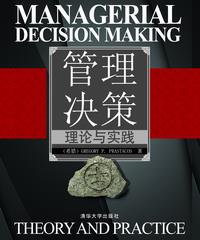
管理决策:理论与实践"
A constant pressure on companies to reduce costs while improving quality,efficiency,service and innovation,is on the daily agenda。In this complex and continuously evolving environment,a company's ability to react to the challenges becomes of vital importance。
In this new business reality,managers must have the ability to make decisions quickly and thoroughly,by taking evidence into account,and evaluating consequences and alternative plans in terms of growth,profitability and acceptable risk。In today's environment,being able to make good and fast decisions in all areas of business,including financial and risk management,marketing strategy and customer understanding,production and logistics,procurement and supply chain management,human resources management and development,IT-based process redesign, is becoming strategically important。


CHAPTER 1 INTRODUCTION TO MANAGEMENT SCIENCE 2
1.1 Introduction to Managerial Decision Making 2
1.2 Trends Affecting Decision Making Today 5
1.3 Key Characteristics of Management Science for Decision Making 6
1.4 The Use of Models for Making Decisions 7
1.5 The Use of Software in Decision Making 17
1.6 Applications of Management Science in Business 18
References 22■CHAPTER 2 AVOIDING BAD DECISIONS: The Methodology of
Decision Making 242.1 Introduction 24
2.2 Decision Making Traps 25
2.3 Decision Making Tips 27
2.4 The Rational Methodology for Decision Making 30
2.5 Identification of the Problem 31
2.6 Analysis of the System 33
2.7 Formulation of the Objectives 35
2.8 Initial System Design 37
2.9 Detailed System Design 39
2.10 Solution Implementation and Monitoring 40
References 43Managerial Decision MakingTABLE OF CONTENTSPART IIMODELS IN MANAGERIAL DECISION MAKING45■CHAPTER 3 LINEAR PROGRAMMING 47
3.1 Introduction 47
3.2 Characteristics of LP Problems 48
3.3 A Maximization Problem 50
3.4 A Trial-and-Error Approach in Solving LP Problems 51
3.5 Graphical Solution of a LP Problem 52
3.6 A Minimization Problem 55
3.7 General Formulation and Assumptions of LP Models 56
3.8 Solving LP Problems 58
Problems 59
References 61■CHAPTER 4 USING SOLVER TO SOLVE LINEAR PROGRAMMING
PROBLEMS 634.1 Introduction 63
4.2 Introducing the Model in Excel 64
4.3 Solving the Problem 66
4.4 Understanding and Analyzing the Solution-SOLVER Reports 71
4.5 Solving Integer Programming Problems with SOLVER 75
4.6 Solving Non-Linear Programming Problems with SOLVER 75
4.7 Conclusions 77
Problems 77
References 78■CHAPTER 5 SENSITIVITY ANALYSIS IN LINEAR
PROGRAMMING 795.1 Introduction 79
5.2 An Example 80
5.3 Dual Prices in LP 82
5.4 Reduced Costs in LP 83
5.5 Changes in the Objective Function's Coefficients 84
5.6 Changes in the Right Hand Sides (RHS) of the Constraints 86
5.7 Evaluation of a New Activity 88
5.8 Conclusions 88
Problems 89
References 99
■CHAPTER 6 INTEGER PROGRAMMING 100
6.1 Introduction 100
6.2 Formulating IP Problems with Binary Variables 101
6.3 An Investment Example 103
6.4 Formulating IP Problems with Fixed Costs and/or Discounts 104
6.5 Solving IP Problems 108
6.6 Heuristic Methods to Solve IP Problems 109
6.7 Conclusions 112
Problems 112
References 115
■CHAPTER 7 MULTI-CRITERIA DECISION MAKING 116
7.1 Introduction 116
7.2 Empirical Methods 117
7.3 Goal Programming 119
7.4 The Analytical Hierarchy Process 124
7.5 Using Expert Choice to Solve Multicriteria Problems 130
Problems 135
References 138■CHAPTER 8 STATISTICAL METHODS IN DECISION
MAKING 1398.1 Introduction to Forecasting 139
8.2 Key Concepts about Forecasting 141
8.3 The Moving Averages Forecasting Method 144
8.4 Exponential Smoothing Forecasting Method 148
8.5 Other Forecasting Methods 150
8.6 Linear Regression 152
8.7 Multiple Regression 157
8.8 Discriminant Analysis 161
8.9 Using SPSS for Statistical Analysis 164
Problems 167
References 172
■CHAPTER 9 DECISION ANALYSIS 173
9.1 Introduction 173
9.2 Key Concepts about Decision Analysis 174
9.3 Criteria for Making Decisions under Uncertainty 175
9.4 The Expected Value of Perfect Information 178
9.5 Introduction to Decision Trees 179
9.6 Calculating the Risk Profile a Strategy 184
9.7 Sensitivity Analysis 185
9.8 Using Precision Tree to Solve Decision Analysis Problems 186
Problems 190
References 192
■CHAPTER 10 SIMULATION 193
10.1 Introduction 193
10.2 Key Characteristics of Simulation 196
10.3 Implementation of Simulation under Conditions of Uncertainty 197
10.4 Simulation of Queuing Systems 200
10.5 Simulation of an Inventory System 202
10.6 Analysis of Simulation Results 205
10.7 Using Simulation for Risk Management 207
10.8 Using Simulation for Business Process Reengineering 213
Problems 222
References 225
PART IIIIMPLEMENTING MANAGEMENT SCIENCE IN PRACTICE227■CHAPTER 11 GETTING TO KNOW YOUR CUSTOMER 228
11.1 Introduction 228
11.2 Determining Customer Satisfaction 229
11.3 Designing New Products 233
11.4 Sales-Advertising Response Analysis 236
11.5 Forecasting Sales of New Products 240
11.6 Identifying Areas of Improvement 243
11.7 Studying Product Positioning 246
11.8 Identifying Market Segments 251
11.9 Identifying Prospect Customers 257
Problems 260
References 264
■CHAPTER 12 MARKETING AND SALES MANAGEMENT 265
12.1 Introduction 265
12.2 A Product Selection Problem 267
12.3 Design of Sales Network 269
12.4 Selection of Communication Media 271
12.5 Selection of Location 274
12.6 Design of New Product Marketing Strategy 278
12.7 Design of Promotion Strategy 281
12.8 Sales Strategy 284
12.9 Evaluation of Customer Value for CRM Implementation 287
Problems 292
References 295■CHAPTER 13 PRODUCTION AND INVENTORY
MANAGEMENT 29613.1 Introduction 296
13.2 Production Planning-Selection of Production Mix 297
13.3 Capacity Planning 300
13.4 Outsourcing Management 303
13.5 Planning Production Personnel 304
13.6 Production Planning under Demand Uncertainty 307
13.7 Production and Sales Planning under Discounting 310
13.8 Selection of Production Technology 313
13.9 Sequencing and Scheduling Production Problems 318
Problems 320
References 322
■CHAPTER 14 NETWORKS AND TRANSPORT PROBLEMS 323
14.1 Introduction 323
14.2 The Transportation Problem 324
14.3 Designing the Shortest Path 328
14.4 Managing Network Flow Problems 330
14.5 Designing the Minimum Spanning Tree 332
14.6 Planning Route Schedules with Multiple Vehicles 334
14.7 Scheduling an Airline's Flights 338
14.8 Project Management 342
Problems 345
References 347■CHAPTER 15 LOGISTICS AND SUPPLY CHAIN
MANAGEMENT 34815.1 Introduction 348
15.2 Designing the Supply Chain 349
15.3 Evaluating a Company Acquisition 352
15.4 Planning Product Distribution 355
15.5 Planning Distribution of Hazardous Materials 361
15.6 Selection of Transportation Media 363
15.7 Design and Introduction of New Product 368
Problems 373
References 376
■CHAPTER 16 MANAGING INVESTMENTS 377
16.1 Introduction 377
16.2 A Simple Investment Selection Problem 378
16.3 Selecting a Multi-Period Investment Portfolio 380
16.4 Investing in Real Estate 383
16.5 Multi-Period Investment Planning 388
16.6 Asset and Liability Management in a Bank 391
16.7 Deciding on Production and Capital Structure for a Family Business 395
16.8 Developing Effective Export Planning 398
16.9 Developing a Customized Portfolio among FTSE-20 Companies 401
Problems 405
References 407
■CHAPTER 17 MANAGING UNCERTAINTY IN FINANCE 408
17.1 Introduction 408
17.2 Investment Appraisal 409
17.3 Investment Selection 411
17.4 Business Analysis for a New Product 414
17.5 Project Finance Decision 418
17.6 Stock Portfolio Management 421
17.7 Capacity Planning under Demand Uncertainty 425
17.8 Portfolio Value at Risk (VAR) Calculation 429
Problems 431
References 433
■CHAPTER 18 HUMAN RESOURCES MANAGEMENT 434
18.1 Introduction 434
18.2 Allocating Personnel Workload 435
18.3 Scheduling for Personnel Time 438
18.4 Recruiting Personnel Using Performance Score Cards 440
18.5 Recruiting Personnel Using Multiple Criteria 443
18.6 Implementing a Fair Bonus System 447
18.7 Selecting Training Program 452
18.8 Building up Personnel Motivation 457
Problems 459
References 461
■CHAPTER 19 ORGANIZATIONAL REDESIGN 462
19.1 Introduction 462
19.2 Reorganization of Hospital Processes 463
19.3 Evaluation of the Efficiency of Bank Stores 466
19.4 Supply System Reengineering 472
19.5 Toll Station Management 475
19.6 Planning the Port Services 479
19.7 Factory Production Planning 483
19.8 Reengineering the Rank Xerox Supply Chain 491
References 498■CHAPTER 20 USING MANAGEMENT SCIENCE IN THE
WORLD 49920.1 Introduction 499
20.2 Designing Financial Products at Merrill Lynch 501
20.3 Designing a Supply Chain at IBM 508
20.4 Managing Blood in New York City 513
20.5 Routing and Distribution Scheduling at Federal Express 518
20.6 Human Resources Management at Emporiki Bank 522
20.7 Fire Fighting in Canada 526
20.8 Managing a Supply Chain in the Philippines 530
20.9 Recycling Waste Lube Oils in Greece 533
20.10 Yield Management at American Airlines 538
References 542