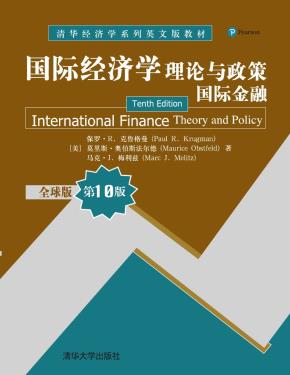
国际经济学:理论与政策(国际金融)(全球版第10版)"
《国际经济学:理论与政策》的三位作者都是著名的经济学家。本书是美国许多知名大学的首选教材,它深刻洞悉了国际贸易和国际金融领域的最新变化和争议,在内容安排上既包含国际经济学的最新进展,又重视长期以来作为学科核心的传统理论与见解。本书配有大量的案例、专栏和图表,注重理论在实践中的应用。作者以其多年来对国际经济学的研究和实践经验,系统介绍了国际贸易理论和政策、国际收支平衡、汇率决定和国际宏观经济政策的最新研究成果,是一本不可多得的国际经济学教材。
Years after the global financial crisis that broke out in 2007–2008, the industrial world’s economies are still growing too slowly to restore full employment. Emerging markets, despite impressive income gains in many cases, remain vulnerable to the ebb and flow of global capital. And finally, an acute economic crisis in the euro area has lasted since 2009, bringing the future of Europe’s common currency into question. This tenth edition therefore comes out at a time when we are more aware than ever before of how events in the global economy influence each country’s economic for- tunes, policies, and political debates. The world that emerged from World War II was one in which trade, financial, and even communication links between countries were limited. More than a decade into the 21st century, however, the picture is very dif- ferent. Globalization has arrived, big time. International trade in goods and services has expanded steadily over the past six decades thanks to declines in shipping and communication costs, globally negotiated reductions in government trade barriers, the widespread outsourcing of production activities, and a greater awareness of for- eign cultures and products. New and better communications technologies, notably the Internet, have revolutionized the way people in all countries obtain and exchange information. International trade in financial assets such as currencies, stocks, and bonds has expanded at a much faster pace even than international product trade. This process brings benefits for owners of wealth but also creates risks of contagious financial instability. Those risks were realized during the recent global financial cri- sis, which spread quickly across national borders and has played out at huge cost to the world economy. Of all the changes on the international scene in recent decades, however, perhaps the biggest one remains the emergence of China—a development that is already redefining the international balance of economic and political power in the coming century.
Imagine the astonishment of the generation that lived through the depressed 1930s as adults, had its members been able to foresee the shape of today’s world economy! Nonetheless, the economic concerns that continue to cause international debate have not changed that much from those that dominated the 1930s, nor indeed since they were first analyzed by economists more than two centuries ago. What are the merits of free trade among nations compared with protectionism? What causes countries to run trade surpluses or deficits with their trading partners, and how are such imbalances resolved over time? What causes banking and currency crises in open economies, what causes financial contagion between economies, and how should governments handle international financial instability? How can governments avoid unemployment and inflation, what role do exchange rates play in their efforts, and how can countries best cooperate to achieve their economic goals? As always in international economics, the interplay of events and ideas has led to new modes of analysis. In turn, these analyti- cal advances, however abstruse they may seem at first, ultimately do end up playing a major role in governmental policies, in international negotiations, and in people’s everyday lives. Globalization has made citizens of all countries much more aware than ever before of the worldwide economic forces that influence their fortunes, and global- ization is here to stay.
xv
New to the Tenth Edition
For this edition, we are offering an Economics volume as well as Trade and Finance splits. The goal with these distinct volumes is to allow professors to use the book that best suits their needs based on the topics they cover in their International Economics course. In the Economics volume for a two-semester course, we follow the standard practice of dividing the book into two halves, devoted to trade and to monetary ques- tions. Although the trade and monetary portions of international economics are often treated as unrelated subjects, even within one textbook, similar themes and methods recur in both subfields. We have made it a point to illuminate connections between the trade and monetary areas when they arise. At the same time, we have made sure that the book’s two halves are completely self-contained. Thus, a one-semester course on trade theory can be based on Chapters 2 through 12, and a one-semester course on international monetary economics can be based on Chapters 13 through 22. For pro- fessors’ and students’ convenience, however, they can now opt to use either the Trade or the Finance volume, depending on the length and scope of their course.
We have thoroughly updated the content and extensively revised several chapters. These revisions respond both to users’ suggestions and to some important develop- ments on the theoretical and practical sides of international economics. The most far-reaching changes in the Finance volume are the following:
■ Chapter 6, Output and the Exchange Rate in the Short Run In response to the global economic crisis of 2007–2009, countries throughout the world adopted countercycli- cal fiscal responses. Renewed academic research on the size of the fiscal multiplier soon followed, although most of it was set in the closed economy and so ignored the exchange rate effects stressed in this chapter’s model. For this edition, we have added a new Case Study on the size of the fiscal multiplier in the open economy. In line with recent academic literature, which focuses on fiscal policy at the zero lower in- terest-rate bound, we integrate the discussion with our model of the liquidity trap.
■ Chapter 7, Fixed Exchange Rates and Foreign Exchange Intervention The chapter now includes additional discussion of “inflow attacks” on exchange rates being held at appreciated levels through foreign exchange intervention and other measures, a phenomenon seen in China and other countries. A new Case Study focuses on the Swiss National Bank’s policy of capping the Swiss franc’s level against the euro.
■ Chapter 8, International Monetary Systems: An Historical Overview A detailed der- ivation of an open economy’s multi-period intertemporal budget constraint now complements the discussion of external balance. (Instructors who do not want to cover this relatively more technical material can skip it without loss of continuity.) The intertemporal analysis is applied to analyze the sustainability of New Zealand’s persistent foreign borrowing. In addition, the chapter’s discussion of recent events in the global economy has been updated.
■ Chapter 9, Financial Globalization: Opportunity and Crisis For this new edition, we have switched the earlier order of Chapters 9 and 10 so that the book now covers the international capital market before covering optimum currency areas and the euro crisis. Our reasoning is that the euro crisis is in large part a crisis of the banks, which students cannot understand without a good prior grasp of international banking and its problems. Consistent with this approach, the new Chapter 9 covers bank bal- ance sheets and bank fragility in detail, with emphasis on bank capital and capital regulation. Ever since this book’s first edition, we have stressed the global context of banking regulation. In this edition, we explain the “financial trilemma,” which forces national policymakers to choose at most two from among the potential objectives of financial openness, financial stability, and national control over financial policy.
■ Chapter 10, Optimum Currency Areas and the Euro The crisis in the euro area esca- lated dramatically after the last edition of this book went to press. For this new edi- tion, we have brought our coverage of the euro crisis up to date with new material on initiatives for closer policy coordination in the euro countries, such as banking union. Our theoretical discussion of optimum currency areas also reflects lessons of the euro crisis.
■ Chapter 11, Developing Countries: Growth, Crisis, and Reform Our coverage of capital flows to developing countries now includes recent research on the small size of those flows, as well as their paradoxical tendency to favor low-growth over high-growth developing economies. We point out the close link between theories of capital alloca- tion to developing countries and theories of the cross-country distribution of income.
In addition to these structural changes, we have updated the book in other ways to maintain current relevance. Thus, in the Finance volume, we examine the causes of the large measured global current account surplus (Chapter 2); we describe the outbreak and resolution of Zimbabwe’s hyperinflation (Chapter 4); and we describe the evolving infrastructure of international bank regulation, including Basel III and the Financial Stability Board (Chapter 9).
About the Book
The idea of writing this book came out of our experience in teaching international economics to undergraduates and business students since the late 1970s. We perceived two main challenges in teaching. The fi was to communicate to students the exciting intel- lectual advances in this dynamic fi The second was to show how the development of international economic theory has traditionally been shaped by the need to understand the changing world economy and analyze actual problems in international economic policy.
We found that published textbooks did not adequately meet these challenges. Too often, international economics textbooks confront students with a bewildering array of special models and assumptions from which basic lessons are difficult to extract. Because many of these special models are outmoded, students are left puzzled about the real-world relevance of the analysis. As a result, many textbooks often leave a gap between the somewhat antiquated material to be covered in class and the exciting issues that dominate current research and policy debates. That gap has widened dra- matically as the importance of international economic problems—and enrollments in international economics courses—have grown.
This book is our attempt to provide an up-to-date and understandable analytical framework for illuminating current events and bringing the excitement of international economics into the classroom. In analyzing both the real and monetary sides of the subject, our approach has been to build up, step by step, a simple, unified framework for communicating the grand traditional insights as well as the newest findings and approaches. To help the student grasp and retain the underlying logic of international economics, we motivate the theoretical development at each stage by pertinent data and policy questions.
The Place of This Book in the Economics Curriculum
Students assimilate international economics most readily when it is presented as a method of analysis vitally linked to events in the world economy, rather than as a body of abstract theorems about abstract models. Our goal has therefore been to stress con- cepts and their application rather than theoretical formalism. Accordingly, the book
does not presuppose an extensive background in economics. Students who have had a course in economic principles will find the book accessible, but students who have taken further courses in microeconomics or macroeconomics will find an abundant supply of new material. Specialized appendices and mathematical postscripts have been included to challenge the most advanced students.
Some Distinctive Features
This book covers the most important recent developments in international economics without shortchanging the enduring theoretical and historical insights that have tra- ditionally formed the core of the subject. We have achieved this comprehensiveness by stressing how recent theories have evolved from earlier findings in response to an evolving world economy. The text is divided into a core of chapters focused on theory, followed by chapters applying the theory to major policy questions, past and current.
In Chapter 1, we describe in some detail how this book addresses the major themes of international economics. Here we emphasize several of the topics that previous authors failed to treat in a systematic way.
asset Market approach to Exchange rate Determination
The modern foreign exchange market and the determination of exchange rates by national interest rates and expectations are at the center of our account of open- economy macroeconomics. The main ingredient of the macroeconomic model we develop is the interest parity relation, augmented later by risk premiums (Chapter 3). Among the topics we address using the model are exchange rate “overshooting”; inflation targeting; behavior of real exchange rates; balance-of-payments crises under fixed exchange rates; and the causes and effects of central bank intervention in the foreign exchange market (Chapters 4 through 7).
International Macroeconomic Policy Coordination
Our discussion of international monetary experience (Chapters 8 through 11) stresses the theme that different exchange rate systems have led to different policy coordina- tion problems for their members. Just as the competitive gold scramble of the interwar years showed how beggar-thy-neighbor policies can be self-defeating, the current float challenges national policymakers to recognize their interdependence and formulate policies cooperatively.
the World Capital Market and Developing Countries
A broad discussion of the world capital market is given in Chapter 9 which takes up the welfare implications of international portfolio diversification as well as prob- lems of prudential supervision of internationally active banks and other financial institutions. Chapter 11 is devoted to the long-term growth prospects and to the specific macroeconomic stabilization and liberalization problems of industrializing and newly industrialized countries. The chapter reviews emerging market crises and places in his- torical perspective the interactions among developing country borrowers, developed country lenders, and official financial institutions such as the International Monetary Fund. Chapter 11 also reviews China’s exchange-rate policies and recent research on the persistence of poverty in the developing world.
Learning Features
This book incorporates a number of special learning features that will maintain stu- dents’ interest in the presentation and help them master its lessons.
Case Studies
Case studies that perform the threefold role of reinforcing material covered earlier, illustrating its applicability in the real world, and providing important historical infor- mation often accompany theoretical discussions.
Special Boxes
Less central topics that nonetheless offer particularly vivid illustrations of points made in the text are treated in boxes. Among these markets for nondeliverable forward exchange (Chapter 3); and the rapid accumulation of foreign exchange reserves by developing countries (Chapter 11).
Captioned Diagrams
More than 200 diagrams are accompanied by descriptive captions that reinforce the discussion in the text and help the student in reviewing the material.
Learning Goals
A list of essential concepts sets the stage for each chapter in the book. These learning goals help students assess their mastery of the material.
Summary and Key terms
Each chapter closes with a summary recapitulating the major points. Key terms and phrases appear in boldface type when they are introduced in the chapter and are listed at the end of each chapter. To further aid student review of the material, key terms are italicized when they appear in the chapter summary.
Problems
Each chapter is followed by problems intended to test and solidify students’ compre- hension. The problems range from routine computational drills to “big picture” ques- tions suitable for classroom discussion. In many problems we ask students to apply what they have learned to real-world data or policy questions.
Further readings
For instructors who prefer to supplement the textbook with outside readings, and for students who wish to probe more deeply on their own, each chapter has an annotated bibliography that includes established classics as well as up-to-date examinations of recent issues.
MyEconLab
MyEconLab
MyEconLab is the premier online assessment and tutorial system, pairing rich online content with innovative learning tools. MyEconLab includes comprehensive home- work, quiz, test, and tutorial options, allowing instructors to manage all assessment
needs in one program. Key innovations in the MyEconLab course for the tenth edition of International Economics: Theory & Policy include the following:
■ Real-Time Data Analysis Exercises, marked with , allow students and instructors to use the latest data from FRED, the online macroeconomic data bank from the
Federal Reserve Bank of St. Louis. By completing the exercises, students become familiar with a key data source, learn how to locate data, and develop skills to inter- pret data.
■ In the enhanced eText available in MyEconLab, figures labeled MyEconLab Real- Time Data allow students to display a pop-up graph updated with real-time data from FRED.
■ Current News Exercises, new to this edition of the MyEconLab course, provide a turn- key way to assign gradable news-based exercises in MyEconLab. Every week, Pearson scours the news, finds a current article appropriate for an economics course, creates an exercise around the news article, and then automatically adds it to MyEconLab. Assigning and grading current news-based exercises that deal with the latest economic events has never been more convenient.
Students and MyEconLab
This online homework and tutorial system puts students in control of their own learning through a suite of study and practice tools correlated with the online, in- teractive version of the textbook and learning aids such as animated figures. Within MyEconLab’s structured environment, students practice what they learn, test their understanding, and then pursue a study plan that MyEconLab generates for them based on their performance.
Instructors and MyEconLab
MyEconLab provides flexible tools that allow instructors easily and effectively to cus- tomize online course materials to suit their needs. Instructors can create and assign tests, quizzes, or homework assignments. MyEconLab saves time by automatically grading all questions and tracking results in an online gradebook. MyEconLab can even grade assignments that require students to draw a graph.
After registering for MyEconLab instructors have access to downloadable supple- ments such as an instructor’s manual, PowerPoint lecture notes, and a test bank. The test bank can also be used within MyEconLab, giving instructors ample material from which they can create assignments—or the Custom Exercise Builder makes it easy for instructors to create their own questions.
Weekly news articles, video, and RSS feeds help keep students updated on current events and make it easy for instructors to incorporate relevant news in lectures and homework.
For more information about MyEconLab or to request an instructor access code, visit www.myeconlab.com.
additional Supplementary resources
A full range of additional supplementary materials to support teaching and learning accompanies this book.
■ The Online Instructor’s Manual—updated by Hisham Foad of San Diego State University—includes chapter overviews and answers to the end-of-chapter problems.
■ The Online Test Bank offers a rich array of multiple-choice and essay questions, in- cluding some mathematical and graphing problems, for each textbook chapter. It is available in Word, PDF, and TestGen formats. This Test Bank was carefully revised and updated by Robert F. Brooker of Gannon University.
■ The Computerized Test Bank reproduces the Test Bank material in the TestGen software that is available for Windows and Macintosh. With TestGen, instructors can easily edit existing questions, add questions, generate tests, and print the tests in variety of formats.
■ The Online PowerPoint Presentation with Tables, Figures, & Lecture Notes was re- vised by Amy Glass of Texas A&M University. This resource contains all text fig- ures and tables and can be used for in-class presentations.
■ The Companion Web Site at www.pearsonhighered.com/krugman contains additional appendices. (See page xvi of the Contents for a detailed list of the Online Appendices.)
Instructors can download supplements from our secure Instructor’s Resource Center. Please visit www.pearsonhighered.com/irc.
Acknowledgments
Our primary debt is to Christina Masturzo, the Acquisitions Editor in charge of the project. We also are grateful to the Program Manager, Carolyn Philips, and the Proj- ect Manager, Carla Thompson. Heather Johnson’s efforts as Project Manager with Integra-Chicago were essential and efficient. We would also like to thank the me- dia team at Pearson—Denise Clinton, Noel Lotz, Courtney Kamauf, and Melissa Honig—for all their hard work on the MyEconLab course for the tenth edition. Last, we thank the other editors who helped make the first nine editions of this book as good as they were.
We also wish to acknowledge the sterling research assistance of Tatjana Kleine- berg and Sandile Hlatshwayo. Camille Fernandez provided superb logistical support, as usual. For helpful suggestions and moral support, we thank Jennifer Cobb, Gita Gopinath, Vladimir Hlasny, and Phillip Swagel.
We thank the following reviewers, past and present, for their recommendations and insights:
Jaleel Ahmad, Concordia University Lian An, University of North Florida Anthony Paul Andrews, Governors State
University
Myrvin Anthony, University of Strathclyde, U.K.
Michael Arghyrou, Cardiff University Richard Ault, Auburn University Amitrajeet Batabyal, Rochester Institute
of Technology
Tibor Besedes, Georgia Tech
George H. Borts, Brown University
Robert F. Brooker, Gannon University
Francisco Carrada-Bravo, W.P. Carey School of Business, ASU
Debajyoti Chakrabarty, University of Sydney
Adhip Chaudhuri, Georgetown University
Jay Pil Choi, Michigan State University
Jaiho Chung, National University of Singapore
Jonathan Conning, Hunter College and The Graduate Center, The City University
of New York
Brian Copeland, University of British Columbia
Kevin Cotter, Wayne State University
Barbara Craig, Oberlin College
Susan Dadres, University of North Texas Ronald B. Davies, University College Dublin Ann Davis, Marist College
Gopal C. Dorai, William Paterson University Robert Driskill, Vanderbilt University Gerald Epstein, University of Massachusetts
at Amherst
JoAnne Feeney, State University of New York
at Albany
Robert Foster, American Graduate School of International Management
Patrice Franko, Colby College
Diana Fuguitt, Eckerd College
Byron Gangnes, University of Hawaii at Manoa
Ranjeeta Ghiara, California State University, San Marcos
Neil Gilfedder, Stanford University
Amy Glass, Texas A&M University
Patrick Gormely, Kansas State University
Thomas Grennes, North Carolina State University Bodil Olai Hansen, Copenhagen Business School Michael Hoffman, U.S. Government Accountability
Office
Henk Jager, University of Amsterdam
Arvind Jaggi, Franklin & Marshall College
Mark Jelavich, Northwest Missouri State University
Philip R. Jones, University of Bath and University of Bristol, U.K.
Tsvetanka Karagyozova, Lawrence University
Hugh Kelley, Indiana University Michael Kevane, Santa Clara University Maureen Kilkenny, University of Nevada Hyeongwoo Kim, Auburn University
Stephen A. King, San Diego State University, Imperial Valley
Faik Koray, Louisiana State University
Corinne Krupp, Duke University
Bun Song Lee, University of Nebraska, Omaha
Daniel Lee, Shippensburg University Francis A. Lees, St. Johns University Jamus Jerome Lim, World Bank Group Rodney Ludema, Georgetown University Stephen V. Marks, Pomona College
Michael L. McPherson, University of North Texas
Marcel Mérette, University of Ottawa
Shannon Mitchell, Virginia Commonwealth University
Kaz Miyagiwa, Emory University
Shannon Mudd, Ursinus College
Marc-Andreas Muendler, University of California, San Diego
Ton M. Mulder, Erasmus University, Rotterdam
Robert G. Murphy, Boston College
E. Wayne Nafziger, Kansas State University
Steen Nielsen, University of Aarhus
Dmitri Nizovtsev, Washburn University Terutomo Ozawa, Colorado State University Arvind Panagariya, Columbia University Nina Pavcnik, Dartmouth College
Iordanis Petsas, University of Scranton
Thitima Puttitanun, San Diego State University
Peter Rangazas, Indiana University-Purdue University Indianapolis
James E. Rauch, University of California, San Diego
Michael Ryan, Western Michigan University Donald Schilling, University of Missouri, Columbia Patricia Higino Schneider, Mount Holyoke College Ronald M. Schramm, Columbia University
Craig Schulman, Texas A&M University Yochanan Shachmurove, University of Pennsylvania Margaret Simpson, The College of William
and Mary
Enrico Spolaore, Tufts University
Robert Staiger, University of Wisconsin-Madison Jeffrey Steagall, University of North Florida Robert M. Stern, University of Michigan Abdulhamid Sukar, Cameron University Rebecca Taylor, University of Portsmouth, U.K. Scott Taylor, University of British Columbia Aileen Thompson, Carleton University
Sarah Tinkler, Portland State University
Arja H. Turunen-Red, University of New Orleans Dick vander Wal, Free University of Amsterdam Gerald Willmann, University of Kiel
Rossitza Wooster, California State University, Sacramento
Bruce Wydick, University of San Francisco Jiawen Yang, The George Washington University Kevin H. Zhang, Illinois State University
Although we have not been able to make each and every suggested change, we found reviewers’ observations invaluable in revising the book. Obviously, we bear sole respon- sibility for its remaining shortcomings.
Paul R. Krugman Maurice Obstfeld Marc J. Melitz October 2013


Preface xv
Introduction 1
What Is International Economics About? 3
The Gains from Trade 4
The Pattern of Trade 5
How Much Trade? 5
Balance of Payments 6
Exchange Rate Determination 6
International Policy Coordination 7
The International Capital Market 8
International Economics: Trade and Money 8
Part 1 Exchange rates and Open-Economy Macroeconomics 11
National Income Accounting and the Balance
of Payments 11
The National Income Accounts 13
National Product and National Income 14
Capital Depreciation and International Transfers 15
Gross Domestic Product 15
National Income Accounting for an Open Economy 16
Consumption 16
Investment 16
Government Purchases 17
The National Income Identity for an Open Economy 17
An Imaginary Open Economy 18
The Current Account and Foreign Indebtedness 18
Saving and the Current Account 21
Private and Government Saving 22
box: The Mystery of the Missing Deficit 23
The Balance of Payments Accounts 24
Examples of Paired Transactions 25
The Fundamental Balance of Payments Identity 27
The Current Account, Once Again 27
The Capital Account 28
The Financial Account 29
Net Errors and Omissions 30
Official Reserve Transactions 30
case study: The Assets and Liabilities of the World’s Biggest Debtor 32
Summary 35
Exchange Rates and the Foreign Exchange Market:
An Asset Approach 40
Exchange Rates and International Transactions 41
vii
Domestic and Foreign Prices 42
Exchange Rates and Relative Prices 43
The Foreign Exchange Market 44
The Actors 44
box: Exchange Rates, Auto Prices, and Currency Wars 45
Characteristics of the Market 46
Spot Rates and Forward Rates 48
Foreign Exchange Swaps 49
Futures and Options 49
The Demand for Foreign Currency Assets 50
Assets and Asset Returns 50
box: Nondeliverable Forward Exchange Trading in Asia 51
Risk and Liquidity 53
Interest Rates 54
Exchange Rates and Asset Returns 55
A Simple Rule 56
Return, Risk, and Liquidity in the Foreign Exchange Market 58
Equilibrium in the Foreign Exchange Market 59
Interest Parity: The Basic Equilibrium Condition 59
How Changes in the Current Exchange Rate Affect
Expected Returns 60
The Equilibrium Exchange Rate 61
Interest Rates, Expectations, and Equilibrium 64
The Effect of Changing Interest Rates on the Current Exchange Rate 64
The Effect of Changing Expectations on the Current Exchange Rate 65
case study: What Explains the Carry Trade? 66
Summary 68
Appendix: Forward Exchange Rates and Covered Interest Parity 74
Money, Interest Rates, and Exchange Rates 77
Money Defined: A Brief Review 78
Money as a Medium of Exchange 78
Money as a Unit of Account 78
Money as a Store of Value 79
What Is Money? 79
How the Money Supply Is Determined 79
The Demand for Money by Individuals 80
Expected Return 80
Risk 81
Liquidity 81
Aggregate Money Demand 81
The Equilibrium Interest Rate: The Interaction of Money Supply
and Demand 83
Equilibrium in the Money Market 83
Interest Rates and the Money Supply 85
Output and the Interest Rate 86
The Money Supply and the Exchange Rate in the Short Run 87
Linking Money, the Interest Rate, and the Exchange Rate 87
U.S. Money Supply and the Dollar/Euro Exchange Rate 89
Europe’s Money Supply and the Dollar/Euro Exchange Rate 90
Money, the Price Level, and the Exchange Rate in the Long Run 92
Money and Money Prices 92
The Long-Run Effects of Money Supply Changes 93
Empirical Evidence on Money Supplies and Price Levels 94
Money and the Exchange Rate in the Long Run 95
Inflation and Exchange Rate Dynamics 96
Short-Run Price Rigidity versus Long-Run Price Flexibility 96
box: Money Supply Growth and Hyperinflation in Zimbabwe 98
Permanent Money Supply Changes and the Exchange Rate 99
Exchange Rate Overshooting 101
case study: Can Higher Inflation Lead to Currency Appreciation? The Implications
of Inflation Targeting 103
Summary 106
Price Levels and the Exchange Rate in the Long Run 111
The Law of One Price 112
Purchasing Power Parity 113
The Relationship between PPP and the Law of One Price 113
Absolute PPP and Relative PPP 114
A Long-Run Exchange Rate Model Based on PPP 115
The Fundamental Equation of the Monetary Approach 115
Ongoing Inflation, Interest Parity, and PPP 117
The Fisher Effect 118
Empirical Evidence on PPP and the Law of One Price 121
Explaining the Problems with PPP 123
Trade Barriers and Nontradables 123
Departures from Free Competition 124
Differences in Consumption Patterns and Price Level Measurement 125
box: Some Meaty Evidence on the Law of One Price 125
PPP in the Short Run and in the Long Run 128
case study: Why Price Levels Are Lower in Poorer Countries 129
Beyond Purchasing Power Parity: A General Model of Long-Run Exchange
Rates 130
The Real Exchange Rate 131
Demand, Supply, and the Long-Run Real Exchange Rate 133
box: Sticky Prices and the Law of One Price: Evidence from Scandinavian
Duty-Free Shops 133
Nominal and Real Exchange Rates in Long-Run Equilibrium 136
International Interest Rate Differences and the Real Exchange Rate 138
Real Interest Parity 139
Summary 141
Appendix: The Fisher Effect, the Interest Rate, and the Exchange Rate under
the Flexible-Price Monetary Approach 146
Output and the Exchange Rate in the Short Run 149
Determinants of Aggregate Demand in an Open Economy 150
Determinants of Consumption Demand 150
Determinants of the Current Account 151
How Real Exchange Rate Changes Affect the Current Account 152
How Disposable Income Changes Affect the Current Account 153
The Equation of Aggregate Demand 153
The Real Exchange Rate and Aggregate Demand 153
Real Income and Aggregate Demand 154
How Output Is Determined in the Short Run 155
Output Market Equilibrium in the Short Run: The DD Schedule 156
Output, the Exchange Rate, and Output Market Equilibrium 156
Deriving the DD Schedule 157
Factors that Shift the DD Schedule 157
Asset Market Equilibrium in the Short Run: The AA Schedule 160
Output, the Exchange Rate, and Asset Market Equilibrium 161
Deriving the AA Schedule 162
Factors that Shift the AA Schedule 163
Short-Run Equilibrium for an Open Economy: Putting the DD and AA
Schedules Together 164
Temporary Changes in Monetary and Fiscal Policy 166
Monetary Policy 166
Fiscal Policy 167
Policies to Maintain Full Employment 168
Inflation Bias and Other Problems of Policy Formulation 169
Permanent Shifts in Monetary and Fiscal Policy 170
A Permanent Increase in the Money Supply 171
Adjustment to a Permanent Increase in the Money Supply 172
A Permanent Fiscal Expansion 173
Macroeconomic Policies and the Current Account 175
Gradual Trade Flow Adjustment and Current Account Dynamics 176
The J-Curve 176
Exchange Rate Pass-Through and Inflation 178
The Current Account, Wealth, and Exchange Rate Dynamics 179
The Liquidity Trap 179
case study: How Big Is the Government Spending Multiplier? 182
Summary 183
Appendix 1: Intertemporal Trade and Consumption Demand 188
Appendix 2: The Marshall-Lerner Condition and Empirical Estimates
of Trade Elasticities 190
Fixed Exchange Rates and Foreign Exchange
Intervention 193
Why Study Fixed Exchange Rates? 194
Central Bank Intervention and the Money Supply 195
The Central Bank Balance Sheet and the Money Supply 195
Foreign Exchange Intervention and the Money Supply 197
Sterilization 198
The Balance of Payments and the Money Supply 198
How the Central Bank Fixes the Exchange Rate 199
Foreign Exchange Market Equilibrium under a Fixed Exchange Rate 200
Money Market Equilibrium under a Fixed Exchange Rate 200
A Diagrammatic Analysis 201
Stabilization Policies with a Fixed Exchange Rate 202
Monetary Policy 203
Fiscal Policy 204
Changes in the Exchange Rate 205
Adjustment to Fiscal Policy and Exchange Rate Changes 206
Balance of Payments Crises and Capital Flight 207
Managed Floating and Sterilized Intervention 210
Perfect Asset Substitutability and the Ineffectiveness of Sterilized Intervention 210
case study: Can Markets Attack a Strong Currency? The Case of Switzerland 211
Foreign Exchange Market Equilibrium under Imperfect Asset Substitutability 213
The Effects of Sterilized Intervention with Imperfect Asset Substitutability 213
Evidence on the Effects of Sterilized Intervention 215
Reserve Currencies in the World Monetary System 216
The Mechanics of a Reserve Currency Standard 216
The Asymmetric Position of the Reserve Center 217
The Gold Standard 218
The Mechanics of a Gold Standard 218
Symmetric Monetary Adjustment under a Gold Standard 218
Benefits and Drawbacks of the Gold Standard 219
The Bimetallic Standard 220
The Gold Exchange Standard 220
case study: The Demand for International Reserves 221
Summary 225
Appendix 1: Equilibrium in the Foreign Exchange Market with Imperfect
Asset Substitutability 230
Demand 230
Supply 231
Equilibrium 231
Appendix 2: The Timing of Balance of Payments Crises 233
Part 2 International Macroeconomic Policy 236
International Monetary Systems: An Historical Overview 236
Macroeconomic Policy Goals in an Open Economy 237
Internal Balance: Full Employment and Price Level Stability 238
External Balance: The Optimal Level of the Current Account 239
box: Can a Country Borrow Forever? The Case of New Zealand 241
Classifying Monetary Systems: The Open-Economy Monetary Trilemma 245
International Macroeconomic Policy under the Gold Standard, 1870–1914 246
Origins of the Gold Standard 246
External Balance under the Gold Standard 247
The Price-Specie-Flow Mechanism 247
The Gold Standard “Rules of the Game”: Myth and Reality 248
Internal Balance under the Gold Standard 249
case study: The Political Economy of Exchange Rate Regimes: Conflict
over America’s Monetary Standard during the 1890s 250
The Interwar Years, 1918–1939 251
The Fleeting Return to Gold 251
International Economic Disintegration 252
case study: The International Gold Standard and the Great Depression 253
The Bretton Woods System and the International Monetary Fund 254
Goals and Structure of the IMF 255
Convertibility and the Expansion of Private Financial Flows 256
Speculative Capital Flows and Crises 257
Analyzing Policy Options for Reaching Internal and External Balance 258
Maintaining Internal Balance 258
Maintaining External Balance 260
Expenditure-Changing and Expenditure-Switching Policies 260
The External Balance Problem of the United States under Bretton Woods 262
case study: The End of Bretton Woods, Worldwide Inflation, and
the Transition to Floating Rates 263
The Mechanics of Imported Inflation 264
Assessment 265
The Case for Floating Exchange Rates 266
Monetary Policy Autonomy 266
Symmetry 267
Exchange Rates as Automatic Stabilizers 268
Exchange Rates and External Balance 270
case study: The First Years of Floating Rates, 1973–1990 270
Macroeconomic Interdependence under a Floating Rate 274
case study: Transformation and Crisis in the World Economy 275
What Has Been Learned since 1973? 281
Monetary Policy Autonomy 281
Symmetry 282
The Exchange Rate as an Automatic Stabilizer 283
External Balance 283
The Problem of Policy Coordination 284
Are Fixed Exchange Rates Even an Option for Most Countries? 284
Summary 285
Appendix: International Policy Coordination Failures 292
Financial Globalization: Opportunity and Crisis 295
The International Capital Market and the Gains from Trade 296
Three Types of Gain from Trade 296
Risk Aversion 298
Portfolio Diversification as a Motive for International Asset Trade 298
The Menu of International Assets: Debt versus Equity 299
International Banking and the International Capital Market 300
The Structure of the International Capital Market 300
Offshore Banking and Offshore Currency Trading 301
The Shadow Banking System 303
Banking and Financial Fragility 303
The Problem of Bank Failure 303
Government Safeguards against Financial Instability 306
Moral Hazard and the Problem of “Too Big to Fail” 308
box: The Simple Algebra of Moral Hazard 309
The Challenge of Regulating International Banking 310
The Financial Trilemma 310
International Regulatory Cooperation through 2007 312
case study: The Global Financial Crisis of 2007–2009 313
box: Foreign Exchange Instability and Central Bank Swap Lines 316
International Regulatory Initiatives after the Global Financial Crisis 318
How Well Have International Financial Markets Allocated Capital and Risk? 320
The Extent of International Portfolio Diversification 320
The Extent of Intertemporal Trade 322
Onshore-Offshore Interest Differentials 323
The Efficiency of the Foreign Exchange Market 323
Summary 327
Optimum Currency Areas and the Euro 332
How the European Single Currency Evolved 334
What Has Driven European Monetary Cooperation? 334
The European Monetary System, 1979–1998 335
German Monetary Dominance and the Credibility Theory of the EMS 336
Market Integration Initiatives 337
European Economic and Monetary Union 338
The Euro and Economic Policy in the Euro Zone 339
The Maastricht Convergence Criteria and the Stability and Growth Pact 339
The European Central Bank and the Eurosystem 340
The Revised Exchange Rate Mechanism 341
The Theory of Optimum Currency Areas 341
Economic Integration and the Benefits of a Fixed Exchange
Rate Area: The GG Schedule 342
Economic Integration and the Costs of a Fixed Exchange
Rate Area: The LL Schedule 344
The Decision to Join a Currency Area: Putting the GG and LL Schedules
Together 346
What Is an Optimum Currency Area? 348
Other Important Considerations 348
case study: Is Europe an Optimum Currency Area? 349
The Euro Crisis and the Future of EMU 353
Origins of the Crisis 353
Self-Fulfilling Government Default and the “Doom Loop” 358
A Broader Crisis and Policy Responses 360
ECB Outright Monetary Transactions 361
The Future of EMU 362
Summary 363
Developing Countries: Growth, Crisis, and Reform 368
Income, Wealth, and Growth in the World Economy 369
The Gap between Rich and Poor 369
Has the World Income Gap Narrowed Over Time? 370
Structural Features of Developing Countries 372
Developing-Country Borrowing and Debt 375
The Economics of Financial Inflows to Developing Countries 375
The Problem of Default 377
Alternative Forms of Financial Inflow 379
The Problem of “Original Sin” 380
The Debt Crisis of the 1980s 382
Reforms, Capital Inflows, and the Return of Crisis 383
East Asia: Success and Crisis 386
The East Asian Economic Miracle 386
box: Why Have Developing Countries Accumulated Such High Levels
of International Reserves? 387
Asian Weaknesses 389
box: What Did East Asia Do Right? 390
The Asian Financial Crisis 391
Lessons of Developing-Country Crises 392
Reforming the World’s Financial “Architecture” 394
Capital Mobility and the Trilemma of the Exchange Rate Regime 395
“Prophylactic” Measures 396
Coping with Crisis 397
case study: China’s Pegged Currency 398
Understanding Global Capital Flows and the Global Distribution of Income:
Is Geography Destiny? 401
box: Capital Paradoxes 402
Summary 406
Mathematical Postscripts 411
Postscript to Chapter 9: Risk Aversion and International Portfolio Diversification 411
An Analytical Derivation of the Optimal Portfolio 411
A Diagrammatic Derivation of the Optimal Portfolio 412
The Effects of Changing Rates of Return 414
ONLINE APPENDICES (www.pearsonhighered.com/krugman)
Appendix A to Chapter 17 in International Economics (Chapter 6 in International Finance): The IS-LM Model and the DD-AA Model
Appendix A to Chapter 18 in International Economics (Chapter 7 in International Finance): The Monetary Approach to the Balance of Payments
普林斯顿大学教授,2008年诺贝尔经济学奖获得者,目前还担任许多国家和地区的经济政策咨询顾问。他的主要研究领域包括国际贸易、国际金融、货币危机与汇率变化理论,被誉为当今世界上最令人瞩目的贸易理论家之一。