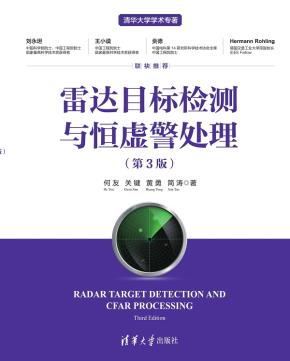
雷达目标检测与恒虚警处理(第3版)"
本书是关于雷达目标检测和恒虚警(CFAR)处理理论与方法的一部专著。书中总结了三十多年来,在这一领域国际上的研究进展及大量研究成果。全书由15章组成,主要内容有经典的固定门限检测、均值类CFAR检测器、有序统计类CFAR检测器、采用自动筛选技术的广义有序统计类CFAR检测器、自适应CFAR检测器、韦布尔和对数正态杂波背景中的CFAR检测器、复合高斯分布杂波中的CFAR处理、非参量CFAR处理、杂波图CFAR处理、变换域CFAR处理、距离扩展目标检测、多传感器分布式CFAR处理以及其他CFAR处理方法,最后是本书的回顾、建议与展望。本书可供从事雷达工程、声纳、电子工程、信号与信息处理等专业的科技人员阅读和参考,还可以作为上述专业的研究生教材
Abstract
This book is a monograph about radar target detection and constant false alarm rate (CFAR) processing theory and technique.In this book,the international advances in this research field for decades and many fruits of authors research are summarized.The book is composed of sixteen chapters.The main contents are classical detection with fixed threshold,meanlevel type CFAR processing methods,orderstatistics type CFAR processing methods,generalized order statistics CFAR detectors with automatic censoring technique,adaptive CFAR detectors,classical CFAR processing in nonGaussian clutter,CFAR processing in compound Gaussian clutter,nonparametric CFAR processing,clutter map CFAR processing,CFAR processing in transform domain,detection of high resolution radar target,distributed CFAR processing with multisensor,multidimension CFAR processing and featurebased CFAR processing,the last is a brief review,suggestion and prospect.
This book could be used by the scientific and technical staffs engaged in radar engineering,sonar technique,electronic engineering,signal and information processing etc.to read and consult,and can also serve as textbook of graduate students of the above professions.
第3版
雷达信号处理是雷达软件化的重要支撑。雷达目标检测则是雷达信号处理的重要环节,恒虚警(CFAR)处理在目标检测中起着不可或缺的作用。数十年来,雷达目标检测与CFAR处理技术逐渐发展成为国际雷达信号处理界的热点研究领域。
《雷达目标检测与恒虚警处理》于1999年出版第1版、2011年出版第2版,受到了广大读者的厚爱与关怀,作者再次表示衷心感谢。近十年来,雷达目标检测与CFAR处理理论又有了很大的发展,使我们认识到应当对本书继续进行扩展和完善,以适应雷达目标检测领域快速发展的需要。本书第3版结合本领域近十多年的研究成果对第2版做了修订,全书总删减、新增、扩展和调整内容约达54.9%,第3版修订后全书共16章。第3版主要做了如下修订。
(1) 充实了有序统计类CFAR检测器的内容,如扩充了对MXCMLD、OSGO、OSSO、SCFAR检测器的性能分析,增加了对CATM、SOSGO、MSCFAR检测器的讨论。
(2) 充实了GOSCA、GOSGO、GOSSO、MOSCA、OSCAGO、OSCASOCFAR检测器的性能分析结果,使得这部分的内容更加系统和完善。
(3) 对自适应CFAR检测器一章进行了较大修改,新增了“基于回波形状信息的删除单元平均CFAR检测器”一节,拓展了参考距离单元自适应筛选的方法。
(4) 对韦布尔和对数正态杂波背景中CFAR检测器一章进行了较大修改,拓展为经典非高斯杂波背景中的CFAR检测器,补充了韦布尔杂波下多脉冲二进制积累的OS和OSGO检测性能分析,作为α稳定分布的两个特例增加了Pearson分布和Cauchy分布背景下的CFAR检测器。
(5) 充实了复合高斯杂波中的CFAR处理,增加了球不变随机杂波下相参CFAR检测技术,补充了近年来复合高斯杂波下CFAR检测的研究成果。
(6) 扩充了非参量CFAR处理章节,主要内容包括韦布尔杂波下非参量检测器的性能分析,以及利用逆正态得分函数修正秩的非参量检测器和相应的性能分析。
(7) 充实了杂波图CFAR处理章节,补充了Nitzberg杂波图在韦布尔分布中的性能分析,增加了双参数杂波图检测技术。
(8) 对变换域CFAR方法进行重新梳理,在介绍频域CFAR、小波域CFAR方法基础上,新增了分数阶傅里叶变换域、HilbertHuang变换域和稀疏表示域目标检测,重点讨论多种变换域的检测器设计及相应的检测方法。
(9) 对距离扩展目标检测一章进行了较大修改,拓展为高分辨率雷达目标检测,新增了SAR图像CFAR检测,重点讨论了SAR图像CFAR检测的杂波单元选取、基于广义Gamma杂波模型的SAR图像CFAR检测、基于语义知识辅助的SAR图像CFAR检测、基于密度特征的SAR图像CFAR检测快速实现等内容。
(10) 对多传感器分布式CFAR处理一章进行了较大修改,新增了“分布式MIMO雷达CFAR检测”一节内容,以分布式MIMO雷达为研究对象,讨论了AMF CFAR检测器的设计及性能。
(11) 新增了多维CFAR处理一章,重点从阵列雷达CFAR检测的角度讨论了“阵元脉冲”二维联合CFAR检测,从基于自适应空时编码设计的MIMO阵列雷达目标检测的角度讨论了“阵元波形”二维联合CFAR检测,并从空时距三维联合自适应处理的角度讨论了“阵元脉冲波形”三维联合CFAR检测。
(12) 新增了基于特征的CFAR处理一章,重点讨论了特征提取与CFAR处理相结合的检测器,包括利用频域分形特征的目标CFAR检测方法和基于深度循环神经网络的脉压、检测一体化处理方法。
(13) 删除了第2版的第14章,将α稳态分布编入第7章,将应用图像处理技术的方法与SAR图像CFAR处理结合归入第12章,将“阵列”和“极化”内容编入新增的第14章。
(14) 全面修改了“回顾、建议和展望”一章,结合雷达目标检测领域的新发展,系统地总结了全书的内容,并为今后继续开展该领域的工作给出了建议。
在本书第3版出版之际,本书作者再次衷心感谢德国汉堡工业大学Hermann Rohling教授、清华大学陆大教授、彭应宁教授,以及国内著名雷达专家王越院士、保铮院士、刘永坦院士、王小谟院士、郭桂蓉院士、毛二可院士、贲德院士、张光义院士、黄培康院士、吴一戎院士、吴曼青院士、王永良院士、黎湘院士、丁赤彪院士、龙腾院士、吴剑旗院士等,多年来对我们的研究工作所给予的指导、支持、关心和帮助。
在本书的撰写出版过程中,中国人民解放军海军航空大学刘宁波博士、陈小龙博士,清华大学王学谦博士等也参与了撰写工作,丁昊博士、王国庆博士、董云龙博士、薛永华博士、张建博士、周伟博士、张林博士、于恒力博士等参与了试验数据采集与处理分析等工作。电子科技大学蔡德强教授在文献检索和查询中给予了众多帮助,在此一并表示衷心的感谢。此外,
还要感谢清华大学出版社,特别是盛东亮和崔彤编辑对本书按期高质量出版的大力支持。
我们希望本书的再版能够继续给从事雷达目标检测与CFAR处理的广大科技人员和研究生提供有益的参考及帮助。恳请广大学者一如既往地关心本书,并提出宝贵意见和建议。
何友关键黄勇简涛
2022年1月于清华大学和中国人民解放军海军航空大学
Foreword of the Third Edition
Radar signal processing is an important support of software defined radar.Radar target detection is an important part of radar signal processing and the constant false alarm rate (CFAR) processing plays an indispensable role in radar target detection.For decades,radar target detection and CFAR processing technology have gradually developed into a hot research field in the international radar signal processing community.
Since the first edition of Radar Target Detection and CFAR Processing was published in 1999 and the second edition in 2011,this book has received great love and care from readers.The authors would like to express our sincere gratitude again.In the past ten years,the theory of radar target detection and CFAR processing has made great progress,which makes us recognize the necessity to continue to expand and improve this book,in order to adapt to the rapid development of the research field of radar target detection.The second edition is revised based on the research results in this field for more than ten years.The total contents of the book are deleted,added,expanded and adjusted by about 54.9%.The revised third edition consists of 16 chapters.The main work is as follows.
(1) The contents of ordered statistics type CFAR detectors are enriched.For example,the performance analysis of MXCMLD,OSGO,OSSO and SCFAR detectors is expanded,and the discussion of CATM,SOSGO and MSCFAR detectors is added.
(2) The performance analysis results of GOSCA,GOSGO,GOSSO,MOSCA,OSCAGO and OSCASOCFAR detectors were enriched,which makes this part more systematic and perfect.
(3) The chapter on Adaptive CFAR Processing was greatly modified with adding a new section named“Envelope Shapebased Excision Cell Average CFAR Detector”,which expands the adaptive censoring method of reference range cells.
(4) The chapter on CFAR Detector in the Background of Weibull and Lognormal Clutter is greatly modified and extended to the CFAR Detector in the Background of Classical NonGaussian Clutter,which supplements the detection performance analysis of OS and OSGO based on multipulse binary accumulation under Weibull clutter,and adds the CFAR detectors under Pearson distribution and Cauchy distribution background as two special cases under α stable distribution.
(5) The CFAR processing in compound Gaussian clutter is enriched,which adds the coherent CFAR detection technique under spherically invariant random clutter,and complements the research results of CFAR detection under compound Gaussian clutter in recent years.
(6) The chapter on nonparametric CFAR processing is extended,which mainly includes the performance analysis of nonparametric detectors under Weibull clutter,and nonparametric detectors based on the rank modified by inverse normal score function and corresponding performance analysis.
(7) The chapter on Clutter Map CFAR Processing is enriched,which supplements the performance analysis of the Nitzberg’s clutter map technique in Weibull distribution clutter,and the detection technique of twoparameter clutter map.
(8) The CFAR methods in the transform domain is reorganized.On the basis of elaborating CFAR methods in the frequency domain and wavelet domain,target detection in the fractional Fourier transform domain,HilbertHuang transform domain and sparse representation domain are added,which focuses on detector design and corresponding detection methods in a variety of transform domains.
(9) The chapter on Detection of RangeDistributed Target is greatly modified,which is extended to CFAR detection of highresolution radar targets,with adding the CFAR detection in SAR images.The selection of clutter cells for CFAR detection in SAR images,CFAR detection in SAR images based on generalized Gamma clutter model,CFAR detection in SAR images based on semantic knowledge aids,and fast implementation of CFAR detection in SAR images based on density features are discussed.
(10) The chapter on Distributed CFAR Processing with Multisensor is greatly modified with adding a new section named “CFAR Detection of Distributed MIMO Radar”,in which the design and performance of AMF CFAR detector is discussed for distributed MIMO radar.
(11) A new chapter on Multidimensional CFAR Processing is added,which focuses on discussing the “array elementpulse” twodimensional joint CFAR detection from the perspective of array radar CFAR detection,the “array elementwaveform” twodimensional joint CFAR detection from the perspective of MIMO array radar target detection based on adaptive spacetime coding design,and the “array elementpulsewaveform” threedimensional joint CFAR detection from the perspective of spacetimerange joint adaptive processing.
(12) A new chapter on CFAR processing based on feature is added,and the detector combining feature extraction with CFAR processing is highlighted,which includes target CFAR detection method using frequency domain fractal features and the integration of pulse compression and detection based on RNN.
(13) The Chapter 14 in the second edition is deleted,in which α stable distribution is incorporated into the Chapter 7,the image processing methods and SAR image CFAR processing are incorporated into the Chapter 12,and the contents about “array” and “polarization” are incorporated into the new Chapter 14.
(14) The chapter on “Review,Suggestion and Prospect” is overhauled.By combining with the new development of radar target detection,the chapter systematically summarizes the content of the book,and gives suggestions for the future work in this field.
At the moment of the publication of the third edition,the authors again would like to express sincere thanks to Professor Hermann Rohling in Technical University HamburgHarburg of Germany,Professor Lu Dajin,Peng Yingning in Tsinghua University,as well as other domestic wellknown radar experts,Wang Yue academician,Bao Zheng academician,Liu Yongtan academician,Wang Xiaomo academician,Guo Guirong academician,Mao Erke academician,Ben De academician,Zhang Guangyi academician,Huang Peikang academician,Wu Yirong academician,Wu Manqing academician,Wang Yongliang academician,Li Xiang academician,Ding Chibiao academician,Long Teng academician and Wu Jianqi academician,et al.Thanks for their guidance,support,care and help to our scientific research work over the years.
In the process of writing and publishing of this book,Dr.Liu Ningbo and Chen Xiaolong of Naval Aeronautical University,as well as Dr.Wang Xueqian of Tsinghua University also participate in the writing work,Dr.Ding Hao,Dr.Wang Guoqing,Dr.Dong Yunlong,Dr.Xue Yonghua,Dr.Zhang Jian,Dr.Zhou Wei,Dr.Zhang Lin,and Dr.Yu Hengli,et al.participate in the test data acquisition and processing analysis,and Professor Cai Deqiang of University of Electronic Science and Technology of China gives a lot of help in literature retrieval and query.Here,we would like to express our sincere thanks to all of them.
Also,we would like to give thanks to the Tsinghua University Press,especially the great support of Editor Sheng Dongliang and Cui Tong who guarantee the publication on schedule with high quality.
We hope that the republication of this book will continue to provide useful reference and help to all the technologist and graduate students engaged in radar target detection and CFAR processing.We sincerely hope that all scholars will continue to care about this book and put forward valuable opinions and suggestions.
He YouGuan JianHuang YongJian Tao
January 2022
At Tsinghua University and Naval Aviation University
第2版
雷达自动检测和跟踪中的虚警问题是每个雷达系统和设计人员不可回避的重要问题之一。三十多年来,雷达自动检测与CFAR处理技术逐渐发展成为国际雷达信号处理界的一大热门研究领域和关键性课题。CFAR技术是雷达自动检测系统中控制虚警率的最重要手段,它在雷达自动检测过程中起着极其重要的作用。
《雷达自动检测与恒虚警处理》自从1999年出版第1版以来,受到广大读者的厚爱与关怀,作者对此表示衷心的感谢。雷达自动检测与恒虚警处理的理论、算法和应用的不断发展,使我们迫切感觉到要对本书进行全面扩展、完善、修改和补充新的内容,以适应当前雷达目标检测领域发展的需要。
本书是在1999年由我们所著《雷达自动检测与恒虚警处理》的基础上进行系统地扩展、完善并加以修改和增订而成的。这次结合近十多年的最新研究成果对原书做了较大幅度的修订。主要做了如下工作。
(1) 将书名修订为《雷达目标检测与恒虚警处理》,因为在以前的雷达目标自动检测技术中强调“自动”,而现在的雷达目标检测方法的“自动”功能是不言而喻的,因此还是强调目标检测,而不用“雷达自动检测”,以区别于雷达的自动测试。
(2) 综合近十几年雷达目标检测技术的发展,对雷达目标检测的研究现状给予了更全面的阐述。
(3) 充实了雷达目标自动检测所需的基础理论,对第1章雷达自动检测原理和第2章均值类CFAR检测器两章内容进行了完善和扩充,特别是补充了多脉冲和相干脉冲条件下雷达目标检测的原理和方法,并将“雷达自动检测原理”更名为“经典的固定门限检测”。
(4) 充实了有序统计类CFAR检测器的研究内容,增加了一些理论分析。
(5) 增加了采用自动筛选技术的MTMCFAR、TMGOCFAR和TMSOCFAR检测器的研究内容,使得这部分的内容更加系统和完善。
(6) 对自适应CFAR处理一章进行了较大修改,大幅删减了ECFAR检测器、VTMCFAR检测器以及Himonas的一系列CFAR检测器,主要以文字和框图的形式对这些检测器进行了简要阐述,并补充了一些新的自适应CFAR检测器,归纳总结了“自适应类”CFAR检测器的基本方法。
(7) 将韦布尔和对数正态杂波背景中的CFAR技术以及两参数CFAR技术两章内容合并为一章,首先研究了在韦布尔和对数正态杂波中能提供CFAR检测的经典Logt检测器,再按照非高斯背景中单参数和双参数检测方法的次序对原有内容进行了重新组织和改写。
(8) 将“K分布和莱斯分布杂波中的CFAR处理”更名为“复合高斯分布杂波中的CFAR处理”,从“复合高斯分布”出发,将K分布模型作为特例,重点介绍K分布杂波中的CFAR处理,并补充了近年来意大利Gini等关于复合高斯杂波中CFAR检测的研究成果。
(9) 基于非参量检测最新的理论研究成果和工程实际中的应用状况,对原书中的内容进行了大幅度的更替; 扩展了时频域CFAR处理的最新研究成果,补充了其他变换域CFAR处理的内容。
(10) 增加了杂波图CFAR处理章节,主要内容包括Nitzberg杂波图处理、杂波图处理的点技术和面技术,以及空域和时域混合处理的CM/LCFAR检测器和相应内容的性能分析。
(11) 新增了距离扩展目标检测技术,重点讨论了复合高斯杂波、复合高斯杂波加热噪声及SαS分布杂波背景中距离扩展目标的检测问题。
(12) 新增了多传感器分布式CFAR处理,重点讨论了两类多传感器分布式CFAR检测器,具体包括分布式CACFAR检测器、分布式OSCFAR检测器以及基于R类、S类和P类局部检测统计量的分布式CFAR检测器。
(13) 全面修改了“回顾、建议和展望”一章,结合雷达目标自动检测技术的新发展,系统地总结了全书的内容,并为今后继续开展该领域的工作给予了指导性意见。此外,根据最近十多年来国内外的研究成果,本书增加了必要的参考文献,并对一些文字叙述不正确之处进行了修正,旨在进一步提高本书的可读性。
在本书第2版出版之际,本书作者在此衷心感谢德国汉堡工业大学Hermann Rohling教授、清华大学陆大教授、彭应宁教授,以及国内著名雷达专家郭桂蓉院士、王越院士、保铮院士、毛二可院士、刘永坦院士、王小谟院士、张光义院士、贲德院士、黄培康院士、吴一戎院士、吴曼青院士等,多年来对我们的科学研究工作所给予的指导、关心和帮助。
在本书撰写出版过程中,海军航空工程学院黄勇博士、简涛博士、曲付勇博士等参与了本书的修订和文字录入工作,在此向他们表示谢意,还要感谢清华大学出版社,特别是王一玲编辑对本书按期高质量出版的大力支持。
我们希望本书的出版,不仅给广大从事雷达目标自动检测和CFAR处理的科技人员提供一本可读性较好的参考书,也给学习雷达目标自动检测和CFAR处理的研究生提供一本内容比较全面的教材。
恳请广大学者能一如既往地关心本书,并提出宝贵的意见和建议。
何友关键孟祥伟
2010年10月
于海军航空工程学院
Foreword of the Second Edition
The false alarm problem of automatic radar detection and tracking is one of the important issues which can not be avoided by each radar system and designer.The automatic radar detection and CFAR processing technology have gradually developed into a popular research area and key issues in the international radar signal processing community over the past three decades.CFAR technology is the most important tool in the control of false alarm rate in automatic radar detection system,which plays an important role in the process of automatic radar detection.
Since 1999,the first edition of Automatic Radar Detection and CFAR Processing has been winning the readers’ love and care.The authors would like to express our sincere gratitude.With the development of the theories,algorithms and applications of automatic radar detection and CFAR processing,we urgently feel it is necessary to expand,improve,modify and add new content to meet the current needs of developments in the field of radar target detection.
The content of this book have been expanded systematically,improved,revised and enlarged based on our book Automatic Radar Detection and CFAR Processing written in 1999.We have revised the first edition extensively with the latest research over the past ten years.The revisions are as follows.
(1) The book is renamed as Radar Target Detection and CFAR Processing.Because the past automatic radar target detection stresses the word “automatic”,while the “automatic” function of present radar target detection methods is selfevident.Thus,we emphasize the radar detection instead of “automatic radar detection” in order to differ from automatic radar test.
(2) Combing with the development of radar target detection algorithms over the past ten years,more comprehensive elaboration has been made on the present study of automatic radar detection algorithms.
(3) The necessary basic theories of automatic radar target detection are enlarged.The principles of automatic radar detection in Chapter 1 and the meanlevel type CFAR detectors in Chapter 2 are improved and enlarged.Especially,the theories and methods of radar target detection with multiple pulses and coherent pulses are supplemented and as well “principles of automatic radar detection” is renamed as “classic fixed threshold detection”.
(4) The content of “order statistics type CFAR detectors” are extended with some theoretical analysis.
(5) The MTMCFAR,TMGOCFAR and TMSOCFAR detectors of automatic censoring technique are added so as to make the content more systematical and substantial.
(6) The chapter named as adaptive CFAR detectors is revised greatly and the ECFAR detector,VTMCFAR detector and a series of Himonas CFAR detectors are scaled back with brief descriptions in the form of text and diagram.Some novel adaptive CFAR detectors are added and the fundamental algorithms of adaptive CFAR detectors are summarized.
(7) The chapter named as CFAR technique in Weibull and lognormal clutter background and the chapter named as biparametric CFAR techniques are combined into one chapter.The classical Logt CFAR detector in Weibull and lognormal clutter is researched and then the original content are reorganized and rewritten according to the order of single parametric detection and biparametric detection.
(8) “CFAR processing in K distribution and Rice distribution clutter” is renamed as “CFAR processing in compound Gaussian distribution clutter”.Beginning with the “compound Gaussian distribution”,CFAR detection in K distribution clutter is emphasized with regarding the K distribution model as the special case.Also the recent research results of the Italian professor Gini about the CFAR detection in compound Gaussian clutter are added.
(9) Based on the recent theories and research results of nonparametric CFAR processing and its engineering applications,the content of the original book are revised extensively,the recent research results about the CFAR processing in timefrequency domain and the CFAR processing technology in other transform domains are added.
(10) Clutter map CFAR processing technology is added,and main content includes Nitzbergs clutter map technique,clutter map point/planedetection technique,spatial and temporal hybrid CM/LCFAR clutter map detection technique as well as corresponding performance analysis.
(11) Detection technology of rangespread target is added,and the rangespread target detection issues in compound Gaussian clutter,compound Gaussian clutter plus thermal noise as well as SαS clutter are mainly discussed.
(12) Multisensor distributed CFAR processing is added and two kinds of detectors are mainly discussed,and the main content includes the distributed CACFAR detector,the distributed OSCFAR detector and the distributed CFAR detectors based on kinds of R,S,and P local test statistic.
(13) The chapter named as “review,suggestion and prospect” is revised Comprehen sively.The overall content of this book is summarized systematically with the new development of automatic radar detection technologies,which provides guidance for the future work in this area.In addition,according to the domestic and foreign research results over the past ten years,necessary references are added in the book and some mistakes on word description are revised.All of these aim at increasing the readability of this book.
At the moment of the publication of the second edition,the authors would like to express sincere thanks to Professor Hermann Rohling in Technical University HamburgHarburg of Germany,Professor Lu Dajin,Peng Yingning in Tsinghua University,and other domestic wellknown radar experts,Guo Guirong academician,Wang Yue academician,Bao Zheng academician,Mao Erke academician,Liu Yongtan academician,Wang Xiaomo academician,Zhang Guangyi academician,Ben De academician,Huang Peikang academician,Wu Yirong academician and Wu Manqing academician,et al.Thanks for their guidance,care and help to our scientific research over the years.
In the process of writing and publishing of this book,Dr.Huang Yong,Jian Tao,Qu Fuyong et al of Naval Aeronautical and Astronautical University in Yantai are thanked for their jobs of revising and word typing.Also,we would like to give thanks to the Tsinghua University Press,especially the great support of Editor Wang Yiling who guarantees the publication on schedule with high quality.
We hope that the publication of this book will not only provide a readable reference book for the scientific workers engaged in the automatic radar target detection and CFAR processing but also provide a comprehensive teaching material for the graduate students engaged in the automatic radar target detection and CFAR processing.
Sincerely hope the majority of scholars continue to care about the book and make valuable comments and suggestions.
He YouGuan JianMeng Xiangwei
October 2010
At Naval Aeronautical and Astronautical University
第1版
在自然界中,无论是在人造的机器还是在生物体中,检测都是广泛存在的行为方式,它根据一定的准则做出事件是否存在的判决。由于环境的不稳定和准则的不精确,在此过程中事件并没有发生而被错误判决为发生的概率,即虚警概率。
雷达是军事和民用领域中探测目标的主要工具。它的主要用途是在存在干扰的背景中检测出有用目标,这些干扰包括接收机内部热噪声、地物、雨雪、海浪等杂波干扰和电子对抗措施(ECM)、人工有源和无源干扰以及与有用目标混杂在一起的邻近干扰目标和它的旁瓣等。在雷达自动检测系统中,通常是将自动检测和恒虚警(Constant False Alarm Rate,CFAR)技术结合使用以保持在变化的杂波环境中获得可预测的检测性能和恒定虚警率。
雷达自动检测和跟踪中的虚警问题是每个雷达系统和设计人员不可回避的重要问题之一。二十多年来,雷达自动检测与CFAR处理技术逐渐发展成为国际雷达信号处理界的一大热门研究领域和关键性课题。CFAR技术是雷达自动检测系统中控制虚警率的最重要手段,它在雷达自动检测过程中起着极其重要的作用。现在CFAR研究已经出现了多个研究方向,根据模拟杂波背景所使用的杂波分布模型分为瑞利分布、韦布尔分布、对数正态分布、K分布和莱斯分布模型中的CFAR研究; 按照数据处理方式分为参量和非参量CFAR技术; 按处理所在的数域分为时域和频域CFAR研究方法; 根据数据的形式分为标量和向量CFAR技术; 根据信号的相关程度分为相关和不相关信号及部分相关信号的CFAR方法。此外,还可分为单参数和多参数CFAR技术,单传感器和多传感器分布式CFAR技术,以及其他的一些研究方法。
涉足该领域的雷达系统研究与设计人员,多年来一直渴望有一部全面、系统介绍自动检测重要准则和CFAR处理模型的专著。本书试图较全面、系统地向读者介绍当代雷达自动检测原理与CFAR处理技术的发展与最新研究成果,并重点介绍均值(ML)类CFAR检测器、有序统计量(OS)类CFAR检测器、具有自动筛选技术的广义有序统计量CFAR检测器、自适应CFAR检测器、韦布尔和对数正态杂波中的CFAR处理、两参数CFAR技术、莱斯和K分布杂波中的CFAR处理、非参量CFAR处理和频域中的CFAR处理方法等,同时研究它们在均匀杂波背景、多目标环境和杂波边缘环境这三种典型信号背景中的性能。在撰写过程中,我们尽可能地搜集了大量有关CFAR和自动检测理论的文献,并通过各章节的合理编排使读者对这些种类繁多的CFAR处理方法有一个比较清晰和系统的了解。
应当指出,雷达自动检测理论和CFAR处理技术当前仍处于迅速发展阶段,由于篇幅的限制,本书不可能对这些发展做出统览无余的介绍。为此,我们在每章的最后都进行了归纳和总结,指出一些重要的新发展,并罗列了相应的参考文献,供读者进一步阅览和研究参考。
本书第一作者在德国不伦瑞克工业大学进修期间,在CFAR领域得到了Hermann Rohling教授开拓性的指导,他对本书的出版给予了极大的鼓励和支持,在此表示最衷心的谢意。
著名雷达专家郦能敬教授和北京航空航天大学毛士艺教授对本书提出了一些宝贵意见。海军航空工程学院刘永硕士参与了本书的出版工作,并为本书绘制了插图。在此一并表示感谢。
何友关键彭应宁陆大
1998年10月
于清华大学和海军航空工程学院
Foreword of the First Edition
In whatever manmade machines or organisms all over the world,detection is a widespread behavior pattern.It is a judgment for the presence of an event,based on a given criterion.Due to the instability of the environment and the impreciseness of the criteria,the probability of nothappening events,which are judged to happen,is the false alarm probability.
Radar is the main tool of detecting targets in the martial and civilian applications. Its main purpose is to detect the interesting targets in the disturbances including internal thermal noise of receiver; clutter from ground, rain, snow and sea waves; electronic counter measures (ECM); active and passive interferences; neighboring useless targets and its side lobes. In radar systems, the automatic detection is usually combined with constant false alarm rate (CFAR) techniques to obtain the predictable detection performance, and at the same time, to keep the false alarm probability constant in changing clutter environment.
Radar is the main tool of detecting targets in the martial and civilian applications.Its main purpose is to detect the interesting targets in the disturbances.These disturbances include internal thermal noise of receiver; clutter from ground,rain,snow and sea waves; electronic counter measures (ECM); active and passive interferences; neighboring useless targets and its side lobes.In radar systems,the automatic detection is usually combined with constant false alarm rate (CFAR) techniques to obtain the predictable detection performance,and at the same time,to keep the false alarm probability constant in changing clutter environment.
The false alarm problem in radar automatic detection and track is one of the important issues,which can not be avoided in the radar system design.In the past two decades,radar automatic detection and CFAR processing techniques gradually developed into popular research fields,and now is the key issues in the international radar signal processing community.More precisely,CFAR technique is the most important means to control the false alarm rate in radar system,and it plays an important role in the radar automatic detection process.At present,several research directions have appeared in the CFAR processing.According to the clutter distribution models,CFAR technique involves the Rayleigh,Weibull,lognormal,Rician and K distributions.According to the data processing methods,it includes parameters CFAR techniques and Nonparametric ones.According to the processing domains,it includes time domain CFAR methods and frequency domain ones.According to the data forms,it contains scalar CFAR techniques and vector ones.According to the signal correlation,it involves relevant,irrelevant and partly relevant signals.In addition,it also includes singleparameter and multiparameter CFAR techniques,singlesensor and multisensor distributed CFAR techniques,as well as other methods.
For those who are engaged in the fields of radar system research and design,a comprehensive and systematic monograph introducing the important criteria for automatic detection and CFAR processing model is desirable for them.In this book,we attempt to introduce the contemporary theories and the latest research results of radar CFAR processing techniques,comprehensively and systematically.It covers the mean lever (ML) CFAR detector,order statistics (OS) CFAR detector,CFAR detector based on generalized order statistics with automatic excision,adaptive CFAR detector,CFAR processing in Weibull and lognormal clutter,twoparameters CFAR technique,CFAR processing in Rician and K distributed clutter,nonparametric CFAR processing and frequency domain processing methods.Moreover,the performances for these CFAR detectors are investigated in homogeneous backgrounds,multiple target situations and clutter edge situations.In the writing process,we collected a wealth of literatures about automatic CFAR detection theory,and arranged each chapter appropriately so that the readers can understand various CFAR detectors clearly and systemically.
It should be noted that,both of radar automatic detection theory and CFAR processing techniques are still in rapid development.For the space limitations,we hardly give a finedrawn description in this book.Hence,we provided the corresponding comparison and summary at the end of each chapter; and pointed out some new developments,while listing the corresponding references for readers’ further reading and research.
The first author of this book was guided by Prof.H.Rohling,in the study period Technical University of Braunschweig in Germany.Herein we express our honestly appreciations to Prof.H.Rohling for his great encouragements and supports for the book publication.
The famous radar expert Prof.Li Nengjing,and Prof.Mao Shiyi of Beijing University of Aeronautics and Astronautics,gave lots of valuable suggestions for this book.Moreover,Liu Yong,master of Naval Aeronautical and Astronautical Engineering University,has worked for the book publication and has drawn figures for this book.Thank them together.
He YouGuan JianPeng YingningLu Dajin
October 1998At Tsinghua University and Naval Aeronautical and Astronautical Engineering University


第1章绪论
参考文献
第2章经典的固定门限检测
2.1雷达目标自动检测的基本问题
2.1.1最大检测距离
2.1.2虚警率
2.1.3目标雷达截面积的Swerling起伏模型
2.1.4自动检测的经典问题——固定门限检测
2.2匹配滤波
2.2.1白噪声背景下的匹配滤波
2.2.2匹配滤波与相关接收
2.2.3相参脉冲串信号的匹配滤波
2.3单脉冲检测
2.3.1对非起伏目标的单脉冲线性检测
2.3.2对Swerling起伏目标的单脉冲线性检测
2.4多脉冲检测
2.4.1二元检测
2.4.2线性检测
2.4.3相参脉冲串检测
2.5小结
参考文献
第3章均值类CFAR处理方法
3.1引言
3.2基本模型描述
3.3CACFAR检测器
3.4GO和SOCFAR检测器
3.5WCACFAR检测器
3.6采用对数检波的CACFAR检测器
3.7单脉冲线性CACFAR检测器
3.8多脉冲CACFAR检测器
3.8.1双门限CACFAR检测器
3.8.2多脉冲非相参积累CACFAR检测器
3.9ML类CFAR检测器在均匀杂波背景中的性能
3.10ML类CFAR检测器在多目标环境中的性能
3.11ML类CFAR检测器在杂波边缘环境中的性能
3.12比较与总结
参考文献
第4章有序统计类CFAR处理方法
4.1引言
4.2基本模型描述
4.3OSCFAR检测器
4.4CMLDCFAR检测器
4.5TMCFAR检测器
4.6MXCMLD CFAR检测器
4.7OSGOCFAR和OSSOCFAR检测器
4.8SCFAR检测器
4.9其他OS类CFAR检测器
4.9.1CATMCFAR检测器
4.9.2SOSGOCFAR与MSCFAR检测器
4.10OS类CFAR检测器的性能分析
4.10.1在均匀杂波背景中的性能
4.10.2在多目标环境中的性能
4.10.3在杂波边缘背景中的性能
4.11比较与总结
参考文献
第5章采用自动筛选技术的GOS类CFAR检测器
5.1引言
5.2基本模型描述
5.2.1OSOS类CFAR检测器的模型描述
5.2.2OSCA类检测器的模型描述
5.2.3TMTM类检测器的模型描述
5.3GOSCA、GOSGO、GOSSOCFAR检测器
5.3.1GOSCACFAR检测器
5.3.2GOSGOCFAR检测器
5.3.3GOSSOCFAR检测器
5.4MOSCA、OSCAGO、OSCASOCFAR检测器
5.4.1MOSCACFAR检测器
5.4.2OSCAGOCFAR检测器
5.4.3OSCASOCFAR检测器
5.5MTM、TMGO、TMSOCFAR检测器
5.5.1MTMCFAR检测器
5.5.2TMGOCFAR检测器
5.5.3TMSOCFAR检测器
5.6GOS类CFAR检测器在均匀背景和多目标环境中的性能
5.6.1GOS类CFAR检测器在均匀背景中的性能
5.6.2GOS类CFAR检测器在多目标环境中的性能
5.7GOS类CFAR检测器在杂波边缘环境中的性能
5.7.1GOSCACFAR检测器在杂波边缘环境中的性能
5.7.2GOSGOCFAR和GOSSOCFAR检测器在杂波边缘环境中的性能
5.7.3MOSCACFAR检测器在杂波边缘环境中的性能
5.7.4OSCAGO,OSCASOCFAR检测器在杂波边缘环境中的性能
5.7.5MTM、TMGOCFAR检测器在杂波边缘环境中的性能
5.8比较与总结
参考文献
第6章自适应CFAR检测器
6.1引言
6.2CCACFAR检测器
6.3HCECFAR检测器
6.4ECFAR检测器
6.4.1ECFAR检测器结构
6.4.2ECFAR检测器在均匀杂波背景中的性能
6.4.3ECFAR检测器在多目标环境中的性能
6.5OSTACFAR检测器
6.5.1OSTACFAR检测器基本原理
6.5.2OSTACFAR检测器在杂波边缘环境中的性能
6.5.3OSTACFAR检测器在多目标环境中的性能
6.6VTMCFAR检测器
6.6.1VTMCFAR检测器基本原理
6.6.2VTMCFAR检测器在均匀杂波背景中的性能
6.6.3VTMCFAR检测器在多目标环境中的性能
6.6.4VTMCFAR检测器在杂波边缘环境中的性能
6.6.5VTMCFAR检测器的参数选择
6.7Himonas的一系列CFAR检测器
6.7.1GCMLDCFAR检测器
6.7.2GO/SOCFAR检测器
6.7.3ACMLDCFAR检测器
6.7.4GTLCMLDCFAR检测器
6.7.5ACGOCFAR检测器
6.8VICFAR检测器
6.8.1VICFAR检测器在不同背景中的应用
6.8.2VICFAR检测器的性能分析
6.9基于回波形状信息的删除单元平均CFAR检测器
6.9.1基于回波形状信息的删除单元平均方法
6.9.2检测性能仿真分析
6.10其他自适应CFAR检测器
6.10.1双重自适应CFAR检测器
6.10.2ACCFAR检测器
6.10.3改进的CACFAR检测器
6.10.4自适应长度CFAR检测器
6.10.5ACCAODVCFAR检测器
6.11比较与小结
参考文献
第7章经典非高斯杂波背景中的CFAR检测器
7.1引言
7.2Logt CFAR检测器
7.2.1对数正态分布中的Logt CFAR检测器
7.2.2韦布尔分布中的Logt CFAR检测器
7.3韦布尔分布中有序统计类CFAR检测器
7.3.1OSCFAR检测器在韦布尔背景中的检测性能
7.3.2OSGOCFAR检测器在韦布尔背景中的检测性能
7.3.3韦布尔背景中WeberHaykin恒虚警检测算法
7.3.4用参考单元样本的期望和中值估计c的方法
7.3.5多脉冲二进制积累下OSCFAR的检测性能
7.3.6多脉冲二进制积累下OSGOCFAR的检测性能
7.4MLHCFAR检测器
7.4.1形状参数已知时韦布尔分布背景中的MLHCFAR检测器
7.4.2形状参数未知时韦布尔分布背景中的MLHCFAR检测器
7.4.3检测概率和CFAR损失
7.5BLUECFAR检测器
7.5.1韦布尔背景中的BLUE检测器
7.5.2对数正态背景中的BLUECFAR检测器
7.6Pearson分布背景下的CFAR检测器
7.6.1Pearson分布背景下的CACFAR检测器
7.6.2Pearson分布背景下的OSCFAR检测器
7.6.3Pearson分布背景下的CMLDCFAR检测器
7.7Cauchy分布背景下的CFAR检测器
7.8比较与小结
参考文献
第8章复合高斯杂波中的CFAR处理
8.1引言
8.2复合高斯分布
8.2.1复合高斯复幅度模型
8.2.2K分布杂波包络模型
8.2.3相关K分布杂波幅度模型
8.2.4K分布杂波的仿真
8.3K分布杂波加热噪声中的检测性能
8.3.1K分布与记录数据的匹配
8.3.2杂波加噪声中目标检测的计算
8.3.3性能分析
8.4经典CFAR检测器在K分布杂波中的性能分析
8.4.1调制过程不相关的K分布杂波下CFAR检测
8.4.2调制过程完全相关的K分布杂波下CFAR检测
8.4.3调制过程部分相关时K分布杂波下CFAR检测
8.5复合高斯杂波中的最优CFAR检测器
8.5.1复合高斯杂波包络中的最优CFAR检测
8.5.2复合高斯杂波中的最优相参子空间CFAR检测
8.6球不变随机杂波下相参CFAR检测
8.6.1最大似然估计问题
8.6.2CFAR检测问题
8.6.3性能分析
8.7复合高斯杂波中的贝叶斯自适应检测器
8.7.1问题描述
8.7.2贝叶斯自适应检测器设计
8.7.3性能分析
8.8小结
参考文献
第9章非参量CFAR处理
9.1引言
9.2非参量检测器的渐近相对效率
9.3单样本非参量检测器
9.3.1符号检测器
9.3.2Wilcoxon检测器
9.4两样本非参量检测器
9.4.1广义符号检测器
9.4.2MannWhitney检测器
9.4.3Savage检测器与修正的Savage检测器
9.4.4秩方检测器与修正的秩方检测器
9.4.5几种非参量检测器的渐近相对效率
9.4.6非参量检测器采用有限样本时的检测性能
9.5次优秩非参量检测器
9.5.1局部最优秩检测器
9.5.2次优秩检测器
9.5.3性能分析
9.6韦布尔杂波下非参量检测器的性能分析
9.6.1韦布尔背景下量化秩非参量检测器
9.6.2韦布尔背景下广义符号非参量检测器
9.7利用逆正态得分函数修正秩的非参量检测器
9.7.1基本设计思路
9.7.2检测器设计
9.7.3性能分析
9.8比较与总结
参考文献
第10章杂波图CFAR处理
10.1引言
10.2Nitzberg杂波图技术
10.2.1Nitzberg杂波图检测的原理
10.2.2Nitzberg杂波图ADT值和虚警指标对w取值的约束
10.2.3Nitzberg杂波图在韦布尔分布中的性能
10.3杂波图单元平均CFAR平面检测技术
10.3.1基本模型描述
10.3.2均匀背景中的性能分析
10.3.3面技术与点技术的性能比较
10.4混合CM/LCFAR杂波图检测技术
10.4.1基本模型
10.4.2均匀背景中的性能分析
10.4.3存在干扰目标时的性能分析
10.5双参数杂波图检测技术
10.5.1双参数杂波图基本模型
10.5.2对目标自遮蔽的处理
10.6比较和总结
参考文献
第11章变换域CFAR处理
11.1引言
11.2频域CFAR检测
11.2.1信号和杂波噪声的离散傅里叶变换处理
11.2.2频域CACFAR检测器
11.2.3MTIFFT频域CACFAR方案
11.2.4频域奇偶处理检测器
11.3小波域CFAR检测
11.3.1基于离散小波变换的CMCFAR检测方法
11.3.2基于正交小波变换的CACFAR检测方法
11.4分数阶傅里叶变换域目标检测
11.4.1基于FRFT的LFM信号检测与参数估计
11.4.2FRFT域动目标检测器设计
11.4.3FRFT域长时间相参积累检测方法
11.5HilbertHuang变换域目标检测
11.5.1HHT基本原理
11.5.2基于IMF特性的微弱目标检测方法
11.6稀疏表示域目标检测
11.6.1信号稀疏表示模型及求解方法
11.6.2基于稀疏时频分布的雷达目标检测方法
11.6.3雷达目标检测结果与分析
11.7小结
参考文献
第12章高分辨率雷达目标检测
12.1引言
12.2距离扩展目标的信号模型
12.2.1秩1信号模型
12.2.2多秩子空间信号模型
12.3复合高斯杂波中多秩距离扩展目标的子空间检测器
12.3.1问题描述
12.3.2广义匹配子空间检测器的设计
12.3.3广义匹配子空间检测器虚警概率的计算
12.3.4广义匹配子空间检测器的自适应实现
12.3.5性能分析
12.4复合高斯杂波加热噪声中的距离扩展目标检测器
12.4.1问题描述
12.4.2热噪声的等效处理
12.4.3复合高斯杂波加热噪声中距离扩展目标检测器的设计
12.4.4检测器的性能分析
12.5SαS分布杂波中的距离扩展目标检测器
12.5.1SαS分布及PFLOM变换
12.5.2问题描述
12.5.3基于PFLOM变换的距离扩展目标检测器
12.5.4SαS分布杂波中的二元积累柯西检测器
12.6SAR图像CFAR检测研究的主要方面及杂波单元选取
12.6.1SAR图像CFAR检测研究的主要方面
12.6.2SAR图像CFAR检测的杂波单元选取
12.7基于广义Gamma杂波模型的SAR图像CFAR检测
12.7.1检测方法设计
12.7.2性能分析
12.8基于语义知识辅助的SAR图像CFAR检测
12.8.1检测方法设计
12.8.2性能分析
12.9基于密度特征的SAR图像CFAR检测快速实现
12.9.1检测方法设计
12.9.2性能分析
12.10比较与小结
参考文献
第13章多传感器分布式CFAR处理
13.1引言
13.2基于局部二元判决的分布式CFAR检测
13.2.1分布式CACFAR检测
13.2.2分布式OSCFAR检测
13.2.3分布式CFAR检测性能分析
13.3基于局部检测统计量的分布式CFAR检测
13.3.1基于R类局部检测统计量的分布式CFAR检测
13.3.2基于S类局部检测统计量的分布式CFAR检测
13.4分布式MIMO雷达CFAR检测
13.4.1目标回波经典线性模型及检测器设计
13.4.2MIMO分布孔径雷达AMF检测器性能分析
13.4.3仿真分析
13.5小结
参考文献
第14章多维CFAR处理
14.1引言
14.2阵列雷达CFAR检测
14.2.1信号模型与二元假设检验
14.2.2秩1目标模型下的阵列雷达目标检测器
14.2.3子空间目标模型下的阵列雷达目标检测器
14.2.4阵列雷达目标检测器的性质与性能
14.3基于自适应空时编码设计的二维联合CFAR检测
14.3.1信号模型及MSD检测器
14.3.2自适应空时编码设计
14.3.3仿真与分析
14.4基于空时距三维联合的自适应检测
14.4.1MIMO雷达信号模型
14.4.2匹配滤波后的空时距自适应处理
14.4.3空时距自适应处理
14.4.4算法实施与矩阵快速更新
14.4.5自适应聚焦和检测一体化处理
14.4.6仿真与分析
14.5其他多维CFAR检测
14.5.1扫描间融合CFAR检测
14.5.2极化CFAR检测
14.6小结
参考文献
第15章基于特征的CFAR处理
15.1引言
15.2海杂波时域分形特征与CFAR检测
15.2.1海尖峰判定
15.2.2海尖峰描述参数及统计特性
15.2.3海尖峰的Paretian泊松模型
15.2.4目标检测及性能分析
15.3海杂波频域分形特征与CFAR检测
15.3.1分数布朗运动在频域中的分形特性
15.3.2海杂波频谱的单一分形特性
15.3.3海杂波频谱单一分形参数的影响因素
15.3.4目标检测与性能分析
15.4海杂波时/频域多特征与目标检测
15.4.1特征提取与分析
15.4.2三维特征检测器
15.4.3检测性能分析
15.5基于深度学习的目标检测
15.5.1基于深度循环神经网络的脉压、检测一体化
15.5.2仿真与分析
15.5.3实测数据验证
15.6小结
参考文献
第16章回顾、建议与展望
16.1回顾
16.1.1形成CFAR处理理论体系
16.1.2提出GOS类CFAR检测器并建立统一模型
16.1.3延伸自适应CFAR检测
16.1.4发展多传感器分布式CFAR检测
16.1.5将CFAR处理由时域和频域拓展到多种变换域
16.1.6将CFAR处理的信息源维度由一维扩展到多维并形成多维CFAR检测
16.1.7将幅度特征拓展到分形等多种特征
16.2问题与建议
16.2.1性能分析与评价方法
16.2.2加强对目标特性的研究
16.2.3拓展CFAR研究思路
16.2.4注重新体制雷达中的CFAR处理研究
16.3研究方向展望
16.3.1多维信号CFAR处理
16.3.2背景杂波辨识与智能处理
16.3.3信号处理新方法应用与多特征CFAR处理
16.3.4其他领域的CFAR处理
参考文献
英文缩略语
CONTENTS
Chapter 1Preface
Reference
Chapter 2Classical Detection with Fixed Threshold
2.1Fundamental Problems and Principles of Radar Automatic Detection
2.1.1Maximum Detection Range
2.1.2False Alarm Rate
2.1.3Swerlingfluctuation Models of Target Radar Cross Section
2.1.4Classical Issue of Automatic Detection—the Detection with Fixed Threshold
2.2Matched Filtering
2.2.1Matched Filtering in White Gaussian Noise Background
2.2.2Matched Filtering and Correlated Receiving
2.2.3Matched Filter for Coherent Pulsetrain Signals
2.3SinglePulse Detection
2.3.1SinglePulse Linear Detection for Nonfluctuation Target
2.3.2SinglePulse Linear Detection for Swerlingfluctuation Target
2.4MultiplePulse Detection
2.4.1Binary Detection
2.4.2Linear Detection
2.4.3Detection of Coherent PulseTrain Signals
2.5Summary
Reference
Chapter 3The CFAR Processing Methods Based on Mean Level
3.1Introduction
3.2Description of Basic Models
3.3CACFAR Detector
3.4GO and SOCFAR Detector
3.5WCACFAR Detector
3.6CACFAR Scheme with LogarithmicLaw Detector
3.7CACFAR Scheme with SinglePulse Linear Detector
3.8CACFAR Detector for Multiple Pulses
3.8.1CACFAR Detector with Double Threshold
3.8.2CACFAR Detector based on Multiple Pulses Noncoherent Accumulation
3.9Performance of MLCFAR Detectors in Homogeneous Background
3.10Performance of MLCFAR Detectors in Multiple Target Situations
3.11Performance of MLCFAR Detectors at Clutter Edges
3.12Comparison and Summary
Reference
Chapter 4The CFAR Processing Methods Based on Order Statistics
4.1Introduction
4.2Description of Basic Models
4.3OSCFAR Detector
4.4CMLDCFAR Detector
4.5TMCFAR Detector
4.6MXCMLD CFAR Detector
4.7OSGOCFAR and OSSOCFAR Detectors
4.8SCFAR Detector
4.9Other CFAR Detectors based on Order Statistics
4.9.1CATMCFAR Detector
4.9.2SOSGOCFAR and MSCFAR Detectors
4.10Performance of OrderStatistic CFAR Detectors
4.10.1Performance in Homogeneous Background
4.10.2Performance in Multiple Target Situations
4.10.3Performance at Clutter Edges
4.11Comparison and Summary
Reference
Chapter 5The Generalized OrderStatistic (GOS) CFAR Detectors with
Automatic Censoring Technique
5.1Introduction
5.2Description of Basic Models
5.2.1Model Description of OSOS Type CFAR Detectors
5.2.2Model Description of OSCA Type CFAR Detectors
5.2.3Model Description of TMTM Type CFAR Detectors
5.3GOSCA,GOSGO,GOSSOCFAR Detectors
5.3.1GOSCACFAR Detector
5.3.2GOSGOCFAR Detector
5.3.3GOSSOCFAR Detector
5.4MOSCA,OSCAGO,OSCASOCFAR Detectors
5.4.1MOSCACFAR Detector
5.4.2OSCAGOCFAR Detector
5.4.3OSCASOCFAR Detector
5.5MTM,TMGO,TMSOCFAR Detectors
5.5.1MTMCFAR Detector
5.5.2TMGOCFAR Detector
5.5.3TMSOCFAR Detector
5.6Performance of GOS Type CFAR Detectors in Homogeneous Background
and Multiple Target Situations
5.6.1Performance of GOS Type CFAR Detectors in Homogeneous Background
5.6.2Performance of GOS Type CFAR Detectors in Multiple Target Situations
5.7Performance of GOS Type CFAR Detectors at Clutter Edges
5.7.1Performance of GOSCACFAR Detectors at Clutter Edges
5.7.2Performance of GOSGO,GOSSOCFAR Detectors at Clutter Edges
5.7.3Performance of MOSCACFAR Detectors at Clutter Edges
5.7.4Performance of OSCAGO,OSCASOCFAR Detectors at Clutter Edges
5.7.5Performance of MTM,TMGOCFAR Detectors at Clutter Edges
5.8Comparison and Summary
Reference
Chapter 6Adaptive CFAR Detectors
6.1Introduction
6.2CCACFAR Detector
6.3HCECFAR Detector
6.4ECFAR Detector
6.4.1ECFAR Detector Architecture
6.4.2Performance of ECFAR Detector in Homogeneous Background
6.4.3Performance of ECFAR Detector in Multiple Target Situations
6.5OSTACFAR Detector
6.5.1Principle of OSTACFAR Detector
6.5.2Performance of OSTACFAR Detector in Clutter Edge
6.5.3Performance of OSTACFAR Detector in Multiple Target Situations
6.6VTMCFAR Detector
6.6.1Principle of VTMCFAR Detector
6.6.2Performance of VTMCFAR Detector in Homogeneous Background
6.6.3Performance of VTMCFAR Detector in Multiple Target Situations
6.6.4Performance of VTMCFAR Detector in Clutter Edge
6.6.5Choice of Parameters for VTMCFAR Detector
6.7A Series of CFAR Detectors of Himonas
6.7.1GCMLDCFAR Detector
6.7.2GO/SOCFAR Detector
6.7.3ACMLDCFAR Detector
6.7.4GTLCMLDCFAR Detector
6.7.5ACGOCFAR Detector
6.8VICFAR Detector
6.8.1Application of VICFAR Detector in Different Background
6.8.2Performance Analysis of VICFAR Detector
6.9ESECA CFAR Detector
6.9.1ESECA method
6.9.2Simulation Analysis of Detection Performance
6.10Other Adaptive CFAR Detectors
6.10.1Double Adaptive CFAR Detector
6.10.2ACCFAR Detector
6.10.3Improved CACFAR Detector
6.10.4Adaptive Length CFAR Detector
6.10.5ACCAODVCFAR Detector
6.11Comparison and Summary
Reference
Chapter 7The CFAR Detectors in Classical nonGaussian Background
7.1Introduction
7.2Logt CFAR Detector
7.2.1Logt CFAR Detector in Lognormal Distribution
7.2.2Logt CFAR Detector in Weibull Distribution
7.3OrderStatistic CFAR Detectors in Weibull Background
7.3.1Detection Performance of OSCFAR Detector in Weibull Background
7.3.2Detection Performance of OSGOCFAR Detector in Weibull Background
7.3.3WeberHaykin CFAR Scheme in Weibull Background
7.3.4Estimation of c Based on Expectation and Median of Reference Samples
7.3.5Detection Performance of OSCFAR with Binary Integration for Multiple Pulses
7.3.6Detection Performance of OSGOCFAR with Binary Integration for Multiple Pulses
7.4MLHCFAR Detector
7.4.1MLHCFAR Detector in Weibull Background with Known Shape Parameter
7.4.2MLHCFAR Detector in Weibull Background with Unknown Shape Parameter
7.4.3Detection Probability and CFAR Loss
7.5BLUECFAR Detector
7.5.1BLUE in Weibull Background
7.5.2BLUE in Lognormal Background
7.6CFAR Detectors in Pearson Distribution
7.6.1CACFAR Detectors in Pearson Distribution
7.6.2OSCFAR Detectors in Pearson Distribution
7.6.3CMLDCFAR Detectors in Pearson Distribution
7.7CFAR Detector in Cauchy Distribution
7.8Comparison and Summary
Reference
Chapter 8CFAR Processing in Compound Gaussian Clutter
8.1Introduction
8.2Compound Gaussian Distribution
8.2.1Compound Gaussian Complex Amplitude Model
8.2.2K Distributed Envelop Clutter Model
8.2.3Correlated K Distributed Clutter Model
8.2.4Simulation of K Distributed Clutter
8.3Detection Performance in K Distributed Clutter plus Thermal Noise
8.3.1Matching of K Distribution with Recorded Data
8.3.2Calculation of Detection Performance in Clutter plus Noise
8.3.3Performance Analysis
8.4Performance Analysis of Classical CFAR Detectors in K Distributed Clutter
8.4.1CFAR Detection in K Distributed Clutter with Uncorrelated Modulation Process
8.4.2CFAR Detection in K Distributed Clutter with Completely Correlated Modulation Process
8.4.3CFAR Detection in K Distributed Clutter with Partially Correlated Modulation Process
8.5Optimal CFAR Detectors in Compound Gaussian Clutter
8.5.1Optimal CFAR Detectors in Compound Gaussian Clutter Envelop
8.5.2Optimal Coherent Subspace CFAR Detectors in Compound Gaussian Clutter
8.6Coherent CFAR Detectors in Spherically Invariant Random Clutter
8.6.1Maximum Likelihood Estimation Problem
8.6.2CFAR Detection Problem
8.6.3Performance Analysis
8.7Bayesian Adaptive Detector in Compound Gaussian Clutter
8.7.1Problem Formulation
8.7.2Design of Bayesian Adaptive Detector
8.7.3Performance Analysis
8.8Summary
Reference
Chapter 9Nonparametric CFAR Detection
9.1Introduction
9.2Asymptotic Relative Efficiency for Nonparametric Detector
9.3OneSample Nonparametric Detector
9.3.1Sign Detector
9.3.2Wilcoxon Detector
9.4TwoSample Nonparametric Detector
9.4.1Generalized Sign Detector
9.4.2MannWhitney Detector
9.4.3Savage Detector and Modifier
9.4.4Rank Squared Detector and Modifier
9.4.5Asymptotic Relative Efficiency of Several Nonparametric Detectors
9.4.6Detection Performance of Nonparametric Detector with Finite Samples
9.5Suboptimal Rank Nonparametric Detector
9.5.1Locally Optimal Rank Detector
9.5.2Suboptimal Rank Detector
9.5.3Performance Analysis
9.6Performance Analysis of Nonparametric Detectors in Weibull Clutter
9.6.1Rank Quantization Nonparameter Detector in Weibull Clutter
9.6.2Generalized Sign Nonparameter Detector in Weibull Clutter
9.7Nonparametric Detectors Using InverseNormalScore Function Modified Rank
9.7.1Basic Design Idea
9.7.2Detector Design
9.7.3Performance Analysis
9.8Comparison and Summary
Reference
Chapter 10Clutter Map CFAR Processing
10.1Introduction
10.2Nitzbergs Clutter Map Technique
10.2.1Principle of Nitzbergs Clutter Map
10.2.2Restriction on w by the ADT and False Alarm Rate of Nitzbergs Clutter Map
10.2.3Performance of Nitzbergs Clutter Map in Weibull Clutter
10.3Clutter Map CACFAR PlaneDetection Technique
10.3.1Basic Model Description
10.3.2Performance Analysis in Homogeneous Background
10.3.3Performance Comparison between PlaneDetection and PointDetection
10.4Hybrid CM/LCFAR Clutter Map Detection Technique
10.4.1Basic Model
10.4.2Performance in Homogeneous Background
10.4.3Performance in the Situations with Interference Target
10.5Biparametric Clutter Map Detection Technique
10.5.1Basical Model of Biparametric Clutter Map
10.5.2Target Selfmasking Avoidance
10.6Comparison and Summary
Reference
Chapter 11CFAR Processing in Transform Domain
11.1Introduction
11.2Transform Domain CFAR
11.2.1Discrete Fourier Transform of Signal,Clutter and Noise
11.2.2Frequency Domain CACFAR
11.2.3MTIFFTfrequency Domain CACFAR
11.2.4Frequency Domain Oddeven Processing Detector
11.3Wavelet domain CFAR
11.3.1CMCFAR Based on Discrete Wavelet Transform
11.3.2CACFAR Based on Orthogonal Wavelet Transform
11.4Fractional Fourier Transform Domain Target Detection
11.4.1LFM Signal Detection and Estimation via FRFT
11.4.2Moving Target Detector in FRFT Domain
11.4.3Longtime Coherent Integration in FRFT Domain
11.5HilbertHuang Transform Domain Target Detection
11.5.1Principle of HHT
11.5.2Weak Target Detection Based on IMF Property
11.6Sparse representation domain target detection
11.6.1Signal Sparse Representation Model and Solution
11.6.2Radar Target Detection Based on Sparse Timefrequency Distribution
11.6.3Radar Target Detection Result and Analysis
11.7Summary
Reference
Chapter 12Target Detection for High Resolution Radar
12.1Introduction
12.2Signal Model of RangeSpread Target
12.2.1Rank One Signal Model
12.2.2MultiRank Subspace Signal Model
12.3MultiRank Subspace Detector of RangeSpread Target in Compound Gaussian Clutter
12.3.1Problem Formulation
12.3.2Design of Generalized Matched Subspace Detector
12.3.3Calculation of Probability of False Alarm for Generalized Matched Subspace Detector
12.3.4Adaptive Implementation of Generalized Matched Subspace Detector
12.3.5Performance Analysis
12.4RangeSpread Target Detector in Compound Gaussian Clutter plus Thermal Noise
12.4.1Problem Formulation
12.4.2Equivalent Processing of Thermal Noise
12.4.3Design of RangeSpread Target Detector in Compound
Gaussian Clutter plus Thermal Noise
12.4.4Detection Performance Analysis
12.5Detector of RangeSpread Target in SαS Clutter
12.5.1SαS Distribution and PFLOM Transform
12.5.2Problem Formulation
12.5.3RangeSpread Target Detector based on PFLOM Transform
12.5.4Binary Integration Cauchy Detector in SαS Clutter
12.6Main Aspects of CFAR Detection for SAR Images and Selection of Clutter Cells
12.6.1Main Aspects of CFAR Detection for SAR Images
12.6.2Selection of Clutter Cells for SAR Images in CFAR Detection
12.7CFAR Detection for SAR Images based on Generalized Gamma Clutter Model
12.7.1Detector Design
12.7.2Performance Analysis
12.8Semantic Knowledgeaided CFAR Detection for SAR Images
12.8.1Detector Design
12.8.2Performance Analysis
12.9Fast Implementation based on Density Character of CFAR Detection for SAR Images
12.9.1Detector Design
12.9.2Performance Analysis
12.10Comparison and Summary
Reference
Chapter 13Distributed CFAR Processing with Multisensor
13.1Introduction
13.2Distributed CFAR Detection with Multisensor based on Local Binary Decision
13.2.1Distributed CACFAR Detection
13.2.2Distributed OSCFAR Detection
13.2.3Examples for Distributed CFAR Detection
13.3Distributed CFAR Detection with Multisensor based on Local Test Statistic
13.3.1Distributed CFAR Detection based on R Type Local Test Statistic
13.3.2Distributed CFAR Detection based on S Type Local Test Statistic
13.4CFAR Detection of Distributed MIMO Radar
13.4.1the Classical Linear Model of Target Returns and Detector Design
13.4.2Performance Analysis of AMF Detector for Distributed MIMO Apertures
13.4.3Simulation and Analysis
13.5Summary
Reference
Chapter 14Multidimensional CFAR Processing
14.1Introduction
14.2CFAR Detection for Array Radar
14.2.1Signal Model and Binary Hypothesis Test
14.2.2Array Radar Detector with Rank1 Target Model
14.2.3Array Radar Detector with Subspace Target Model
14.2.4Property and Performance of Array Radar Target Detector
14.3Twodimension CFAR Detection based on Adaptive Spacetime Coding Design
14.3.1Signal Model and MSD Detector
14.3.2Adaptive Spacetime Coding Design
14.3.3Simulation and Analysis
14.4Spacetimerange Adaptive Detection
14.4.1MIMO Radar Signal Model
14.4.2Spacetimerange Adaptive Processing after Matched Filtering
14.4.3Spacetimerange Adaptive Processing
14.4.4Implementation and Fast Matrix Update
14.4.5Adaptive Focus and Detection Integrated Processing
14.4.6Simulation and Analysis
14.5Other Multidimensional CFAR Detection
14.5.1CFAR Detection with ScantoScan Fusion
14.5.2Polarimetric CFAR Processing
14.6Summary
Reference
Chapter 15CFAR Processing Based on Feature
15.1Introduction
15.2Fractal Feature of Sea Clutter in Time Domain and CFAR Detection
15.2.1Judge of Sea Spike
15.2.2Parameter of Sea Spike and Statistics
15.2.3Paretian Possion Model of Sea Spike
15.2.4Target Detection and Performance Analysis
15.3Fractal Feature of Sea Clutter in Frequency Domain and CFAR Detection
15.3.1Fractal Property of FBM in Frequency Domain
15.3.2Monofractal Property of Sea Clutter Frequency Spectrum
15.3.3Influence Factor of Sea Clutter Monofractal Parameter
15.3.4Target Detection and Performance Analysis
15.4Multifeature of Sea Clutter in Time/Frequency Domain and Target Detection
15.4.1Feature Extraction and Analysis
15.4.2Detector Using Three Features
15.4.3Detection Performance Analysis
15.5Target Detection Based on Deep Learning
15.5.1Integration of Pulse Compression and Detection based on RNN
15.5.2Simulation and Analysis
15.5.3Verification Using Measured Data
15.6Conclusion
Reference
Chapter 16Review,Suggestion and Prospect
16.1Review
16.1.1Foundation of Theory System of CFAR Processing
16.1.2Proposal of GOS Type CFAR Detectors with Automatic Censoring Technique
and Foundation of Uniform Model
16.1.3Expand Adaptive CFAR Processing
16.1.4Develop Distributed CFAR Detection with Multisensor
16.1.5Expand CFAR Processing from Time and Frequency Domain to other Transform Domains
16.1.6Expand the Information Source Dimension of CFAR Processing from One to Many,
and Form Multidimensional CFAR Detection
16.1.7Expand the Amplitude Feature to Multiple Feature including Fractal Feature
16.2Problems and Suggestions
16.2.1Performance Analysis and Evaluation Methods
16.2.2Strengthen the Research on Target Characteristics
16.2.3Expand the Research ideas about CFAR
16.2.4Pay Attention to the CFAR Processing Research in the New System Radar
16.3Prospect for Research Direction
16.3.1Multidimensional Signal CFAR Processing
16.3.2Background Clutter Identification and Intelligent Processing
16.3.3Application of New Signal Processing Method and Multifeature CFAR Processing
16.3.4CFAR Processing in Other Areas
Reference
English Abbreviation Glossary
本书是关于雷达目标检测和恒虚警(CFAR)处理理论及方法的一部专著。书中总结了三十多年来,在这一领域国际上的研究进展及大量研究成果。全书由15章组成,主要内容有经典的固定门限检测、均值类CFAR检测器、有序统计类CFAR检测器、采用自动筛选技术的广义有序统计类CFAR检测器、自适应CFAR检测器、韦布尔和对数正态杂波背景中的CFAR检测器、复合高斯分布杂波中的CFAR处理、非参量CFAR处理、杂波图CFAR处理、变换域CFAR处理、距离扩展目标检测、多传感器分布式CFAR处理及其他CFAR处理方法,最后是本书的回顾、建议与展望。本书可供从事雷达工程、声纳、电子工程、信号与信息处理等专业的科技人员阅读和参考,还可以作为上述专业的研究生教材。
"何友 教授,博士生导师,中国工程院院士,中共“十七大”代表,第十二届全国政协委员,中国人工智能和指挥与控制学会副理事长、中国航空学会名誉副理事长,全国优秀教师。获国家科学技术进步奖二等奖4项,获国家教学成果一、二等奖各1项,获省部级一等奖11项,授权中国发明专利和软件著作权60余项。获全国百篇优秀博士学位论文,在IEEE会刊等发表重要论文260余篇,出版专著6部。先后入选国家百千万人才工程,荣获何梁何利基金科学与技术进步奖、中国科协“求是”工程奖、全国留学回国人员成就奖、山东省科学技术**奖等。研究领域包括信号检测、信息融合、智能技术与应用等。
关键 教授,博士生导师。发表学术论文被三大检索收录100余篇,出版专著3部,授权国家发明专利30余项;获国家科学技术进步奖二等奖1项,省部级科学技术奖一等奖4项;获中国科协“求是”工程奖、全国优秀博士学位论文奖;“国家百千万人才工程”国家级人选,省部级科技领军人才,山东省“泰山学者”特聘教授。研究领域包括雷达目标检测跟踪与识别、目标特性、海上目标探测等。
黄勇 副教授、硕士生导师,信息感知与融合岗位“泰山学者”团队骨干成员。首届山东省高等学校青创科技团队带头人、山东省优秀创新团队“信息融合及应用创新团队”核心成员。发表学术论文50余篇,授权国家发明专利20余项,出版专著2部。获山东省科学技术发明奖1项,省部级科学技术进步奖一等奖1项,中国专利优秀奖1项。研究领域包括雷达信号处理、海上目标探测。
简涛 教授、博士生导师,中国电子学会高级会员、信号处理分会委员,中国指挥与控制学会(CICC)高级会员,教育部学位与研究生教育发展中心评审专家。发表学术论文60余篇,授权国家发明专利20余项。获省部级科学技术奖一等奖2项、三等奖3项,CICC科学技术创新奖一等奖。入选山东省“泰山学者”青年专家、首届山东省高等学校青创科技团队带头人、山东省优秀创新团队“信息融合及应用创新团队”核心成员。研究领域包括雷达目标检测与识别等。"