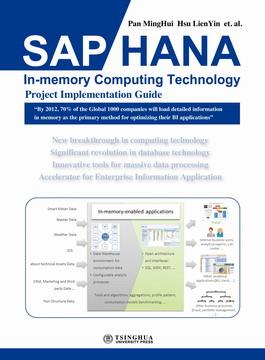
SAPHANA内存计算技术项目实战指南"
This book extracts from lots of experience of enterprise information theory research and application, to which the author and his IT team have devoted many years. The book bases on the latest technology of modern research theory, and tries to reflect the up-to-date development of the information technology and theory and combine the application and preparation.
According to the research and applications, the authors think that memory computing technology is a breakthrough of database technology and a revolution of information analysis technology. This book systematically explores the latest memory computing theory and applications at home and abroad, and illustrates with 36 technical verification scenarios within 10 business domains. It describes in a detailed way how to use SAP HANA to meet query and analysis needs from business application systems after ERP fully covers the main business; how to choose business and capture real-time data for decision-making; how to make use of a variety of modelling tools offered by HANA; how to choose a presentation tool to complete analysis report; how to obtain the balance between models and analytical tools for better analytical performance; how to deploy the roll-out; how to manage and maintain the system after the roll-out; and the management priorities of the HANA executive project. By reading this book, readers can experience the high efficiency and the powerful integrated function of SAP memory computing technology.
The book can be used as the supplementary readings for the universities' computer and information technology study, and also can guide the future management and implementation of SAP memory computing technology projects. It is suitable for readers such as college teachers and students of computer and information management major, business leaders, information system architects, project managers, business consultants, implementation consultants, key users and end users within the enterprise.
Preface
This book extracts from lots of experience of enterprise information theory research and application, to which the author and his IT team have devoted many years. The book bases on the latest technology of modern research theory, and tries to reflect the up-to-date development of the information technology and theory and combine the application and preparation.
According to the research and applications, the authors think that memory computing technology is a breakthrough of database technology and a revolution of information analysis technology. This book systematically explores the latest memory computing theory and applications at home and abroad, and illustrates with 36 technical verification scenarios within 10 business domains. It describes in a detailed way how to use SAP HANA to meet query and analysis needs from business application systems after ERP fully covers the main business; how to choose business and capture real-time data for decision-making; how to make use of a variety of modelling tools offered by HANA; how to choose a presentation tool to complete analysis report; how to obtain the balance between models and analytical tools for better analytical performance; how to deploy the roll-out; how to manage and maintain the system after the roll-out; and the management priorities of the HANA executive project. By reading this book, readers can experience the high efficiency and the powerful integrated function of SAP memory computing technology.
The book can be used as the supplementary readings for the universities' computer and information technology study, and also can guide the future management and implementation of SAP memory computing technology projects. It is suitable for readers such as college teachers and students of computer and information management major, business leaders, information system architects, project managers, business consultants, implementation consultants, key users and end users within the enterprise.
After Chinese version published, the authors received lots of encouragement from SAP experts at home and abroad and business people involving in-memory computing technology during the SAP Sapphire Congress on July 26, 2012. So again, editors and translators were organized and trying their best to translate the book into English, for readers and friends who want to leverage in-memory computing technology to explore business opportunities, to improve enterprise operating performance, or to upgrade information system performance. With English version published, we hope it can contribute for the popularization of science and technology innovation and the improvement of the social informationization level.
Editorial and Translation Team
September 27, 2012


Contents
Chapter 1 Introduction 1
Chapter 2 Evolution of Computer and Origin of In-memory Computing Technology 7
2.1 Evolution of Computer 8
2.1.1 Changes of Generations of Computer 8
2.1.2 Development of Processor 9
2.1.3 History of Memory 10
2.2 Origin of In-memory Computing Technology 11
2.2.1 Business Needs 12
2.2.2 Development of Hardware 14
2.2.3 Software Technology Innovation 19
2.3 Conclusions 20
Chapter 3 Features of SAP HANA In-memory Computing Technology 23
3.1 Profiles of Main In-memory Computing Technology Products 24
3.1.1 SAP HANA 24
3.1.2 Oracle Exalytics 25
3.1.3 Oracle TimesTen 26
3.1.4 IBM SolidDB 27
3.2 Characteristics of SAP HANA memory technology 28
3.2.1 Efficient Parallel Processing Mechanism 29
3.2.2 Memory-based Efficient Data Read and Process 30
3.2.3 Efficient Data Compression to Optimize Memory Utilization 31
3.2.4 Row-column Storage Mixed-mode 32
3.2.5 Virtual Modelling to Reduce Data Redundancy 33
3.2.6 Data-intensive Computing at the Database Layer 35
3.2.7 Other Characteristics of SAP HANA 36
3.3 Conclusions 37
Chapter 4 Basic Knowledge of SAP HANA In-memory Computing Technology
Application 39
4.1 SAP HANA Appliance Architecture 40
4.1.1 HANA In-memory Computing Engine 41
4.1.2 HANA Studio 41
4.1.3 Presentation Layer of HANA 42
4.1.4 HANA-Enabled Data Sources 43
4.2 SAP HANA Applicable Hardware Servers 43
4.2.1 SAP HANA Applicable Platform Requirements 44
4.2.2 Explanation of Adaptability of SAP HANA to P770 46
4.2.3 Instruction of Support of HANA to Superdome and rx8640 46
4.2.4 Conclusions of Analysis on SAP HANA Applicable Platform 47
4.3 SAP HANA Studio (HANA Studio) 48
4.3.1 System Requirements 48
4.3.2 Enabling Platforms 49
4.3.3 Functions of HANA Studio 49
4.4 SAP HANA Reporting Presentation Tools 53
4.4.1 HANA Database Access Interfaces 53
4.4.2 HANA Reporting Presentation Tools 54
4.5 SAP HANA Application Restrictions 56
Chapter 5 Data Extraction Mechanism of SAP HANA 59
5.1 Trigger-Based Replication-SLT Data Synchronization 61
5.1.1 Initialization Import 63
5.1.2 Incremental Updating 63
5.1.3 SLT Data Synchronization Features 63
5.2 ETL-Based Replication-DS Data Synchronization 64
5.2.1 Data Service Modelling Tools 64
5.2.2 Data Initialization Import and Incremental Updating 65
5.2.3 Features of DS Data Synchronization 65
5.2.4 Components Required by ETL-Based Data Synchronization 65
5.3 Log-Based Replication-SRS Data Synchronization 66
5.3.1 Data Initialization Import and Incremental Updating 66
5.3.2 Features of SRS Data Synchronization 67
5.3.3 Components of Log-Based Data Synchronization 67
5.4 Comprehensive Comparison of Three Data Replication Technologies 68
Chapter 6 System Security and Privilege Management of SAP HANA 69
6.1 User Management and Authentication 70
6.1.1 User Management Tools and Validation 70
6.1.2 User Type 71
6.1.3 Standard Users and Roles 71
6.2 Authorization 72
6.2.1 Authorization Concepts 72
6.2.2 Privilege Type 73
6.3 Network and Communications Security 74
6.3.1 Network Security 74
6.3.2 Communications Security 74
6.4 Storage Security 75
6.4.1 Protection of Data in File System 75
6.4.2 Data Encryption 75
6.4.3 Data Storage Security 75
6.5 System Audit 75
6.5.1 Audit Policy 76
6.5.2 Global Audit Configuration 76
Chapter 7 SAP HANA Modelling Techniques 77
7.1 SAP HANA Studio Modelling 78
7.1.1 SAP HANA Modelling Process 78
7.1.2 Three View Tools of HANA Studio 79
7.1.3 Procedures of HANA Studio (Procedures) 82
7.1.4 Model Import/Export 83
7.2 HANA Data Modelling in BW 86
7.3 Call HANA Database via ABAP in ECC6 88
7.4 Comparison of Three Data Modelling Approaches 92
Chapter 8 Applications of SAP HANA In-memory Computing Technology 97
8.1 SAP HANA and Value of Information System 98
8.2 Enterprise Operational Performance and Manpower, Assets
and Materials Management 103
8.2.1 Integrated Management 103
8.2.2 Human Resource Management 104
8.2.3 Financial Management 105
8.2.4 Materials Management 106
8.3 Planning and Construction 107
8.3.1 Grid Planning 107
8.3.2 Grid Construction 107
8.4 Marketing Management 108
8.4.1 Customer Relationship Management 108
8.4.2 Marketing Business Management 109
8.4.3 Marketing Project Management 110
8.5 Operation and Maintenance Management 110
8.5.1 Grid Scheduling Operation Management 111
8.5.2 Grid Equipment Maintenance (Safety Production) 112
8.5.3 Operating Status of Information System 112
Chapter 9 SAP HANA PoC Project Conducted by LNEPC 121
9.1 Authentication Goals 122
9.2 System Architecture Overview 124
9.2.1 Authentication of System Architecture 125
9.2.2 Hardware Authentication 127
9.2.3 Authentication Software 130
9.3 PoC Project Methods 132
9.4 Issues and Solutions 135
9.4.1 Hardware and Software Installation and System Configuration 135
9.4.2 Modelling and Configuration in Implementation Process 136
9.4.3 System Migration Issues 138
9.4.4 System Upgrading 139
9.4.5 System Application Issues 139
9.4.6 SAP HANA Support Issue 140
Chapter 10 Project Management of SAP HANA Implementation 141
10.1 SAP HANA Implementation Methodology Overview 142
10.2 SAP HANA Project Implementation Organizational Structure 143
10.2.1 Goal of Project Organizational Structure 143
10.2.2 Members of HANA Project Implementation Team 144
10.3 Implementation Plan and Steps of HANA Project 147
10.3.1 Implementation Plan 147
10.3.2 Implementation Process Overview 148
10.3.3 Project Implementation Process Examples 164
10.4 Key Outputs and Deliverables of HANA 166
10.5 HANA Project Training and Knowledge Transfer 168
10.5.1 Training and Knowledge Transfer Targets 168
10.5.2 Training and Knowledge Transfer Methods 169
10.5.3 Training and Knowledge Transfer Contents 170
10.6 Other Project Management Activities 172
10.6.1 Project Integration Management 172
10.6.2 Project Scope Management 172
10.6.3 Project Communication Management 175
10.6.4 Project Risk Management 177
10.7 Conclusions and Recommendations 178
Chapter 11 SAP HANA System Building 181
11.1 System Installation and Administration 182
11.1.1 Server Installation 182
11.1.2 SAP HANA System Administration 184
11.2 Modelling Practice 187
11.2.1 Naming Rules of Development Objects 187
11.2.2 Case 1: Plan and Execute Comparison 190
11.2.3 Case 2: Financial Accounting Analysis 220
11.3 Go live Strategy 235
11.3.1 Environment Preparation 235
11.3.2 Object Migration 237
11.3.3 Data Extraction 238
11.3.4 Authentication Testing 238
11.3.5 Formal Go live 238
11.4 System Migration Operation Practice 239
11.4.1 SAP HANA Migration 239
11.4.2 DS Migration 245
11.4.3 BO Migration 248
11.4.4 System Migration Experience Summary 253
Chapter 12 Experience and Recommendations on SAP HANA System
Deployment and Application 255
12.1 Deployment Experience of HANA Project 256
12.2 HANA Application Constraints 258
12.3 HANA Application Suggestions 259
Reference 261
Appendix 1 Manual for HANA System Server Installation 265
Appendix 2 Manual for Installation of HANA Studio and BO4.0 Client 275
Appendix 3 Manual for HANA-SLT data provisioning training 295
Appendix 4 Manual for HANA Modelling Operation 303
Appendix 5 Manual for Excel on SAP HANA 339
Appendix 6 Manual for System Deployment - Production System Preparation 345