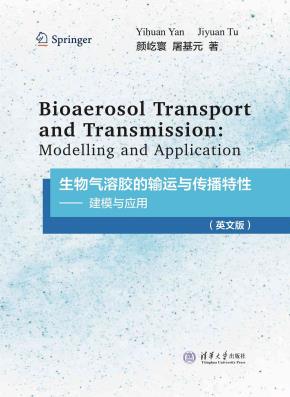
生物气溶胶的输运与传播特性—建模与应用(英文版)"
《生物气溶胶的输运与传播特性—建模与应用(英文版)》通过多个角度(尺寸分布,动能特性,化学特性,生物特性等),从机理上来剖析何为生物气溶胶,并进一步解释其在空气中的传播特征以及主要的影响因素(外在作用力, 湍流耗散,吸入沉积等)。随后,通过与微生物的活性,感染性等生物特性相结合,分析生物气溶胶吸入后在人体呼吸道的传播特征并关联相应的吸入感染风险分析。本书还将通过运用CFD建模与模拟,来实现对于生物气溶胶在空气中传播的系统性预测并对其在具体环境下传播特性的捕捉。同时,通过对于模拟数据的分析,评估预测感染风险。除此之外,本书将涵盖多类案例分析(包含吸入前与吸入后),通过对于案例的讨论与剖析,进一步展望生物气溶胶模拟在实际应用中的前景。最后通过实际数据为依据,提供一些提升有效防疫防控措施的建议与设计。
Preface
The study of airborne transmission has been limited to the plausible transmission route of these highly infectious respiratory pathogens in epidemiological investigations. Meanwhile, the importance of the pathogen spread via bioaerosols (i.e. airborne route) has not been awakened until the frequent occurrences of those respiratory-related pandemics (i.e. SARS, MERS, etc.). With the escalating urgency to contain the wide and fast spread of contagious respiratory-related bioaerosols globally, any essential knowledge from a multi-disciplinary field is in great demand to mitigate the outbreaks. Although the epidemiological study is often solid and accurate to restrict the fast disease transmission, they require a great deal of clinical data or epidemiological data to support their contributions. This could be often delayed at the early stage of an emerging pandemic. Alternatively, computational fluid dynamics (CFD) has become a fast-rising approach to investigate and predict the transport characteristics of airborne particles or droplets via its strong capability of dynamic analysis on particle travel patterns and direct visualisation of their trajectories in the air. From the perspective of fluid mechanics, the entire transmission cycle of respiratory disease transmission can be divided into four main stages, from the infectious host's exhalation, suspension of the pathogen-bearing droplets and aerosols in the air, inhalation by the susceptible individuals, and ultimate deposition of the in the human respiratory system. For this comprehensive transmission cycle, each stage can be carefully mediated by various complex flow phenomena, which can be generally described as air-mucous interaction, dynamic distribution of droplets, respiratory jet flow, droplet evaporation, flow-induced aerosol suspension and dispersion, etc. Such highly participated fluid phenomena and mechanisms in each transmission process bring insight and opportunity for the CFD method to contribute its powerful modelling capability for the disease transmission analysis.
In addition, as the term "bio" additionally endows the biological meanings for these aerosol particles, understanding the biological parameter and characteristics of pathogen-bearing aerosols (i.e. bioaerosols) is essential. Such important parameters would all ultimately affect the infectious risk of the individuals in the indoor space, including the stability, viability, survivability and etc. These biological attributes of the respiratory droplets could be further integrated into the modelling processes and risk assessments to provide an enhanced understanding of the exposure and infection risk analysis of the bioaerosol transmission.
The purpose of this book is to provide an in-depth understanding of how CFD application becomes an excellent analysing and modelling tool to support the research community, government and regulatory agency for the investigation, mitigation and prevention of the respiratory-related pandemic, especially when the solid epidemiological data is insufficient with the newly emerging respiratory disease. With the solid knowledge being obtained from the entire book content, a computational-based virtual platform is proposed and demonstrated, aiming to provide a quantitative and holistic analysis of the bioaerosol infection risk assessment from source to sink.
The book begins with an introduction in Chapter 1 to provide an overview of the severity of the respiratory disease, its major transmission routes, and its deadly consequence on human health and the global economy. It aims to initiate the awareness for the reader to consider the importance of the solid and accurate analysis and investigation of respiratory disease transmission.
The second chapter devoted to bringing the readers with fundamental understand- ings in relation to the definition and the key characteristics of the respiratory-related bioaerosol. The key focus of this chapter is to provide the basic description of the dynamic mechanism of the droplet motion in the air and the corresponding physical and biological properties, which is part of the cornerstone for the subsequent modelling procedure.
The respiratory-based bioaerosol infections are further introduced in Chapter 3. In this chapter, the potential bioaerosol source in various environments (i.e. indoor and outdoor) for the bioaerosol growth and spread are represented, followed by the basic description of how the pathogens interact with the human respiratory system. Based on these findings, the human inter-clearance mechanism and current control strategies are demonstrated.
With the fundamental of the bioaerosol and the transmission being carefully introduced, the essential modelling approach in the CFD method to restore the comprehensive disease transmission investigation is introduced in Chapter 4. This chapter brings an important idea of how respiratory-related problems are solved with the traditional CFD workflow, and the corresponding numerical method required to solve complicated flow-particle interactions are also carefully represented (turbulence model, meshing, discretisation scheme, etc.).
To achieve a solid prediction of the disease transmission scenario, the key challenges in each disease transmission stage should be carefully solved by breaking down those critical processes. Before analysing the entire transmission process, the deepened understanding of the surrounding environment from the host is of great importance. Therefore, as the major source of bioaerosol, the surrounding environment of humans is carefully investigated in Chapter 5, especially in the micro-environment. It aims to bring the readers with the fundamentals of these dominating factors to affect the human micro-environment and the corresponding numerical approaches to model that. As human is the leading factor to affect the surrounding environment, the modelling of the computational manikin model is also important. To obtain a computationally efficient investigation, the recommended optimisation method of the manikin model is given in Chapter 5.
The effect of the influential factors on bioaerosol transport is described in Chapter 6. Two contaminant modelling approaches are introduced in this chapter, namely the Eulerian method and the Lagrangian method. An important focus of this chapter is to distinguish the major difference between these two methods in the context of the fluid dynamic and the practical applications. In addition, the major difficulties for the investigation of bioaerosol transport in the indoor environment are introduced, such as interpreting the complex flow phenomena induced by the ventilation and human thermal plume. The analysis could be more challenging if many occupants share a very limited space indoors. Staying in these such enclosed environments with multifarious affecting factors could potentially make the analysis more complicated than expected. Based on the findings, several numerical case studies are represented to demonstrate the importance of the influential factors in affecting the particle transport characteristics in the densely occupied environment (thermal plume, ventilation, etc.).
Chapter 7 further introduces the effect of the ambient conditions (i.e. humidity and temperature) on the physicochemical process of respiratory droplets before the inhalation. This chapter is particularly critical as the physical fundamentals of the pathogen-bearing particles are vastly dependent on the dynamic size distribution owing to the evaporation process. The conventional experimental study could hardly capture the dynamic properties of the droplets due to the devoid of advanced techniques, whereas the CFD method could effectively restore this complicated physicochemical process and provide a clear visualisation of the droplet size variation. Notwithstanding, describing the biological attributes of the pathogen-bearing particle is still a big challenge for the CFD method. To further account for the biological attribute of the pathogens, the integration of numerical method and mathematical risk assessment model is represented in this chapter. Two widely adopted risk assessment models (i.e. Wells-Riley and Dose-response model) are carefully introduced and demonstrated with the numerical case studies, respectively.
Chapter 8 represents the comprehensive workflow of how the CFD method is being used for deposition quantification in the human respiratory system, including the nasal cavity and lower respiratory airway. Before particle deposition, particle inhalability is an essential criterion when evaluating the infection and exposure risk of the individuals. For a stationary individual, this parameter is often the function of the particle size. In this chapter, the effect of long-overlooked human factors, human motion on particle inhalability is investigated. After that, deposition quantification in the human respiratory system is further studied. To obtain a solid quantification, the re-construction or simplification of the airway geometry is required. This chapter provides the comprehensive modelling workflow of the human airway, and the in-depth knowledge of the deposition pattern in the respiratory system, aiming to bring the reader with the fundamentals of particle deposition mechanism. Further integration of particle suspension in the air to the deposition in the human nasal cavity is numerically demonstrated to reveal the CFD method's strong multi-coupling and multi-scale modelling capability.
Chapter 9 further demonstrates the powerful modelling capability of the CFD approach and its value for the general environmental practice, including the risk assessment, control strategy and prevention. The conjunction of the CFD approach and the mathematical risk assessment could provide a solid, direct and flexible analysis of the individual infection risks in the enclosed environment. Based on the quantifiable results obtained from the risk assessment framework, the control strategy can be further proposed. In this chapter, fan-driven indoor vortex ventilation is carefully introduced, aiming to broaden the insight of the innovative design of the ventilation schemes. Apart from the CFD application for risk assessment and control strategy, it could also be used for the regulation of effective precautionary measures. The major purpose of this chapter is to strongly demonstrate that the CFD method has a powerful modelling capability for solving and optimising the general environmental practice.
Chapter 10 is a brief exploration of the future trends and more advanced modelling techniques. In this chapter, the potential research direction or field is proposed based on the authors' own insight, which aims to stimulate the further development and advancement of the modelling capability and the comprehensive workflow of the disease transmission analysis. It is expected that in the near future, the rapid development of the CFD method and rising computational science could bring considerable benefits in solving the respiratory-related problem in the context of the fluid dynamic. Among the advances, the conjunction of the machine learning (ML) with the current virtual-based risk assessment platform can be clearly foreseen. It is believe that the blossoming development of the ML would bring fresh insights for fluid mechanics research, especially for indoor disease transmission analysis.
Yihuan Yan
Jiyuan Tu


? ?
Chapter 1 Introduction 1
1.1 Emerging Respiratory Pandemics. 1
1.2 Transmission Modes. . 4
1.3 From the Fluid Dynamics Perspective 9
1.3.1 Exhalation 9
1.3.2 Transport Characteristics in the Air. . 10
1.3.3 Exposure and Inhalability 12
1.3.4 Deposition in Human Respiratory System 13
1.4 Research Method 14
1.5 CFD Application to Transmission Control 21
References 25
Chapter 2 Bioaerosol Dynamics 32
2.1 What is Bioaerosol 32
2.2 Types of Bioaerosols 33
2.3 Properties of Bioaerosol 36
2.3.1 Size Distribution 36
2.3.2 Kinetic Properties 39
2.3.3 Biological Properties 40
2.4 Motion in the Air 42
2.5 Dynamic Size Distribution 47
2.5.1 Evaporation and Condensation 47
2.5.2 Influential Factors 48
2.6 Deposition Mechanism 51
2.7 Summary 53
References 54
Chapter 3 Respiratory-based Bioaerosol Infections 59
3.1 Bioaerosol in the Air 59
3.2 Bioaerosol Inhalation and Deposition in Human Respiratory System 61
3.2.1 The Human Respiratory System 61
3.2.2 Concept and Physical Basis of Inhalability 63
3.2.3 Definition and Physical Basis of Deposition 63
3.2.4 Local and Total Respiratory Tract Deposition . 64
3.2.5 Biological Mechanisms of Clearance and Redistribution 65
3.3 Bioaerosol-related Infections. 66
3.4 Chain Infection due to Bioaerosol Transmission. . 68
3.5 Bioaerosol Infection Control 69
3.6 Summary 71
References 72
Chapter 4 Computational Fluid Dynamics 76
4.1 Introduction 76
4.2 Principles of CFD and Equations. . 77
4.3 Turbulent Flow and Models 81
4.4 Bioaerosol Transport Models 85
4.4.1 Lagrangian Model 86
4.4.2 Eulerian Model . 87
4.5 CFD Workflow and Scheme 89
4.6 Current Status of CFD Software 93
4.7 Summary 94
References 95
Chapter 5 Effects of Occupant's Micro-environment on Bioaerosol Transport 98
5.1 Introduction 98
5.2 Metabolic Body Heat and Thermal Plume 100
5.2.1 Characteristic of the Thermal Plume for Sitting Posture 102
5.2.2 Interactions between Thermal Plume and Respiratory Flow 103
5.2.3 Plume Effect on the Contaminant Field 105
5.3 Computational Thermal Manikins 106
5.3.1 Four Simplification Approaches 107
5.3.2 Case Study of the CTM Simplification Approaches in an Enclosed
Chamber . 111
5.4 Quantifiable Simplification Approach for CTMs 116
5.4.1 Mesh Decimating Algorithm. . 116
5.4.2 Effect of MDA Simplification on Global Airflow Field. 119
5.4.3 Effect of MDA Simplification on Human Micro-environment. 120
5.4.4 Case Study-Micro-environment of CTMs using Various
Simplification Approaches 122
5.5 Thermal Airflow Field 127
5.5.1 Case Study-An Enclosed Chamber. . 127
5.5.2 Case Study-A Reduced-scale Cabin Environment 130
5.6 Summary 135
References 137
Chapter 6 Bioaerosol Transport in Occupied Environments. . 140
6.1 Introduction 140
6.2 Tracking Models of Bioaerosol Transport 142
6.2.1 The Lagrangian Approach. . 142
6.2.2 The Eulerian Approach 145
6.2.3 Bioaerosol Concentration and Distribution Transport 148
6.2.4 Case Study-Bioaerosol Transport in a Small Chamber 149
6.3 Impacts of Indoor Ventilation Scheme 155
6.3.1 Case Study-Comparison of the Displacement and Mixing Ventilation
in a Small Chamber 155
6.3.2 Case Study-Effect of the Ventilation Layouts in a Conference Room 158
6.4 Bioaerosol Transport in Densely Occupied Environment 162
6.4.1 Case Study-A Typical Cabin Environment 163
6.4.2 Case Study-A Public Transport Train Cabin 169
6.4.3 Case Study-A Large-scale Airliner Cabin Environment 173
6.5 Summary 179
References 181
Chapter 7 Influential Factors on Bioaerosol Transport. 184
7.1 Introduction 184
7.2 Effect of Dynamic Droplets Size Distribution in Indoor Spaces. . 185
7.2.1 Droplets Size Distribution from Various Respiratory Behaviour 186
7.2.2 Droplets Size Reduction due to Evaporation 189
7.2.3 Case Study-Dynamic Size Reduction of Cough Released Bioaerosols
and Droplets due to Evaporation. . 192
7.2.4 Case Study-Interactions between Human Thermal Plume and Cough
Released Droplets 200
7.2.5 Delayed Droplets Deposition due to Evaporation 204
7.3 Effect of Disease Active Time and Viability via Air Transmission 207
7.3.1 Key Parameters of Infectious Diseases 208
7.3.2 Mathematical Models for Quantitative Risk Assessment 210
7.3.3 Integration of Mathematical Models into Numerical Modellings. . 215
7.3.4 Case study-Wells-Riley Based CFD Simulation. 216
7.3.5 Case study-Dose-response Based CFD Simulation 219
7.4 The Social Distancing and Capacity Effects in Indoor Environments 223
7.4.1 Case Study-A Densely Occupied Meeting Room 224
7.4.2 Ventilation Scheme and Room Arrangement 228
7.4.3 Bioaerosol Release via Coughing and Speaking 231
7.4.4 Occupants' Exposure and Infectious Risks over Distance and
Capacity Changes 235
7.5 Summary 238
References 240
Chapter 8 Case Studies of Bioaerosol Inhalation and Deposition. 243
8.1 Introduction 243
8.2 Bioaerosol Inhalability 244
8.2.1 Case Study-Human-induced Wake Flow and Its Impact on
Particle Inhalability. . 245
8.2.2 Release Modes and Source of Particles 247
8.2.3 Impacts of Freestream Velocity and Walking Speed . 249
8.2.4 Particle Size Effects on Aspiration Efficiency During the Motion. 258
8.3 Particle Deposition in Nasal Cavity 263
8.3.1 Construction of Nasal Cavity Models. 263
8.3.2 2D Surface Unwrapping over 3D Nasal Cavity Model 266
8.3.3 Particle Deposition Patterns of Unwrapped Nasal Cavity 269
8.4 Particle Deposition in the Lower Respiratory Airway 275
8.4.1 Simplification of Respiratory Airways 275
8.4.2 Particle Tracking Modelling in the Lower Airway. 278
8.4.3 Deposition Analysis at Various Cross-sectional Studies. . 281
8.5 From Indoors Release to Inhalation and Deposition in the
Respiratory System 285
8.5.1 Interpretation of the Bioaerosol Transmission Cycle using
CFD Method. . 285
8.5.2 Integrated Models of Indoor Space and Human Respiratory System. . 287
8.5.3 Case study - Practical Application of the Integrated Model 291
8.5.4 Case study - Further Practical Application of the All-in-one
Respiratory Model . 295
8.6 Summary 302
References 304
Chapter 9 Health Risk Assessment and Prevention Recommendations. 306
9.1 Introduction 306
9.2 Passengers' Health Risk Assessment in Airliner Cabins 309
9.2.1 Case Study-Modelling of Bioaerosol Transmission in a 7-row Cabin 309
9.2.2 The Wells-Riley Framework 315
9.2.3 Quantifiable Risk Assessment of Individual Passenger 316
9.2.4 Case Study-Passenger Movement Impacts 319
9.2.5 Case Study-Effects of the Personal Jets 323
9.3 Emergency Indoor Ventilation Strategy 326
9.3.1 Case Study-Formation of Fan-driven Indoor Tornado . 326
9.3.2 Dynamic Core Region Identification Approaches 328
9.3.3 Effect of Lift Angle and Vortex Intensity 332
9.4 Other Case Studies on Pandemic Interventions 339
9.4.1 Wearing Masks. 339
9.4.2 Social Distance Rule 343
9.5 Summary 348
References 350
Chapter 10 Advanced Modelling and Future Trend. 352
10.1 Fast Fluid Dynamic on Disease Transmission Modelling 352
10.2 Optimisation of Wells-Riley Framework and Infection Risk
Assessment 355
10.3 Advanced Modelling of Multiple Moving Occupants 358
10.4 Virtual Platform for Infection Risk Assessment Enhanced by Machine
Learning 360
References 364
《生物气溶胶的输运与传播特性—建模与应用(英文版)》将病毒,细菌等有机生物体的活性,致病率,含水量等特性与气溶胶的物理传播特征相耦合,实现一体化模拟与预测,同时通过模拟数据对感染分析进行评估与预测,透彻分析生物气溶胶传输特性,有效评估人体潜在感染风险。
颜屹寰,现于墨尔本皇家墨尔本理工大学(RMIT)任研究员,致力于研究污染物在室内及建筑环境内的传播以及评估人体暴露在污染物下的感染风险,有着丰富的在大尺度机舱环境下的模拟经验及技巧,并深入分析了机舱环境等高人口密度环境下污染物传播的主要影响因素。深入参与了国家重点基础研究发展计划(973计划),大型客机座舱内空气环境控制的关系科学问题研究,曾获得澳洲博士生奖学金(APA)全奖,以及国家优秀自费留学生奖学金(全球仅500名)。