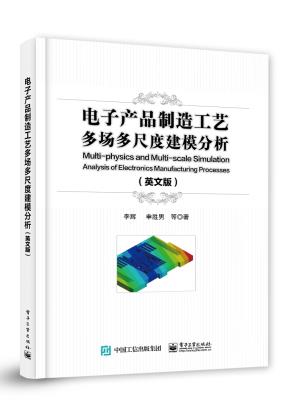
电子产品制造工艺多场多尺度建模分析 "
本书介绍了两种典型电子产品汽车压力传感器和FPCB的制造工艺研究,分别对其关键制造工艺过程进行了多场多尺度建模分析,涵盖了分子动力学与有限元建模分析、工艺参数设计与优化、工艺性能实验验证。全书共10章,汇集了两种典型电子产品的关键工艺过程,包括铜-铜引线键合工艺中微观接触过程,六种典型材料引线键合工艺性能比较,汽车压力传感器灌封工艺中芯片残余应力分析,汽车压力传感器引线键合焊点的热循环失效分析,FPCB化锡工艺分子动力学研究,FPCB曝光工艺中光场分析,FPCB蚀刻工艺中蚀刻剂喷淋特性研究,FPCB蚀刻腔中蚀刻剂浓度分布与流场特性分析,FPCB蚀刻工艺中蚀刻腔几何形貌演化过程分析,FPCB多蚀刻腔蚀刻过程分析。本书针对MEMS和FPCB制造工艺中的实际问题,建立物理模型和数值模拟模型,基于有限元和分子动力学方法,模拟电子产品制造过程中材料、微观结构的演变,揭示加工过程中电子产品变形、应力、缺陷的形成机理与演化机制,在此基础上提出变形、应力与缺陷的抑制策略及调控理论,指导工艺优化,提高电子产品良率。
With the proposal of “Industrial Internet” in the United States and “Industry 4.0” in Germany, the intelligent manufacturing becomes national strategy of many countries. Based on the new generation of digital information technology, combined with new manufacturing processes and materials, intelligent manufacturing runs through all links of product design, production, management, and service. As an important part of intelligent manufacturing industry upgrade, electronic manufacturing has developed rapidly with the support of policies in recent years in China. Although the output value of domestic electronics industry has reached a relatively large scale, the profit margin is still relatively low. To occupy the upstream position of the industrial chain and achieve technological independence, it is urgent to improve electronic manufacturing process since the process is one of the most important factors determining the electronic product quality. Our project, its name is “Integration technologies of high-speed and high-precision intelligent manufacturing production line for large quantities of electronic products based on multi-field modeling and simulation of process”, aims at the major needs of electronic manufacturing industry, overcomes the bottleneck of manufacturing technology, develops the integration technology and application demonstration of mass product manufacturing intelligent production line, forms an industry-class solution, which will promote the leapfrog development of electronic manufacturing technology. The production of automotive micro-electromechanical systems (MEMS) pressure sensor, including the mounting, wire bonding, potting, shell injection, and other multi-step processes, involves a variety of complex manufacturing environments, and occurs various defects as the stress and strain concentration, warping, delamination, desoldering, crack, and so on. The formation mechanism of these defects is complex, involving macro-scale and micro-scale material constitutive relationships, which makes it difficult to control production quality. Currently, the automation level of automobile pressure sensor production is generally low due to the complex production process of automobile pressure sensor. Manufacturing processes need to be investigated to improve the production efficiency and product yield. As the display panel field is developing towards ultra-high resolution and ultra-high refresh rate, the demand for ultra-high resolution display panel is increasing rapidly and the market prospect is broad. Panel industry is facing a strong demand for high-end development. The manufacturing of flexible printed circuit board (FPCB) electrical components with the high performance and reliability is an important step in the manufacturing process of display panel. The FPCB manufacturing line involves exposure, development, etching, and other processes as well as complex manufacturing environment, and there are various problems such as the stress and strain concentration, warpage, crack, short circuit, and so on. However, the current research on the key processes of FPCB manufacturing is limited by high experimental cost, long cycle, over-simplified simulation model, and low accuracy. The influence mechanism of environment, material, structure, and process parameters on the yield and productivity of electronic products in the manufacturing process is not clear, and the intelligent control of manufacturing process still needs work. Therefore, aiming at the defects such as the stress and strain concentration, warping, delamination, crack, short circuit caused by multi-step processes in the complex manufacturing environment of electronic product intelligent production line, this book studies the manufacturing processes and defect formation mechanisms by the multi-field and multi-scale modeling and simulation. In this book, the molecular dynamics theory and finite element analysis method with the multi-field coupling such as electric, thermal, optical, chemical, and fluid are used to study the manufacturing processes. By simulating the microstructures of materials and changes of physical and chemical properties in several electronic product manufacturing processes, the formation mechanisms, and evolution rules of product deformation, stress, defects are revealed, which are beneficial to the process optimization and greatly improve the yield of electronic products. Chapters 1-5 study the manufacturing processes of MEMS automotive pressure sensor, and Chapters 6-9 study the manufacturing processes of FPCB. Chapter 1 investigates the change of bonding force, atomic displacement, and von Mises stress distribution during the bonding process. Chapter 2 studies the behavior of six typical material pairs in wire bonding by analyzing the change of bonding force, energy, atomic displacement and von Mises stress distribution during the bonding process and material squeezing, and the key parameters of six pairs are analyzed to explain the difficulty of bonding. Chapter 3 investigates the residual stress on chip of automobile pressure sensor in the potting process by the experiment and finite element method (FEM) simulation, which analyzes the effect of stress on the pressure sensor by different thicknesses of potting adhesive. Chapter 4 investigates the thermal cycle failure of wire bonding weld by the experiment and FEM simulation, which analyzes the effects of creep and plasticity on the fatigue failure of solder joints and points out the most fatigue location. Chapter 5 investigates the acoustic injection on automobile MEMS accelerometer by the multi-physics field simulation and failure mechanisms of acoustic injection on the microprocessor unit 6050 (MPU6050) accelerometer are investigated by both the experiment and simulation. Chapter 6 studies the wetting behavior of Sn droplet on FPCB substrate surfaces using molecular dynamics simulation, which analyses the influence of different substrate surfaces on the wetting behavior of Cu/Sn wetting systems. Chapter 7 studies the etchant spraying characteristics in the FPCB etching process by numerical method based on the Euler multiphase flow model, and a 3D full model of multi-nozzle array is established to study the velocity distribution of etchant in the spraying domain. Chapter 8 studies the etchant concentration distribution and fluid characteristics in the FPCB etching cavity, which further studies the time evolution of etching cavity, concentration field and velocity field of CuCl2 solution, and effects of initial concentration and inlet velocity on the contour of etching cavity. Chapter 9 studies the etching cavity evolution in FPCB etching process, and the FPCB sample with 18 μm line pitch is manufactured based on the process parameters obtained by simulations, which validates the numerical simulation method by comparing with the micro-scopic analysis of actual structures and cavity profiles of simulation result. Mr. Beikang Gu writes Chapter 1 and Chapter 2, Mr. Yunfan Zhang is responsible for Chapter 3 and Chapter 5, Mr. Kangkang Wu for Chapter 4, Mr. Jiazheng Sheng for Chapter 6 and Chapter 8, Mr. Ruijian Ming for Chapter 7 and Chapter 9, Professor Hui Li and Shengnan Shen are responsible for the organization and verification of the book, and contribute to the method of FEM simulation and molecular dynamics simulation.

Chapter 1 Investigation on micro contact in Cu-Cu wire bonding process 001 1.1 Introduction 001 1.2 Molecular dynamics modeling of Cu-Cu wire bonding 003 1.3 Results and discussions 005 1.3.1 Formation and breakage processes of Cu-Cu weld 005 1.3.2 Analysis of Cu-Cu indentation morphology 007 1.3.3 Analysis of Cu-Cu atomic stress distribution 008 1.4 Conclusions 011 References 011 Chapter 2 Investigation on wire bonding performance with six typical material pairs 014 2.1 Introduction 015 2.2 Molecular dynamics modeling of six material pairs 016 2.3 Results and discussions 018 2.3.1 Analysis of bonding forces and system energy 018 2.3.2 Analysis of atomic morphology for six material pairs 022 2.3.3 Analysis of atomic stress distribution for six material pairs 023 2.3.4 Four critical displacement points of six material pairs 025 2.4 Conclusions 028 References 028 ? Chapter 3 Investigation on residual stress on chip of automobile pressure sensor in potting process 032 3.1 Introduction 032 3.2 Thermal experiment of MEMS pressure sensor 034 3.3 Analytic analysis of thermal stress on sensitive structure 036 3.4 Modeling and Simulation 038 3.4.1 Geometric model of MEMS pressure sensor 039 3.4.2 Finite element model of MEMS pressure sensor 039 3.4.3 Finite element simulation of residual stress 040 3.5 Conclusions 044 References 045 Chapter 4 Investigation on thermal cycle failure of wire bonding weld in automobile pressure sensor 047 4.1 Introduction 048 4.2 Thermal cycling experiments of the MEMS pressure sensor 049 4.2.1 A sample of thermal cycling test 049 4.2.2 Experimental methods of the thermal fatigue test 050 4.2.3 Experimental results and analysis under thermal cycles 052 4.3 Numerical simulation 053 4.3.1 Theoretical model of thermal fatigue 053 4.3.2 Geometric model of the MEMS pressure sensor 055 4.3.3 Simulation model of thermal fatigue of solder joint 056 4.3.4 Simulation results of solder joint failures 058 4.4 Conclusions 062 References 063 Chapter 5 Investigation on acoustic injection on automobile MEMS accelerometer 066 5.1 Introduction 066 5.2 Experimental investigation of acoustic injection 068 5.3 Modeling and simulation 070 5.3.1 Disassembly of inertial measurement unit (IMU) MPU6050 070 5.3.2 Geometric model of accelerometer unit 070 5.3.3 Finite element model of accelerometer sensitive structure 072 5.3.4 Simulation results and discussion of acoustic injection 074 5.4 Conclusions 080 References 081 Chapter 6 Investigation on wetting behavior of Sn droplet on FPCB substrate surfaces 083 6.1 Introduction 083 6.2 Models and methods of different surfaces 085 6.2.1 Modified embed atom method (MEAM) potential 086 6.2.2 Simulation models of different surfaces 087 6.2.3 Experimental procedures of wetting behavior on different surfaces 090 6.3 Results and discussion 090 6.3.1 Effect of temperature on wetting behavior 090 6.3.2 Effect of roughness on wetting behavior 094 6.3.3 Effect of Sn surface on wetting behavior 097 6.3.4 Contact angle measurement on different substrate surfaces 101 6.4 Conclusions 103 References 103 Chapter 7 Investigation on etchant spraying characteristics in FPCB etching process 107 7.1 Introduction 108 7.2 Equipment of the FPCB etching process 110 7.3 Numerical simulation of multi-nozzle spraying system 111 7.3.1 Governing equations of fluid dynamics 111 7.3.2 Simulation model of spraying equipment 112 7.4 Results and discussions 114 7.5 Conclusions 122 References 123 ? Chapter 8 Investigation of etchant concentration distribution and fluid characteristics in FPCB etching cavity 126 8.1 Introduction 126 8.2 Model formulation and method of etching process 129 8.2.1 Governing equations of fluid dynamics and mass flux 129 8.2.2 Simulation model of the FPCB etching cavity 130 8.3 Results and discussions 133 8.4 Conclusions 140 References 140 Chapter 9 Investigation of etching cavity evolution in FPCB etching process 143 9.1 Introduction 143 9.2 Equipment of the FPCB etching process 144 9.3 Numerical simulation of the FPCB etching process 146 9.3.1 Governing equations of the fluid dynamics 146 9.3.2 Simulation model of spraying and etching domain 147 9.4 Results and discussions 149 9.5 Conclusions 153 References 153 Appendix 156