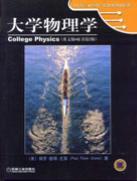
大学物理学(英文版)(原书第2版)"
本书是一本不用微积分的大学物理教材,包含物理内容比较浅,因此更着力于对概念定律的物理意义的定性分析与说明。本书另一特点就是联系实际。概念定律大多联系实际问题提出,例题习题更是尽可能的联生活费实际,本书引述了许多现代物理前沿的知识。本书除了在各处指导学生如何解题外,还设计了深究栏目。本书可作为理工科各专业教学参考书或教材。
本书是一本不用微积分的大学物理教材,包含物理内容比较浅,不讲高斯定律,不列麦克斯韦方程数学式,不介绍洛仑兹变换。也正是由于数学用得较浅,本书更着力于对概念、定律的物理意义的定性分析与说明。例如对牛顿定律的意义与应用、熵的概念、电磁波的产生和发射、相对论时空观等都有清晰的说明。注重定性的物理意义的讲解,而不过多地依赖数学推导是本书一大特点,也是当前物理教学改革的重点之一。 本书另一特点是联系实际。概念定律大多联系实际问题提出,例题、习题更是尽可能地联系实际。特别值得一提的是,本书非常注重联系物理学在人类生活、医疗和生物、生理学方面的应用,如关节受力、血液循环、听觉、视觉、核磁体检、射线防护等都有介绍。这些知识对一般学生可以大开眼界,对有关生物、生理和医学专业的学生学习物理学更是很有帮助。 本书又一明显特点是保证讲授经典基础知识的同时,引述了许多现代物理前沿的知识。除散见于正文各处的现代物理知识,如Cavendishtype的现代实验和广义相对论以及超弦理论的关系、潮汐与黑洞、DNA、加速粒子对撞机等以外,还在开头讲了物理学到近代物理的发展,并在最后一章专门介绍了许多重要的物理学前沿知识,包括宇宙学、量子引力理论、超弦理论、暗物质、混沌、高温超导等等。最后一节还列出了许多当前物理学没有解决而尚待解决的问题。所介绍的物理学前沿知识是目前物理教材中很少见的。 在教学方法方面,本书除了在各处指导学生如何解题外,还设计了“探究任务”、“自编习题”、“不合理结果”等由学生自己探讨或研究的栏目,帮助学生提高学习效果。 总体来说,本书在选材、明晰讲解、教学法考虑等方面都很有创造性,注重实际化和现代化,是一本很好的物理教材,很值得向物理教师和大学生推荐。 张三慧 清华大学物理系 2002年8月


1 INTRODUCTION:PHYSICAL QUANTITIES, UNITS,
AND MATHEMATICAL OVERVIEW
1.1 Physics: An Introduction
1.2 Physical Quantities and Units
1.3 Measurement, Accuracy, and Uncertainty; Significant Figures
1.4* Exponents
1.5* Scientific Notation and Powers of 10
1.6* Logarithms
1.7* The Rules of Algebra
1.8* Angles, Triangles, and Simple Trigonometry
Summary
Conceptual Questions
Problems
Construct Your Own Problem
2 KINEMATICS
2.1 Displacement
2.2 Time, Velocity,and Speed
2.3 Acceleration
2.4 Motion Equations for Constant Acceleration in One Dimension
2.5 Problem-Solving Basics
2.6 Falling Objects
2.7* Graphical Analysis of One-Dimensional Motion
Summary
Conceptual Questions
Problems
Unreasonable Results
Construct Your Own Problem
3 TWO-DIMENSIONAL KINEMATICS
3.1 Kinematics in Two Dimensions:An Introduction
3.2 Vector Definitions and Graphical Methods of Vector Addition and Subtraction
3.3 Analytical Methods of Vector Addition and Subtraction
3.4 Projectile Motion
3.5 Addition of Velocities
Summary
Conceptual Questions
Problems
Unreasonable Results
Construct Your Own Problem
4 DYNAMICS:NEWTON#S LAWS OF MOTION
4.1 Force:The Concept
4.2 Newton#s First Law of Motion: Mass
4.3 Newton#s Second Law of Motion: Concept of a System
4.4 Newton#s Third Law of Motion: Symmetry
4.5 Weight, Friction, Tension, and Other Classes of Forces
4.6* The Four Basic Forces:An Introduction
4.7 Further Applications of Newton#s Laws of Motion: Problem-Solving
Strategies
Summary
Conceptual Questions
Problems
Integrated Concepts
Unreasonable Results
Construct Your Own Problem
5 STATICS,TORQUE,AND ELASTICITY
5.1 The First Condition for Equilibrium
5.2 The Second Condition for Equilibrium
5.3 Center of Mass; Center of Gravity
5.4 Stability
5.5 Applications of Statics, Including Problem-Solving Strategies
5.6* Simple Machines
5.7* Forces and Torques in Muscles and Joints
5.8 Elasticity: Stress and Strain
Summary
Conceptual Questions
Problems
Integrated Concepts
Unreasonable Results
Construct Your Own Problem
6 WORK, ENERGY, AND POWER
6.1 Work: The Scientific Definition
6.2 Kinetic Energy and the Work-Energy Theorem
6.3 Gravitational Potential Energy
6.4 Conservative Forces and Potential Energy
6.5 Nonconservative Forces: Open Systems
6.6 Conservation of Energy
6.7 Power
6.8* Work,Energy, and Power in Humans; Introduction to Efficiency
Summary
Conceptual Questions
Problems
Integrated Concepts
Unreasonable Results
Construct Your Own Problem
7 LINEAR MOMENTUM
7.1 Linear Momentum and Force
7.2 Impulse
7.3 Conservation of Momentum
7.4 Elastic Collisions in One Dimension
7.5 Inelastic Collisions in One Dimension
7.6* Collisions of Point Masses in Two Dimensions
7.7* Introduction to Rocket Propulsion
Summary
Conceptual Questions
Problems
Integrated Concepts
Unreasonable Results
Construct Your Own Problem
8 UNIFORM CIRCULAR MOTION AND GRAVITATION
8.1 Rotation Angle and Angular Velocity
8.2 Centripetal Acceleration
8.3 Centripetal Force
8.4* Fictitious Forces and Noninertial Frames: The Coriolis Force
8.5 Newton#s Universal Law of Gravitation
8.6 Satellites and Kepler#s Laws: An Argument for Simplicity
Summary
Conceptual Questions
Problems
Integrated Concepts
Unreasonable Results
Construct Your Own Problem
9 ROTATIONAL MOTION AND ANGULAR MOMENTUM
9.1 Angular Acceleration
9.2 Kinematics of Rotational Motion
9.3 Dynamics of Rotational Motion: Rotational Inertia
9.4 Rotational Kinetic Energy:Work-Energy Revisited
9.5 Angular Momentum and Its Conservation
9.6* Collisions of Extended Bodies in Two Dimensions:A Brief Treatment of Things
that Go Bump and Spin
9.7* Gyroscopic Effects:Vector Aspects of Angular Momentum
Summary
Conceptual Questions
Problems
Integrated Concepts
Unreasonable Results
Construct Your Own Problem
10 FLUID STATICS
10.1 What is a Fluid?
10.2 Density
10.3 Pressure
10.4 Variation of Pressure with Depth in a Fluid
10.5 Pascal#s Principle
10.6 Gauge Pressure, Absolute Pressure, and Pressure Measurement
10.7 Archimedes# Principle: Buoyant Force, Density Measurement, and
Why Some Things Float
10.8* Cohesion and Adhesion in Liquids: Surface Tension and Capillary Action
10.9* Pressures in the Body and Their Measurement
Summary
Conceptual Questions
Problems
Integrated Concepts
Unreasonable Results
Construct Your Own Problem
11 FLUID DYNAMICS
11.1 Flow Rate and Its Relation to Velocity
11.2 Bernoulli#s Equation
11.3 The Most General Applications of Bernoulli#s Equation
11.4 Viscosity and Laminar Flow: Poiseuille#s Law
11.5* The Onset of Turbulence
11.6* Motion of an Object in a Viscous Fluid
11.7* Molecular Transport Phenomena: Diffusion, Osmosis, and Related Processes
Summary
Conceptual Questions
Integrated Concepts
Problems
Unreasonable Results
Construct Your Own Problem
12 TEMPERATURE, KINETIC THEORY,AND THE GAS LAWS
12.1 Temperature
12.2 Thermal Expansion of Solids and Liquids
12.3 The Ideal Gas Law
12.4 Kinetic Theory: Molecular Explanation of Pressure and
Temperature
12.5 Phase Changes
12.6 Humidity,Evaporation, and Boiling
Summary
Conceptual Questions
Problems
Integrated Concepts
Unreasonable Results
Construct Your Own Problem
13 HEAT AND HEAT TRANSFER METHODS
13.1 Heat
13.2 Temperature Change and Specific Heat
13.3 Phase Change and Latent Heat
13.4 Introduction to Heat Transfer Methods
13.5 Conduction
13.6 Convection
13.7 Radiation
Summary
Conceptual Questions
Problems
Integrated Concepts
Unreasonable Results
Construct Your Own Problem
14 THERMODYNAMICS
14.1 The First Law of Thermodynamics
14.2 The First Law and Some Simple Processes
14.3 Introduction to the Second Law of Thermodynamics:Heat Engines and Their Efficiency
14.4 Carnot#s Perfect Heat Engine:The Second Law of Ther modynamics Restated
14.5* Heat Pumps and Refrigerators
14.6 Entropy and the Second Law of Thermodynamics:Disorder and the
Unavailability of Energy
14.7 Statistical Interpretation of Entropy and the Second Law:The
Underlying Explanation
Summary
Conceptual Questions
Problems
Integrated Concepts
Unreasonable Results
Construct Your Own Problem
15 OSCILLATORY MOTION AND WAVES
15.1 Hooke#s Law:Stress and Strain Recalled
15.2 Period and Frequency in Oscillations
15.3 Simple Harmonic Motion:A Special Periodic Motion
15.4 The Simple Pendulum
15.5 Energy and the Simple Harmonic Oscillator
15.6 Uniform Circular Motion and Simple Harmonic Motion
15.7 Damped Harmonic Motion
15.8 Forced Oscillations and Resonance
15.9 Waves
15.10 Superposition and Interference
15.11 Energy in Waves:Intensity
Summary
Conceptual Questions
Problems
Integrated Concepts
Unreasonable Results
Construct Your Own Problem
16 SOUND AND HEARING
16.1 Sound
16.2 Speed of Sound, Frequency,and Wavelength
16.3 Sound Intensity and Sound Level
16.4 Doppler Effect and Sonic Booms
16.5 Sound Interference and Resonance:Standing Waves in Air Columns
16.6 Hearing
16.7 Ultrasound
Summary
Conceptual Questions
Problems
Integrated Concepts
Unreasonable Results
Construct Your Own Problem
17 ELECTRIC CHARGE AND ELECTRIC FIELD
17.1 Static Electricity and Charge: Conservation of Charge
17.2 Conductors and Insulators: Charging by Contact and by Induction
17.3 Coulomb#s Law
17.4 Electric Field:Concept of a Field Revisited
17.5 Electric Field Lines: Multiple Charges
17.6 Conductors and Electric Fields in Static Equilibrium
17.7 Applications of Electrostatics
Summary
Conceptual Questions
Problems
Integrated Concepts
Unreasonable Results
Construct Your Own Problem
18 ELECTRIC POTENTIAL AND ELECTRIC ENERGY
18.1 Electric Potential Energy: Potential Difference
18.2 Electric Potential in a Uniform Electric Field
18.3 Electric Potential Due to a Point Charge
18.4 Equipotential Lines
18.5 Capacitors and Dielectrics
18.6 Capacitors in Series and Parallel
18.7 Energy Stored in Capacitors
Summary
Conceptual Questions
Problems
Integrated Concepts
Unreasonable Results
Construct Your Own Problem
19 ELECTRIC CURRENT,RESISTANCE,AND OHM#S LAW
19.1 Current
19.2 Ohm#s Law: Resistance and Simple Circuits
19.3 Resistance and Resistivity
19.4 Electric Power and Energy
19.5 Alternating Current versus Direct Current
19.6* Electric Hazards,Thermal and Shock
19.7* Nerve Conduction-Electrocardiograms
Summary
Conceptual Questions
Problems
Integrated Concepts
Unreasonable Results
Construct Your Own Problem
20 CIRCUITS AND DC INSTRUMENTS
20.1 Resistors in Series and Parallel
20.2 Electromotive Force:Terminal Voltage
20.3 Kirchhoff#s Rules
20.4 DC Voltmeters and Ammeters
20.5 Null Measurements
20.6 DC Circuits Containing Resistors and Capacitors
Summary
Conceptual Questions
Problems
Integrated Concepts
Unreasonable Results
Construct Your Own Problem
21 MAGNETISM
21.1 Magnets
21.2 Ferromagnets and Electromagnets:Underlying Currents
21.3 Magnetic Fields and Magnetic Field Lines
21.4 Magnetic Field Strength B: Force on a Moving Charge in a Magnetic Field
21.5 Force on a Moving Charge in a Magnetic Field: Examples and Applications
21.6 The Hall Effect
21.7 Magnetic Force on a Current-Carrying Conductor
21.8 Torque on a Current Loop: Motors and Meters
21.9 Magnetic Fields Produced by Currents:Ampere#s Law
21.10 Magnetic Force between Two Parallel Conductors
21.11 Even More Applications of Magnetism
Summary
Conceptual Questions
Problems
Integrated Concepts
Unreasonable Results
Construct Your Own Problem
22 INDUCTION: AC CIRCUITS AND INSTRUMENTS
22.1 Induced emf and Magnetic Flux
22.2 Faraday#s Law of Induction: Lenz#s Law
22.3 Motional emf
22.4 Eddy Currents and Magnetic Damping
22.5 Electric Generators
22.6 Back emf
22.7 Transformers
22.8* Electrical Safety: Systems and Devices
22.9 Inductance
22.10 RL Circuits
22.11 Reactance, Inductive and Capacitive
22.12 RLC Series AC Circuits
Summary
Conceptual Questions
Problems
Integrated Concepts
Unreasonable Results
Construct Your Own Problem
23 ELECTROMAGNETIC WAVES
23.1 Maxwell#s Equations: Electromagnetic Waves Predicted and Observed
23.2 Production of Eletromagnetic Waves
23.3 The Electromagnetic Spectrum
23.4 Energy in Electromagnetic Waves
Summary
Conceptual Questions
Problems
Integrated Concepts
Unreasonable Results
Construct Your Own Problem
24 GEOMETRIC OPTICS
24.1 The Ray Aspect of Light
24.2 The Law of Reflection
24.3 The Law of Refraction
24.4 Total Internal Reflection
24.5 Dispersion: The Rainbow and Prisms
24.6 Image Formation by Lenses
24.7 Image Formation by Mirrors
24.8 Multiple Lenses and Mirrors
24.9 The Eye and Vision Correction
24.10* Color and Color Vision
Summary
Conceptual Questions
Problems
Integrated Concepts
Unreasonable Results
Construct Your Own Problem
25 WAVE OPTICS
25.1 The Wave Aspect of Light: Interference
25.2 Huygens#s Principle: Diffraction
25.3 Young#s Double Slit Experiment
25.4 Multiple Slit Diffraction
25.5 Single Slit Diffraction
25.6 Limits of Resolution: The Rayleigh Criterion
25.7 Thin Film Interference
25.8 Polarization
25.9* Microscopy Enhanced by the Wave Characteristics of Light
Summary
Conceptual Questions
Problems
Integrated Concepts
Unreasonable Results
Construct Your Own Problem
26 SPECLAL RELATIVITY
26.1 Einstein#s Postulates
26.2 Time Dilation and Simultaneity
26.3 Length Contraction
26.4 Relativistic Addition of Velocities
26.5 Relativistic Momentum
26.6 Relativistic Energy
Summary
Conceptual Questions
Problems
Integrated Concepts
Unreasonable Results
Construct Your Own Problem
27 INTRODUCTION TO QUANTUM MECHANICS:THE PARTICLE WAVE DUALITY
27.1 Quantization of Energy
27.2 The Photoelectric Effect
27.3 Photons
27.4 Photon Momentum
27.5 The Particle-Wave Duality
27.6 The Wave Nature of Matter
27.7 Probability:The Heisenberg Uncertainty Principle
27.8 The Particle-Wave Duality Reviewed
Summary
Conceptual Questions
Problems
Integrated Concepts
Unreasonable Results
Construct Your Own Problem
28 ATOMIC PHYSICS
28.1 Discovery of the Atom
28.2 Discovery of the Parts of the Atom: Electrons and Nuclei
28.3 Bohr#s Theory of the Hydrogen Atom
28.4 The Wave Nature of Matter Causes Quantization
28.5 Patterns in Spectra Reveal More Quantization
28.6 Quantum Numbers and Rules
28.7 The Pauli Exlusion Principle
28.8 X Rays:Atomic Origins and Applications
28.9 Applications of Atomic Excitations and Deexcitations
Summary
Conceptual Questions
Problems
Integrated Concepts
Unreasonable Results
Construct Your Own Problem
29 RADIOACTIVITY AND NUCLEAR PHYSICS
29.1 Nuclear Radioactivity
29.2 Radiation Detection and Detectors
29.3 Substructure of the Nucleus
29.4 Nuclear Decay and Conservation Laws
29.5 Half-Life and Activity
29.6 Binding Energy
29.7* Tunneling
Summary
Conceptual Questions
Problems
Integrated Concepts
Unreasonable Results
Construct Your Own Problem
30 APPLICATIONS OF NUCLEAR PHYSICS
30.1 Medical lmaging and Diagnostics
30.2 Fusion
30.3 Fission
30.4 Nuclear Weapons
30.5 Biological Effects of lonizing Radiation
30.6 Therapeutic Uses of lonizing Radiation
30.7 Food lrradiation
Summary
Conceptual Questions
Problems
Integrated Concepts
Unreasonable Results
Construct Your Own Problem
31 PARTICLE PHYSICS
31.1 The Yukawa Particle and the Hesienberg Uncertainty Principle Revisited
31.2 The Four Basic Forces
31.3 Accelerators Create Matter from Energy
31.4 Particles, Patterns, and Conservation Laws
31.5 Quarks-Is That All There Is?
31.6 GUTS, the Unification of Forces
Summary
Conceptual Questions
Problems
Integrated Concepts
Construct Your Own Problem
32 FRONTIERS OF PHYSICS
32.1 Cosmology and Particle Physics
32.2 General Relativity and Quantum Gravity
32.3 Superstrings
32.4 Dark Matter and Closure
32.5 Complexity and Chaos
32.6 High-Temperature Supercondutors
32.7 Some Questions We Know to Ask
Summary
Conceptual Questions
Problems
Construct Your Own Problem
Epilogue
Appendix A Atomic Masses
Appendix B Selected Radioactive Isotopes
Appendix CO Missions of Exploration Guidance
Glossary
Answers to Odd-Numbered Problems
Index
Credits