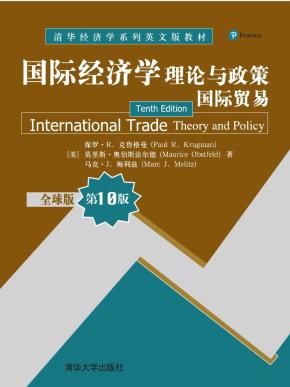
国际经济学:理论与政策(国际贸易)(全球版第10版)"
第1 章 绪论
第1 部分 国际贸易理论
第2 章 世界贸易:概览
第3 章 劳动生产率和比较优势:李嘉图模型
第4 章 特定要素和收入分配
第5 章 资源与贸易:赫克歇尔-俄林模型
第6 章 标准贸易模型
第7 章 外部规模经济和
第8 章 全球经济中的公司:出口决策、外包和跨国企业
第2部分 国际贸易政策
第9 章 贸易政策工具
Preface
Years after the global financial crisis that broke out in 2007–2008, the industrial world’s economies are still growing too slowly to restore full employment. Emerging markets, despite impressive income gains in many cases, remain vulnerable to the ebb and flow of global capital. And finally, an acute economic crisis in the euro area has lasted since 2009, bringing the future of Europe’s common currency into question. This tenth edition therefore comes out at a time when we are more aware than ever before of how events in the global economy influence each country’s economic for- tunes, policies, and political debates. The world that emerged from World War II was one in which trade, financial, and even communication links between countries were limited. More than a decade into the 21st century, however, the picture is very dif- ferent. Globalization has arrived, big time. International trade in goods and services has expanded steadily over the past six decades thanks to declines in shipping and communication costs, globally negotiated reductions in government trade barriers, the widespread outsourcing of production activities, and a greater awareness of for- eign cultures and products. New and better communications technologies, notably the Internet, have revolutionized the way people in all countries obtain and exchange information. International trade in financial assets such as currencies, stocks, and bonds has expanded at a much faster pace even than international product trade. This process brings benefits for owners of wealth but also creates risks of contagious financial instability. Those risks were realized during the recent global financial cri- sis, which spread quickly across national borders and has played out at huge cost to the world economy. Of all the changes on the international scene in recent decades, however, perhaps the biggest one remains the emergence of China—a development that is already redefining the international balance of economic and political power in the coming century.
Imagine the astonishment of the generation that lived through the depressed 1930s as adults, had its members been able to foresee the shape of today’s world economy! Nonetheless, the economic concerns that continue to cause international debate have not changed that much from those that dominated the 1930s, nor indeed since they were first analyzed by economists more than two centuries ago. What are the merits of free trade among nations compared with protectionism? What causes countries to run trade surpluses or deficits with their trading partners, and how are such imbalances resolved over time? What causes banking and currency crises in open economies, what causes financial contagion between economies, and how should governments handle international financial instability? How can governments avoid unemployment and inflation, what role do exchange rates play in their efforts, and how can countries best cooperate to achieve their economic goals? As always in international economics, the interplay of events and ideas has led to new modes of analysis. In turn, these analyti- cal advances, however abstruse they may seem at first, ultimately do end up playing a major role in governmental policies, in international negotiations, and in people’s everyday lives. Globalization has made citizens of all countries much more aware than ever before of the worldwide economic forces that influence their fortunes, and global- ization is here to stay.
xiii
New to the Tenth Edition
For this edition, we are offering an Economics volume as well as Trade and Finance splits. The goal with these distinct volumes is to allow professors to use the book that best suits their needs based on the topics they cover in their International Economics course. In the Economics volume for a two-semester course, we follow the standard practice of dividing the book into two halves, devoted to trade and to monetary questions. Although the trade and monetary portions of international economics are often treated as unrelated subjects, even within one textbook, similar themes and methods recur in both subfields. We have made it a point to illuminate connections between the trade and monetary areas when they arise. At the same time, we have made sure that the book’s two halves are completely self-contained. Thus, a one- semester course on trade theory can be based on Chapters 2 through 12, and a one- semester course on international monetary economics can be based on Chapters 13 through 22. For professors’ and students’ convenience, however, they can now opt to use either the Trade or the Finance volume, depending on the length and scope of their course.
We have thoroughly updated the content and extensively revised several chapters. These revisions respond both to users’ suggestions and to some important develop- ments on the theoretical and practical sides of international economics. The most far-reaching changes in the Trade volume are the following:
■ Chapter 5, Resources and Trade: The Heckscher-Ohlin Model This edition offers expanded coverage of the effects on wage inequality of North-South trade, tech- nological change, and outsourcing. The section describing the empirical evidence on the Heckscher-Ohlin model has been rewritten, emphasizing new research. That section also incorporates some new data showing how China’s pattern of exports has changed over time in a way that is consistent with the predictions of the Heckscher-Olhin model.
■ Chapter 6, The Standard Trade Model This chapter has been updated with some new data documenting how the terms of trade for the U.S. and Chinese economies have evolved over time.
■ Chapter 8, Firms in the Global Economy: Export Decisions, Outsourcing, and Multinational Enterprises The coverage emphasizing the role of firms in interna- tional trade has been revised. There is also a new Case Study analyzing the impact of offshoring in the United States on U.S. unemployment.
■ Chapter 9, The Instruments of Trade Policy This chapter features an updated treat- ment of the effects of trade restrictions on United States firms. This chapter now describes the recent trade policy dispute between the European Union and China regarding solar panels and the effects of the “Buy American” restrictions that were written into the American Recovery and Re-Investment Act of 2009.
■ Chapter 12, Controversies in Trade Policy A new case study discusses the recent gar- ment factory collapse in Bangladesh (in April 2013) and the tension between the costs and benefits of Bangladesh’s rapid growth as a clothing exporter.
In addition to these structural changes, we have updated the book in other ways to maintain current relevance. Thus, in the Trade volume, we examine the educational profile of foreign born workers in the United States and how it differs from the over- all population (Chapter 4); we review recent anti-dumping disputes involving China (Chapter 8).
About the Book
The idea of writing this book came out of our experience in teaching international eco- nomics to undergraduates and business students since the late 1970s. We perceived two main challenges in teaching. The fi was to communicate to students the exciting intellec- tual advances in this dynamic fi The second was to show how the development of in- ternational economic theory has traditionally been shaped by the need to understand the changing world economy and analyze actual problems in international economic policy.
We found that published textbooks did not adequately meet these challenges. Too often, international economics textbooks confront students with a bewildering array of special models and assumptions from which basic lessons are difficult to extract. Because many of these special models are outmoded, students are left puzzled about the real-world relevance of the analysis. As a result, many textbooks often leave a gap between the somewhat antiquated material to be covered in class and the exciting issues that dominate current research and policy debates. That gap has widened dra- matically as the importance of international economic problems—and enrollments in international economics courses—have grown.
This book is our attempt to provide an up-to-date and understandable analytical framework for illuminating current events and bringing the excitement of internation- al economics into the classroom. In analyzing both the real and monetary sides of the subject, our approach has been to build up, step by step, a simple, unified framework for communicating the grand traditional insights as well as the newest findings and approaches. To help the student grasp and retain the underlying logic of international economics, we motivate the theoretical development at each stage by pertinent data and policy questions.
The Place of This Book in the Economics Curriculum
Students assimilate international economics most readily when it is presented as a method of analysis vitally linked to events in the world economy, rather than as a body of abstract theorems about abstract models. Our goal has therefore been to stress con- cepts and their application rather than theoretical formalism. Accordingly, the book does not presuppose an extensive background in economics. Students who have had a course in economic principles will find the book accessible, but students who have taken further courses in microeconomics or macroeconomics will find an abundant supply of new material. Specialized appendices and mathematical postscripts have been included to challenge the most advanced students.
Some Distinctive Features
This book covers the most important recent developments in international economics without shortchanging the enduring theoretical and historical insights that have tra- ditionally formed the core of the subject. We have achieved this comprehensiveness by stressing how recent theories have evolved from earlier findings in response to an evolving world economy. The text is divided into a core of chapters focused on theory, followed by chapters applying the theory to major policy questions, past and current.
In Chapter 1, we describe in some detail how this book addresses the major themes of international economics. Here we emphasize several of the topics that previous authors failed to treat in a systematic way.
Increasing returns and Market Structure
Even before discussing the role of comparative advantage in promoting international exchange and the associated welfare gains, we visit the forefront of theoretical and empirical research by setting out the gravity model of trade (Chapter 2). We return to the research frontier (in Chapters 7 and 8) by explaining how increasing returns and product differentiation affect trade and welfare. The models explored in this discus- sion capture significant aspects of reality, such as intraindustry trade and shifts in trade patterns due to dynamic scale economies. The models show, too, that mutually beneficial trade need not be based on comparative advantage.
Firms in International trade
Chapter 8 also summarizes exciting new research focused on the role of firms in international trade. The chapter emphasizes that different firms may fare differently in the face of globalization. The expansion of some and the contraction of others shift overall production toward more efficient producers within industrial sectors, raising overall productivity and thereby generating gains from trade. Those firms that expand in an environment of freer trade may have incentives to outsource some of their pro- duction activities abroad or take up multinational production, as we describe in the chapter.
Politics and theory of trade Policy
Starting in Chapter 4, we stress the effect of trade on income distribution as the key political factor behind restrictions on free trade. This emphasis makes it clear to stu- dents why the prescriptions of the standard welfare analysis of trade policy seldom prevail in practice. Chapter 12 explores the popular notion that governments should adopt activist trade policies aimed at encouraging sectors of the economy seen as cru- cial. The chapter includes a theoretical discussion of such trade policy based on simple ideas from game theory.
Learning Features
This book incorporates a number of special learning features that will maintain stu- dents’ interest in the presentation and help them master its lessons.
Case Studies
Case studies that perform the threefold role of reinforcing material covered earlier, illustrating its applicability in the real world, and providing important historical infor- mation often accompany theoretical discussions.
Special Boxes
Less central topics that nonetheless offer particularly vivid illustrations of points made in the text are treated in boxes. Among these are U.S. President Thomas Jeffer- son’s trade embargo of 1807–1809 (Chapter 3); the astonishing ability of disputes over banana trade to generate acrimony among countries far too cold to grow any of their own bananas (Chapter 10).
Captioned Diagrams
More than 200 diagrams are accompanied by descriptive captions that reinforce the discussion in the text and help the student in reviewing the material.
Learning Goals
A list of essential concepts sets the stage for each chapter in the book. These learning goals help students assess their mastery of the material.
Summary and Key terms
Each chapter closes with a summary recapitulating the major points. Key terms and phrases appear in boldface type when they are introduced in the chapter and are listed at the end of each chapter. To further aid student review of the material, key terms are italicized when they appear in the chapter summary.
Problems
Each chapter is followed by problems intended to test and solidify students’ compre- hension. The problems range from routine computational drills to “big picture” ques- tions suitable for classroom discussion. In many problems we ask students to apply what they have learned to real-world data or policy questions.
Further readings
For instructors who prefer to supplement the textbook with outside readings, and for students who wish to probe more deeply on their own, each chapter has an annotated bibliography that includes established classics as well as up-to-date examinations of recent issues.
MyEconLab
MyEconLab
MyEconLab is the premier online assessment and tutorial system, pairing rich online content with innovative learning tools. MyEconLab includes comprehensive home- work, quiz, test, and tutorial options, allowing instructors to manage all assessment needs in one program. Key innovations in the MyEconLab course for the tenth edition of International Trade: Theory & Policy include the following:
■ Real-Time Data Analysis Exercises, marked with , allow students and instructors to use the latest data from FRED, the online macroeconomic data bank from the
Federal Reserve Bank of St. Louis. By completing the exercises, students become familiar with a key data source, learn how to locate data, and develop skills to inter- pret data.
■ In the enhanced eText available in MyEconLab, figures labeled MyEconLab Real- Time Data allow students to display a pop-up graph updated with real-time data from FRED.
■ Current News Exercises, new to this edition of the MyEconLab course, provide a turn- key way to assign gradable news-based exercises in MyEconLab. Every week, Pearson scours the news, finds a current article appropriate for an economics course, creates an exercise around the news article, and then automatically adds it to MyEconLab. Assigning and grading current news-based exercises that deal with the latest economic events has never been more convenient.
Students and MyEconLab
This online homework and tutorial system puts students in control of their own learning through a suite of study and practice tools correlated with the online, in- teractive version of the textbook and learning aids such as animated figures. Within MyEconLab’s structured environment, students practice what they learn, test their understanding, and then pursue a study plan that MyEconLab generates for them based on their performance.
Instructors and MyEconLab
MyEconLab provides flexible tools that allow instructors easily and effectively to cus- tomize online course materials to suit their needs. Instructors can create and assign tests, quizzes, or homework assignments. MyEconLab saves time by automatically grading all questions and tracking results in an online gradebook. MyEconLab can even grade assignments that require students to draw a graph.
After registering for MyEconLab instructors have access to downloadable supple- ments such as an instructor’s manual, PowerPoint lecture notes, and a test bank. The test bank can also be used within MyEconLab, giving instructors ample material from which they can create assignments—or the Custom Exercise Builder makes it easy for instructors to create their own questions.
Weekly news articles, video, and RSS feeds help keep students updated on current events and make it easy for instructors to incorporate relevant news in lectures and homework.
For more information about MyEconLab or to request an instructor access code, visit www.myeconlab.com.
additional Supplementary resources
A full range of additional supplementary materials to support teaching and learning accompanies this book.
■ The Online Instructor’s Manual—updated by Hisham Foad of San Diego State University—includes chapter overviews and answers to the end-of-chapter problems.
■ The Online Test Bank offers a rich array of multiple-choice and essay questions, in- cluding some mathematical and graphing problems, for each textbook chapter. It is available in Word, PDF, and TestGen formats. This Test Bank was carefully revised and updated by Robert F. Brooker of Gannon University.
■ The Computerized Test Bank reproduces the Test Bank material in the TestGen software that is available for Windows and Macintosh. With TestGen, instructors can easily edit existing questions, add questions, generate tests, and print the tests in variety of formats.
■ The Online PowerPoint Presentation with Tables, Figures, & Lecture Notes was revised by Amy Glass of Texas A&M University. This resource contains all text figures and tables and can be used for in-class presentations.
■ The Companion Web Site at www.pearsonhighered.com/krugman contains addi- tional appendices. (See page xiv of the Contents for a detailed list of the Online Appendices.)
Instructors can download supplements from our secure Instructor’s Resource Center. Please visit www.pearsonhighered.com/irc.
Acknowledgments
Our primary debt is to Christina Masturzo, the Acquisitions Editor in charge of the project. We also are grateful to the Program Manager, Carolyn Philips, and the Proj- ect Manager, Carla Thompson. Heather Johnson’s efforts as Project Manager with Integra-Chicago were essential and efficient. We would also like to thank the me- dia team at Pearson—Denise Clinton, Noel Lotz, Courtney Kamauf, and Melissa Honig—for all their hard work on the MyEconLab course for the tenth edition. Last, we thank the other editors who helped make the first nine editions of this book as good as they were.
We also wish to acknowledge the sterling research assistance of Tatjana Kleine- berg and Sandile Hlatshwayo. Camille Fernandez provided superb logistical support, as usual. For helpful suggestions and moral support, we thank Jennifer Cobb, Gita Gopinath, Vladimir Hlasny, and Phillip Swagel.
We thank the following reviewers, past and present, for their recommendations and insights:
Jaleel Ahmad, Concordia University Lian An, University of North Florida Anthony Paul Andrews, Governors State
University
Myrvin Anthony, University of Strathclyde, U.K.
Michael Arghyrou, Cardiff University Richard Ault, Auburn University Amitrajeet Batabyal, Rochester Institute
of Technology
Tibor Besedes, Georgia Tech
George H. Borts, Brown University
Robert F. Brooker, Gannon University
Francisco Carrada-Bravo, W.P. Carey School of Business, ASU
Debajyoti Chakrabarty, University of Sydney Adhip Chaudhuri, Georgetown University Jay Pil Choi, Michigan State University
Jaiho Chung, National University of Singapore
Jonathan Conning, Hunter College and The Graduate Center, The City University
of New York
Brian Copeland, University of British Columbia
Kevin Cotter, Wayne State University
Barbara Craig, Oberlin College
Susan Dadres, University of North Texas Ronald B. Davies, University College Dublin Ann Davis, Marist College
Gopal C. Dorai, William Paterson University Robert Driskill, Vanderbilt University Gerald Epstein, University of Massachusetts
at Amherst
JoAnne Feeney, State University of New York at Albany
Robert Foster, American Graduate School of International Management
Patrice Franko, Colby College
Diana Fuguitt, Eckerd College
Byron Gangnes, University of Hawaii at Manoa
Ranjeeta Ghiara, California State University, San Marcos
Neil Gilfedder, Stanford University
Amy Glass, Texas A&M University
Patrick Gormely, Kansas State University
Thomas Grennes, North Carolina State University Bodil Olai Hansen, Copenhagen Business School Michael Hoffman, U.S. Government Accountability
Office
Henk Jager, University of Amsterdam
Arvind Jaggi, Franklin & Marshall College
Mark Jelavich, Northwest Missouri State University
Philip R. Jones, University of Bath and University of Bristol, U.K.
Tsvetanka Karagyozova, Lawrence University
Hugh Kelley, Indiana University Michael Kevane, Santa Clara University Maureen Kilkenny, University of Nevada Hyeongwoo Kim, Auburn University
Stephen A. King, San Diego State University, Imperial Valley
Faik Koray, Louisiana State University
Corinne Krupp, Duke University
Bun Song Lee, University of Nebraska, Omaha
Daniel Lee, Shippensburg University Francis A. Lees, St. Johns University Jamus Jerome Lim, World Bank Group Rodney Ludema, Georgetown University
Stephen V. Marks, Pomona College
Michael L. McPherson, University of North Texas
Marcel Mérette, University of Ottawa
Shannon Mitchell, Virginia Commonwealth University
Kaz Miyagiwa, Emory University
Shannon Mudd, Ursinus College
Marc-Andreas Muendler, University of California, San Diego
Ton M. Mulder, Erasmus University, Rotterdam
Robert G. Murphy, Boston College
E. Wayne Nafziger, Kansas State University
Steen Nielsen, University of Aarhus
Dmitri Nizovtsev, Washburn University Terutomo Ozawa, Colorado State University Arvind Panagariya, Columbia University Nina Pavcnik, Dartmouth College
Iordanis Petsas, University of Scranton
Thitima Puttitanun, San Diego State University
Peter Rangazas, Indiana University-Purdue University Indianapolis
James E. Rauch, University of California, San Diego
Michael Ryan, Western Michigan University
Donald Schilling, University of Missouri, Columbia Patricia Higino Schneider, Mount Holyoke College Ronald M. Schramm, Columbia University
Craig Schulman, Texas A&M University Yochanan Shachmurove, University of Pennsylvania Margaret Simpson, The College of William
and Mary
Enrico Spolaore, Tufts University
Robert Staiger, University of Wisconsin-Madison Jeffrey Steagall, University of North Florida Robert M. Stern, University of Michigan Abdulhamid Sukar, Cameron University Rebecca Taylor, University of Portsmouth, U.K. Scott Taylor, University of British Columbia Aileen Thompson, Carleton University
Sarah Tinkler, Portland State University
Arja H. Turunen-Red, University of New Orleans Dick vander Wal, Free University of Amsterdam Gerald Willmann, University of Kiel
Rossitza Wooster, California State University, Sacramento
Bruce Wydick, University of San Francisco Jiawen Yang, The George Washington University Kevin H. Zhang, Illinois State University
Although we have not been able to make each and every suggested change, we found reviewers’ observations invaluable in revising the book. Obviously, we bear sole respon- sibility for its remaining shortcomings.
Paul R. Krugman Maurice Obstfeld Marc J. Melitz October 2013


Contents
Introduction 1
What Is International Economics About? 3
The Gains from Trade 4
The Pattern of Trade 5
How Much Trade? 5
Balance of Payments 6
Exchange Rate Determination 6
International Policy Coordination 7
The International Capital Market 8
International Economics: Trade and Money 8
Part 1 International trade theory 10
World Trade: An Overview 10
Who Trades with Whom? 10
Size Matters: The Gravity Model 11
Using the Gravity Model: Looking for Anomalies 13
Impediments to Trade: Distance, Barriers, and Borders 14
The Changing Pattern of World Trade 16
Has the World Gotten Smaller? 16
What Do We Trade? 18
Service Offshoring 19
Do Old Rules Still Apply? 21
Summary 22
Labor Productivity and Comparative Advantage:
The Ricardian Model 24
The Concept of Comparative Advantage 25
A One-Factor Economy 26
Relative Prices and Supply 28
Trade in a One-Factor World 29
Determining the Relative Price after Trade 30
box: Comparative Advantage in Practice: The Case of Babe Ruth 33
The Gains from Trade 34
A Note on Relative Wages 35
box: The Losses from Nontrade 36
Misconceptions about Comparative Advantage 37
Productivity and Competitiveness 37
box: Do Wages Reflect Productivity? 38
The Pauper Labor Argument 38
Exploitation 39
Comparative Advantage with Many Goods 40
Setting Up the Model 40
vii
Relative Wages and Specialization 40
Determining the Relative Wage in the Multigood Model 42
Adding Transport Costs and Nontraded Goods 44
Empirical Evidence on the Ricardian Model 45
Summary 48
Specific Factors and Income Distribution 51
The Specific Factors Model 52
box: What Is a Specific Factor? 53
Assumptions of the Model 53
Production Possibilities 54
Prices, Wages, and Labor Allocation 57
Relative Prices and the Distribution of Income 61
International Trade in the Specific Factors Model 63
Income Distribution and the Gains from Trade 64
The Political Economy of Trade: A Preliminary View 67
Income Distribution and Trade Politics 68
case study: Trade and Unemployment 68
International Labor Mobility 70
case study: Wage Convergence in the Age of Mass Migration 72
case study: Immigration and the U.S. Economy 73
Summary 76
Appendix: Further Details on Specific Factors 80
Marginal and Total Product 80
Relative Prices and the Distribution of Income 81
Resources and Trade: The Heckscher-Ohlin Model 84
Model of a Two-Factor Economy 85
Prices and Production 85
Choosing the Mix of Inputs 89
Factor Prices and Goods Prices 90
Resources and Output 92
Effects of International Trade between Two-Factor Economies 94
Relative Prices and the Pattern of Trade 94
Trade and the Distribution of Income 96
case study: North-South Trade and Income Inequality 97
case study: Skill-Biased Technological Change and Income Inequality 99
Factor-Price Equalization 102
Empirical Evidence on the Heckscher-Ohlin Model 103
Trade in Goods as a Substitute for Trade in Factors: Factor Content of Trade 104
Patterns of Exports between Developed and Developing Countries 107
Implications of the Tests 109
Summary 110
Appendix: Factor Prices, Goods Prices, and Production Decisions 114
Choice of Technique 114
Goods Prices and Factor Prices 115
More on Resources and Output 117
The Standard Trade Model 118
A Standard Model of a Trading Economy 119
Production Possibilities and Relative Supply 119
Relative Prices and Demand 120
The Welfare Effect of Changes in the Terms of Trade 123
Determining Relative Prices 124
Economic Growth: A Shift of the RS curve 124
Growth and the Production Possibility Frontier 126
World Relative Supply and the Terms of Trade 126
International Effects of Growth 129
case study: Has the Growth of Newly Industrializing Countries
Hurt Advanced Nations? 129
Tariffs and Export Subsidies: Simultaneous Shifts in RS and RD 132
Relative Demand and Supply Effects of a Tariff 132
Effects of an Export Subsidy 133
Implications of Terms of Trade Effects: Who Gains and Who Loses? 134
International Borrowing and Lending 135
Intertemporal Production Possibilities and Trade 135
The Real Interest Rate 136
Intertemporal Comparative Advantage 138
Summary 138
Appendix: More on Intertemporal Trade 142
External Economies of Scale and the International
Location of Production 145
Economies of Scale and International Trade: An Overview 146
Economies of Scale and Market Structure 147
The Theory of External Economies 148
Specialized Suppliers 148
Labor Market Pooling 149
Knowledge Spillovers 150
External Economies and Market Equilibrium 151
External Economies and International Trade 152
External Economies, Output, and Prices 152
External Economies and the Pattern of Trade 153
box: Holding the World Together 155
Trade and Welfare with External Economies 156
Dynamic Increasing Returns 157
Interregional Trade and Economic Geography 158
box: Tinseltown Economics 160
Summary 161
Firms in the Global Economy: Export Decisions,
Outsourcing, and Multinational Enterprises 164
The Theory of Imperfect Competition 165
Monopoly: A Brief Review 166
Monopolistic Competition 168
Monopolistic Competition and Trade 173
The Effects of Increased Market Size 173
Gains from an Integrated Market: A Numerical Example 174
The Significance of Intra-Industry Trade 178
case study: Intra-Industry Trade in Action: The North American Auto Pact
of 1964 and the North American Free Trade Agreement (NAFTA) 180
Firm Responses to Trade: Winners, Losers, and Industry Performance 181
Performance Differences across Producers 182
The Effects of Increased Market Size 184
Trade Costs and Export Decisions 185
Dumping 188
case study: Antidumping as Protectionism 189
Multinationals and Outsourcing 190
case study: Patterns of Foreign Direct Investment Flows Around the World 190
The Firm’s Decision Regarding Foreign Direct Investment 194
Outsourcing 195
case study: Shipping Jobs Overseas? Offshoring and Unemployment
in the United States 197
Consequences of Multinationals and Foreign Outsourcing 199
Summary 200
Appendix: Determining Marginal Revenue 205
Part 2 International trade Policy 206
The Instruments of Trade Policy 206
Basic Tariff Analysis 206
Supply, Demand, and Trade in a Single Industry 207
Effects of a Tariff 209
Measuring the Amount of Protection 210
Costs and Benefits of a Tariff 212
Consumer and Producer Surplus 212
Measuring the Costs and Benefits 214
box: Tariffs for the Long Haul 216
Other Instruments of Trade Policy 217
Export Subsidies: Theory 217
case study: Europe’s Common Agricultural Policy 218
Import Quotas: Theory 220
case study: An Import Quota in Practice: U.S. Sugar 221
Voluntary Export Restraints 224
case study: A Voluntary Export Restraint in Practice 224
Local Content Requirements 225
box: Bridging the Gap 226
Other Trade Policy Instruments 227
The Effects of Trade Policy: A Summary 227
Summary 228
Appendix: Tariffs and Import Quotas in the Presence of Monopoly 232
The Model with Free Trade 232
The Model with a Tariff 233
The Model with an Import Quota 234
Comparing a Tariff and a Quota 234
The Political Economy of Trade Policy 236
The Case for Free Trade 237
Free Trade and Efficiency 237
Additional Gains from Free Trade 238
Rent Seeking 239
Political Argument for Free Trade 239
case study: The Gains from 1992 240
National Welfare Arguments against Free Trade 242
The Terms of Trade Argument for a Tariff 242
The Domestic Market Failure Argument against Free Trade 243
How Convincing Is the Market Failure Argument? 245
Income Distribution and Trade Policy 246
Electoral Competition 247
Collective Action 248
box: Politicians for Sale: Evidence from the 1990s 249
Modeling the Political Process 250
Who Gets Protected? 250
International Negotiations and Trade Policy 252
The Advantages of Negotiation 253
International Trade Agreements: A Brief History 254
The Uruguay Round 256
Trade Liberalization 256
Administrative Reforms: From the GATT to the WTO 257
Benefits and Costs 258
box: Settling a Dispute—and Creating One 259
case study: Testing the WTO’s Metal 260
The Doha Disappointment 261
box: Do Agricultural Subsidies Hurt the Third World? 262
Preferential Trading Agreements 263
box: Free Trade Area versus Customs Union 265
box: Do Trade Preferences Have Appeal? 266
case study: Trade Diversion in South America 267
Summary 268
Appendix: Proving that the Optimum Tariff Is Positive 272
Demand and Supply 272
The Tariff and Prices 272
The Tariff and Domestic Welfare 273
Trade Policy in Developing Countries 275
Import-Substituting Industrialization 276
The Infant Industry Argument 277
Promoting Manufacturing Through Protection 278
case study: Mexico Abandons Import-Substituting Industrialization 280
Results of Favoring Manufacturing: Problems of Import-Substituting Industrialization 281
Trade Liberalization since 1985 282
Trade and Growth: Takeoff in Asia 284
box: India’s Boom 287
Summary 287
Controversies in Trade Policy 290
Sophisticated Arguments for Activist Trade Policy 291
Technology and Externalities 291
Imperfect Competition and Strategic Trade Policy 293
box: A Warning from Intel’s Founder 296
case study: When the Chips Were Up 297
Globalization and Low-Wage Labor 299
The Anti-Globalization Movement 299
Trade and Wages Revisited 300
Labor Standards and Trade Negotiations 302
Environmental and Cultural Issues 303
The WTO and National Independence 303
case study: A Tragedy in Bangladesh 304
Globalization and the Environment 305
Globalization, Growth, and Pollution 306
The Problem of “Pollution Havens” 307
The Carbon Tariff Dispute 309
Summary 310
Mathematical Postscripts 313
Postscript to Chapter 5: The Factor-Proportions Model 313
Factor Prices and Costs 313
Goods Prices and Factor Prices 315
Factor Supplies and Outputs 316
Postscript to Chapter 6: The Trading World Economy 317
Supply, Demand, and Equilibrium 317
Supply, Demand, and the Stability of Equilibrium 319
Effects of Changes in Supply and Demand 321
Economic Growth 321
A Transfer of Income 322
A Tariff 323
Postscript to Chapter 8: The Monopolistic Competition Model 325
ONLINE APPENDICES (www.pearsonhighered.com/krugman)
Appendix A to Chapter 6: International Transfers of Income and the Terms of Trade
The Transfer Problem
Effects of a Transfer on the Terms of Trade
Presumptions about the Terms of Trade Effects of Transfers
Appendix B to Chapter 6: Representing International Equilibrium with Offer Curves
Deriving a Country’s Offer Curve International Equilibrium
Appendix A to Chapter 9: Tariff Analysis in General Equilibrium
A Tariff in a Small Country A Tariff in a Large Country
普林斯顿大学教授,2008年诺贝尔经济学奖获得者,目前还担任许多国家和地区的经济政策咨询顾问。他的主要研究领域包括国际贸易、国际金融、货币危机与汇率变化理论,被誉为当今世界上最令人瞩目的贸易理论家之一。