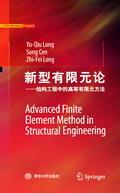
新型有限元论——结构工程中的高等有限元方法"
本书是在中文专著《新型有限元论》(2004年版)的基础上补充了2004年至2008年期间的新成果所撰写的英文专著,是龙驭球院士、岑松博士和龙志飞教授及其研究组多年来在新型有限元方面研究成果的系统论述。全书分为20章。除首尾两章外,其余18章分为3篇:第1篇是变分原理进展,介绍分区和含参变分原理2项成果;它们为构造新型有限元起到理论指导作用。第2篇是有限元法进展初论,重点介绍广义协调元;这是在协调元与非协调元之间另辟的新路,使协调问题和收敛问题得到合理解决,单元构造方案可以灵活优选,学科内容得到充实更新;广义协调元是新型有限元方面的主要成果,在本书中起核心作用。第3篇是有限元法进展续论,补充介绍4项成果,包括分区混合元法、解析试函数法、第一和第二类四边形面积坐标法和样条函数有限元法,在本书中起锦上添花作用。本书还结合7项成果的论述,介绍了总共108个相关的新单元。
本书可作为高等学校力学、土木、机械等专业研究生和高年级本科生的教材和参考书,也可供相关领域教师和科技人员参考。
The main purpose of this book is to describe some developments in finite element method and related variational principles. Since this book only deals with the areas the authors are familiar with, it is impossible to cover every aspect of these subjects. This book is composed of 20 chapters. Except for Introduction (Chap. 1) and Concluding Remarks (Chap. 20), in the other 18 chapters, seven theoretical achievements (two achievements in variational principles and five achievements in finite element methods are introduced, which are subdivided into three Parts.
Part Ⅰ focuses on advances in the variational principles. Two innovations in this subject are discussed here.
(1) Sub-region variational principles (Chap. 2). The concept of sub-region is introduced for establishing new variational principles suitable for the developments of the finite element method.
(2) Variational principles with several adjustable parameters (Chap. 3). Several adjustable parameters are included in the variational principles so that a broader optimization space is available.
Part Ⅱ focuses on the main advances in the finite element method-generalized conforming elements (the third innovation). Eight chapters are employed to illustrate this innovation.
(3) Generalized conforming elements (Chaps. 411). Firstly, from the viewpoint of theory, the generalized conforming element opens a new way between conforming and non-conforming elements, so that the puzzle of the convergence problem for non-conforming elements can be rationally solved. Meanwhile, various new conforming schemes, including point conforming, line conforming, perimeter conforming, SemiLoof conforming, least square conforming and their combination forms, have been successfully proposed. Secondly, from the viewpoint of applications, the successful application of the generalized conforming element method was first realized for thin plate bending problem, in which a series of high performance thin plate element models were presented. Subsequently, the novel technique was successfully generalized to other fields, and a large number of new models, including membrane elements, membrane elements with drilling DOFs, thin-thick plate elements, laminated composite plate elements, flat-shell elements, curved shell elements, etc., were also successfully constructed.
Part Ⅲ focuses on the other advances in the finite element method. Eight chapters are employed to discuss four additional subject innovations.
(4) Sub-region mixed element method (Chaps. 1213). It provides a novel solution strategy for fracture problem by complementarity and coupling of displacement-based element and stress-based element.
(5) Analytical trial function method (Chaps. 1415). This method exhibits rewarding cooperation between analytical and discrete methods, and provides effective solution strategy for shear locking, trapezoidal locking, and singular stress problems.
(6) Quadrilateral area coordinate method (Chaps. 1617). This method indicates that the area coordinate method is generalized from the traditional triangular element field to new fields.
(7) Spline element method (Chaps. 1819). This method indicates that the advantages of the spline functions have been adopted by the finite element method.
While introducing above seven theoretical innovations, five new element series with 108 new element models, which were directly derived from the five achievements in FEM, are also discussed in detail or briefly (see Table 20.2). Furthermore, based on these developments, effective solution strategies for five challenging problems (shear-locking problem in thick plate elements, sensitivity problem to mesh distortion, non-convergence problem of non-conforming elements, accuracy loss problem of stress solutions by displacement-based elements, and singular stress problem) have also been found.
To sum up, in the contents of this book, three aspects should be emphasized:
(1) Seven new achievements in the field of variational principle and FEM;
(2) five new element series with 108 new element models;
(3) five sets of novel solution strategies for five challenging problems.
The authors are very grateful to all the colleagues and students who made significant contributions to the contents included in this book. We also thank China Academy of Building Research for compiling our algorithms and finite element models into their FEM software product, SATWE, for designs of high-rise building structures.
Our research activities were financially supported by many foundations and sponsors. We list them below and express our deep gratitude.
* The National Natural Science Foundation of China (Math85287; 58978341; 59578031; 59878022; 10272063; 10502028; 10872108)
* The Special Foundation for the Authors of the Nationwide (China) Excellent Doctoral Dissertation (200242)
* The Program for New Century Excellent Talents in Universities of China (NCET-07-0477)
* Basic Science Research Foundation of Tsinghua University (JC1999002; JC2002003)
* China Postdoctoral Science Foundation (12836).
* The Special Scientific Foundation for Chinese Doctoral Education (97000315; 20020003044)


Chapter 1 Introduction-The Evolutive Finite Element Method 1
1.1 Brief Review of the Features of Finite Element Method 1
1.2 Finite Element Method and Variational Principles 3
1.3 Research Areas of FEM 5
1.4 Advances in FEM and Outline of This Book 6
References 9
PART Ⅰ Advances in Variational Principles
Chapter 2 The Sub-Region Variational Principles 15
2.1 Introduction 15
2.2 The Sub-Region Variational Principle for Elasticity 16
2.3 The Sub-Region Variational Principle for Elastic Thin Plate 28
2.4 The Sub-Region Variational Principle for Elastic Thick Plate 40
2.5 The Sub-Region Variational Principle for Elastic Shallow Shell 51
2.6 The Sub-Region Mixed Energy Partial Derivative Theorem 58
References 64
Chapter 3 Variational Principles with Several Adjustable Parameters 66
3.1 Introduction 66
3.2 Several Patterns of Functional Transformation 67
3.3 Generalized Variational Principle Involving Several Adjustable
Parameters 75
3.4 Variable-Substitution-Multiplier Method 83
References 85
PART Ⅱ Advances in Finite Element Method—
Generalized Conforming Elements
Chapter 4 Generalized Conforming Element Theory 89
4.1 Introduction 89
4.2 Conforming and Nonconforming Elements-Some Consideration
about "Conforming" 90
4.3 The First Pattern of Generalized Conforming Element-Replacing
Nodal Conforming by Line Conforming Conditions 91
4.4 The Variational Basis of Generalized Conforming Element-Duality 94
4.5 The Synthesis of Energy Method and Weighted Residual Method
-Flexibility 97
4.6 The Convergence of Generalized Conforming Element 99
References 99
Chapter 5 Generalized Conforming Thin Plate Element Ⅰ
-Introduction 101
5.1 Introduction 101
5.2 The Generalized Conforming Conditions and Their Equivalent
Forms for Thin Plate Elements 102
5.3 General Formulations of the Generalized Conforming Thin Plate
Elements 105
5.4 Several Construction Schemes of the Generalized Conforming
Thin Plate Elements 107
5.5 A Collection of the Recent Generalized Conforming Thin Plate
Elements 111
References 118
Chapter 6 Generalized Conforming Thin Plate Element Ⅱ
-Line-Point and SemiLoof Conforming Schemes 120
6.1 Line Conforming Scheme-Elements TGC-9 and TGC-9-1 120
6.2 Line-Point Conforming Scheme-Rectangular Elements 130
6.3 Line-Point Conforming Scheme-Triangular Elements 146
6.4 Super-Basis Line-Point Conforming Scheme-Elements GCⅢ-R12
and GCⅢ-T9 155
6.5 Super-Basis Point Conforming Scheme-Elements MB1-T9
and MB2-T9 164
6.6 SemiLoof Conforming Scheme 167
References 174
Chapter 7 Generalized Conforming Thin Plate Element Ⅲ
-Perimeter-Point and Least-Square Conforming Schemes 176
7.1 Perimeter-Point Conforming Scheme-Elements LR12-1
and LR12-2 176
7.2 The Application of Perimeter Conforming Conditions-Verification
for the Convergence of the Element ACM 181
7.3 Super-Basis Perimeter-Point Conforming Scheme-Verification and
Improvement of the Element BCIZ 187
7.4 Least-square Scheme-Elements LSGC-R12 and LSGC-T9 198
References 202
Chapter 8 Generalized Conforming Thick Plate Element 203
8.1 Summary of the Thick Plate Theory 203
8.2 Comparison of the Theories for Thick Plates and Thin Plates 215
8.3 Thick/Thin Beam Element 232
8.4 Review of Displacement-based Thick/Thin Plate Elements 235
8.5 Generalized Conforming Thick/Thin Plate Elements (1)
-Starting with Assuming 237
8.6 Generalized Conforming Thick/Thin Plate Elements (2)
-Starting with Assuming 249
8.7 Generalized Conforming Thin/Thick Plate Elements
-From Thin to Thick Plate Elements 260
References 266
Chapter 9 Generalized Conforming Element for the Analysis of
the Laminated Composite Plates 268
9.1 Introduction 268
9.2 Fundamental Theory 270
9.3 New Element CTMQ20 for the Analysis of Laminated
Composite Plates 275
9.4 The Hybrid-Enhanced Post-Processing Procedure for Element
Stresses 286
9.5 Vibration Analysis of Laminated Composite Plates 290
9.6 Numerical Examples 292
References 301
Chapter 10 Generalized Conforming Element for the Analysis of
Piezoelectric Laminated Composite Plates 304
10.1 Introduction 304
10.2 The First-Order Shear Deformation Theory of Piezoelectric
Laminated Composite Plate 306
10.3 New Piezoelectric Laminated Composite Plate Element CTMQE 309
10.4 The "Partial Hybrid"-Enhanced Post-Processing Procedure for
Element Stresses 314
10.5 Numerical Examples 318
References 323
Chapter 11 Generalized Conforming Membrane and Shell Elements 325
11.1 Introduction 325
11.2 Generalized Conforming Isoparametric Membrane Element 326
11.3 Membrane Elements with Drilling Freedoms-Definition of the
Drilling Freedom and the Corresponding Rectangular and
Quadrilateral Elements 334
11.4 Membrane Elements with Drilling Freedoms-Triangular Elements 346
11.5 Flat-Shell Elements-Triangular Thick/Thin Shell Element
GMST18 357
11.6 Shallow Shell Element-Variational Principle and Membrane
Locking Problem 370
11.7 Shallow Shell Element-Triangular Element SST21 with
Mid-Side Nodes 375
11.8 Shell Element for Geometrically Nonlinear Analysis
-Triangular Flat-Shell Element GMST18 382
11.9 Shell Element for Geometrically Nonlinear Analysis
-Rectangular Shallow Shell Element SSR28 386
References 398
PART Ⅲ Other Advances in Finite Element Method
Chapter 12 Sub-Region Mixed Element Ⅰ-Fundamental Theory
and Crack Problem 405
12.1 Review of the Sub-Region Mixed Element Method 405
12.2 Basic Equations of the Sub-Region Mixed Element Method 408
12.3 2D Crack Problem 411
12.4 Cracked Thick Plate Problem 418
12.5 Surface Crack Problem in a 3D Body 426
References 435
Chapter 13 Sub-Region Mixed Element Ⅱ-V-Notch Problem 438
13.1 Introduction 438
13.2 Plane V-Notch Problem 438
13.3 Plane V-Notch Problem in a Bi-Material 450
13.4 Anti-Plane V-Notch Problem in a Bi-Material 457
13.5 V-Notch Problem in Reissner Plate 463
13.6 3D V-Notch Problem 481
References 493
Chapter 14 Analytical Trial Function Method Ⅰ-Membrane and
Plate Bending Elements 495
14.1 Recognition of the Analytical Trial Function Method 495
14.2 4-Node Membrane Elements Based on the Analytical Trial
Function Method 498
14.3 Avoiding Trapezoidal Locking Phenomenon by ATF Elements 500
14.4 The Basic Analytical Solutions of the Thick Plate Theory and
ATF Elements Free of Shear Locking 504
14.5 Development of Quadrilateral Thin-Thick Plate Element Based
on the Analytical Trial Function Method 506
14.6 Analytical Trial Function Method for Developing a Triangular
Thick Plate Element Based on a Thin Plate Element 510
References 516
Chapter 15 Analytical Trial Function Method Ⅱ-Singular Elements
with Crack and Notch 518
15.1 Introduction 518
15.2 The Basic Analytical Solutions of the Plane Crack Problem 519
15.3 Element ATF-MS with Crack Formulated by the Analytical
Trial Function Method 523
15.4 Error Analysis of Element ATF-MS with Crack 525
15.5 Analysis of Zero Energy Mode in Element and in Structural
System 529
15.6 The Basic Analytical Solutions of the Plane Notch Problem 535
15.7 Element ATF-VN with Notch Formulated by the Analytical
Trial Function Method 538
15.8 Error Analysis of Element ATF-VN with Notch 542
References 545
Chapter 16 Quadrilateral Area Coordinate Systems, Part Ⅰ
-Theory and Formulae 546
16.1 Introduction 546
16.2 The Isoparametric Coordinate Method and the Area Coordinate
Method 547
16.3 Two Shape Characteristic Parameters of a Quadrilateral 549
16.4 The Definition of Quadrilateral Area Coordinates (QACM-Ⅰ) 553
16.5 Two Identical Relations Among Area Coordinates (QACM-Ⅰ) 556
16.6 Transformation Relations Between the Area Coordinate System
(QACM-Ⅰ) and the Cartesian or Isoparametric Coordinate System 558
16.7 Differential Formulae (QACM-Ⅰ) 560
16.8 Integral Formulae (QACM-Ⅰ) 562
16.9 The Proof of the Basic Formulae (A) and (B) (QACM-Ⅰ) 565
16.10 The Proof of the Basic Formulae (C) (QACM-Ⅰ) 569
16.11 The Quadrilateral Area Coordinate System with Only
Two Components (QACM-Ⅱ) 570
References 580
Chapter 17 Quadrilateral Area Coordinate Systems, Part Ⅱ
-New Tools for Constructing Quadrilateral Elements 582
17.1 Introduction 582
17.2 Sensitivity Analysis of Isoparametric Elements to Mesh Distortion 583
17.3 Brief Review of the Finite Element Models Formulated by
Quadrilateral Area Coordinate Methods 586
17.4 4-Node Quadrilateral Membrane Elements Formulated by
the Area Coordinate Method 589
17.5 Geometrically Nonlinear Analysis Using Element AGQ6-Ⅰ 601
17.6 Quadrilateral Membrane Elements with Drilling Degrees of
Freedom Formulated by the Area Coordinate Method 606
17.7 8-Node Quadrilateral Membrane Elements Formulated by the
Area Coordinate Method 613
17.8 Quadrilateral Thin Plate Element Formulated by the Area
Coordinate Method 620
17.9 Quadrilateral Thick Plate Element Formulated by the Area
Coordinate Method 628
17.10 Quadrilateral Laminated Composite Plate Element Formulated
by the Area Coordinate Method 635
References 637
Chapter 18 Spline Element Ⅰ-Analysis of High-Rise Building
Structures 641
18.1 Introduction 641
18.2 Spline Beam Elements 642
18.3 Spline Plane Membrane Elements 646
18.4 Analysis of Shear Wall Structures by Spline Elements 648
18.5 Analysis of Frame-Tube Structures by Spline Elements 655
References 661
Chapter 19 Spline Element Ⅱ-Analysis of Plate/Shell Structures 663
19.1 Spline Elements for Thin Plate Bending 663
19.2 Spline Elements for Thick/Thin Beam and Plate 665
19.3 Spline Elements for Shallow Shell 670
19.4 Spline Elements for Thick/Thin Shell 672
19.5 Spline Elements for Geometrically Nonlinear Analysis 681
References 689
Chapter 20 Concluding Remarks 691
20.1 Seven New Achievements in the Finite Element Method 691
20.2 Five New Element Series with 108 New Element Models 693
20.3 New Solution Strategies for Five Challenging Problems 699
References 700
Appendix 703
A The equivalent equation of the functional stationary condition (2-45) 703
B The node conditions derived from the stationary condition (2-77) 704
C l1j and ?1j in Eq. (13-137) 705
D s1j and t1j in Eq. (13-144) 706
iv
v